Modern Photovoltaic Energy Systems: Sensors, Artificial Intelligence and Sustainable Transportation Technology
Submission deadline: June 2027
Special Issue Editors:

Affiliation: University of Rijeka
Email: sladic@hotmail.com
ORCID: https://orcid.org/0000-0003-2566-0227
Research Interest: photovoltaics, WECS, electronic power converters, electric power system, electric vehicles

Affiliation: Department of Engineering, University of Campania Luigi Vanvitelli, 81031 Aversa, Italy
Email: michele.desantis@unicampania.it
ORCID: https://orcid.org/0000-0002-4058-1722
Research Interest: electric power systems, renewables

Affiliation: Department of Computer Systems, Faculty of Computer Systems and Technologies, Technical University of Sofia, Sofia, Bulgaria
Email: hinov@tu-sofia.bg
ORCID: https://orcid.org/0000-0002-0308-4858
Research Interest: electronic power converters, renewables, digital technology
Special Issue Information
Dear Colleagues:
The transition toward sustainable transportation is driving the development of new mobility solutions based on the integration of photovoltaic technologies with intelligent energy systems, advanced sensing, artificial intelligence (AI), power electronics, and digital energy management. Photovoltaic energy has become a key renewable resource supporting transportation electrification through vehicle-integrated photovoltaics (VIPV), intelligent charging infrastructure, distributed energy resources, and smart grid applications.
Recent advances in sensing technologies, wireless sensor networks, the Internet of Things (IoT), edge computing, digital twins, cyber-physical systems, and AI are transforming the design, monitoring, control, optimization, and maintenance of photovoltaic energy systems. Intelligent sensing enables continuous monitoring of environmental conditions, photovoltaic modules, batteries, power converters, electric vehicles, and charging infrastructure, providing high-quality data for predictive energy management and autonomous decision-making.
The rapid electrification of transportation has also highlighted the growing impact of electric vehicles on power system stability, reliability, and operation. At the same time, increasing interconnections among renewable energy systems, electric transportation, communication networks, cloud computing, and distributed energy resources introduce significant challenges related to interoperability, cybersecurity, resilience, secure data exchange, and energy management. Addressing these multidisciplinary challenges requires the integration of advanced photovoltaic technologies, intelligent sensing, power electronics, energy storage, secure communication, and AI, supported by research on next-generation photovoltaic solar cell materials (e.g. perovskite and/or thin-film) and emerging semiconductor technologies (e.g. SiC, GaN).
This Special Issue provides an international forum for researchers from academia and industry to present original research, review articles, case studies, and industrial applications on intelligent photovoltaic energy systems and their role in sustainable transportation. Furthermore, all researches in renewables are desirable as a part of developing electric power system and their sophisticated charging stations. Contributions addressing theoretical developments, innovative methodologies (e.g. dynamic mode decomposition), intelligent algorithms, experimental validation, prototype implementation, industrial deployment, and interdisciplinary research are particularly encouraged.
Collection Editor(s)
Keywords:
- smart grids
- photovoltaics
- electric vehicles
- emerging materials
- intelligent photovoltaic systems
- sustainable transport technology
Graphic Abstract (GA) (optional):
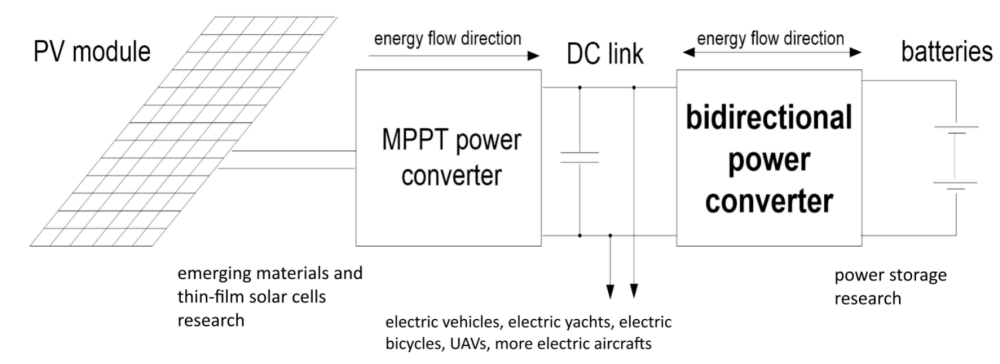
Graphical abstract has been created by Sasa Sladic (unique graphical abstract).
Advantages of Special Issue Publications
This Special Issue aims to bridge the rapidly evolving fields of photovoltaic technologies, intelligent sensing, artificial intelligence, power electronics, digital twins, and sustainable transportation. By bringing together researchers from electrical engineering, computer science, electronics, artificial intelligence, renewable energy, communications, materials science, and transportation engineering, the Special Issue seeks to foster interdisciplinary collaboration and accelerate the development of intelligent, resilient, secure, and sustainable energy solutions for future mobility.
Novel hypothesis, developing methodologies, intelligent algorithms, advanced sensing technologies, digital twin applications, experimental validations, industrial implementations, and interdisciplinary approaches that contribute to the next generation of intelligent photovoltaic energy systems applied to transportation technology present an effort to make a reliable transportation under new circumstances. Thematically unified publications of various approaches make this result more certain.





.jpg)
.jpg)