Supplementary theoretical design framework for Type IV hydrogen storage vessel liners: A minimum wall thickness addressing discharge buckling failure
DOI:
https://doi.org/10.18686/cest447Abstract
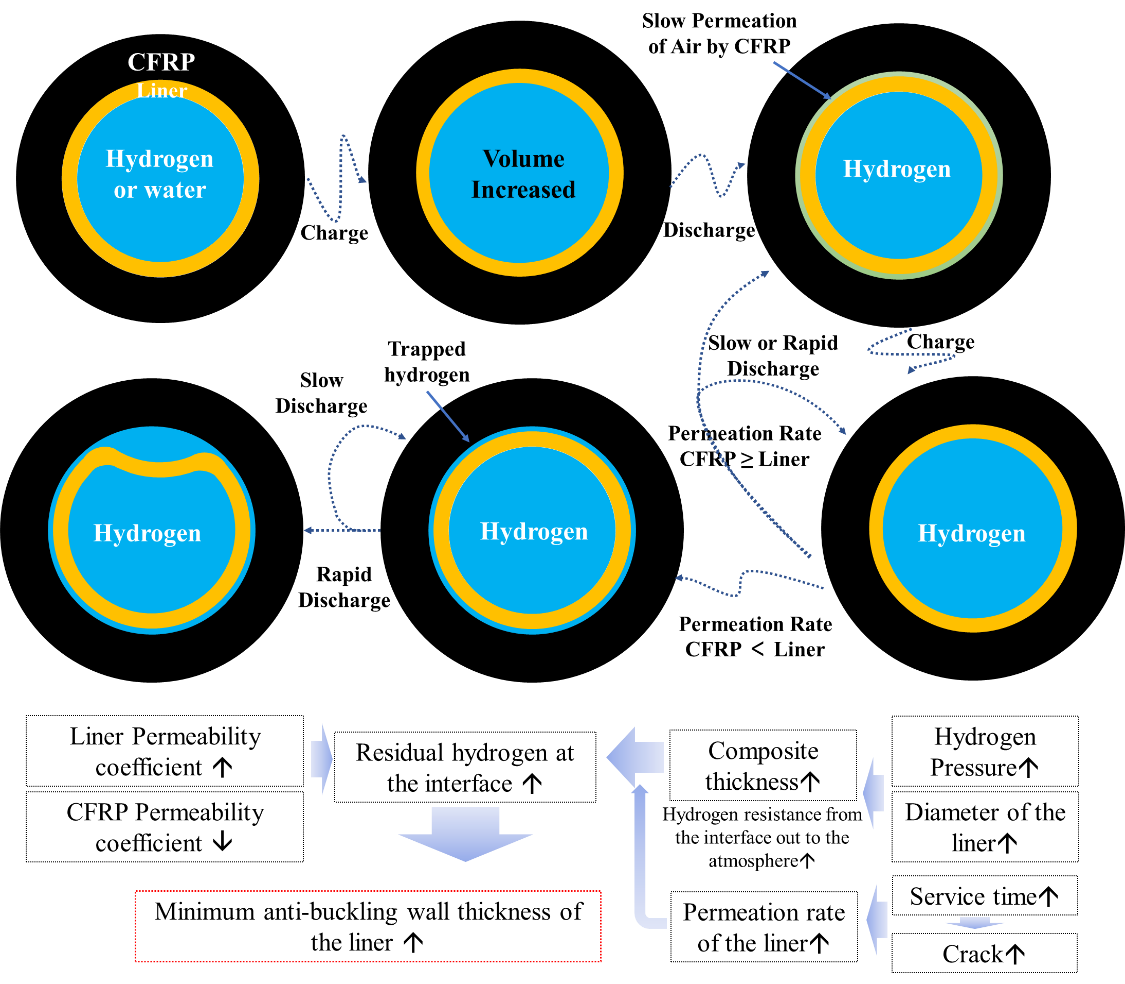
The plastic liner is critical in Type IV hydrogen storage tanks due to its lightweight and hydrogen anti-embrittlement properties. However, hydrogen permeation from free volume and accumulation at the liner-composite interface can cause buckling under inappropriate rapid discharge. Existing studies focus on evaluating buckling under the assumption of its inevitability, examining parameters such as Thickness-to-diameter ratio and discharge rate, but neglect the underlying permeation-structure interaction and lack a systematic design approach for minimizing liner thickness. This work introduces a novel theoretical framework to determine the minimum wall thickness that prevents buckling under any discharge condition by coupling material permeability, structural parameters, and service pressure. The method allows early safety validation via material-level testing, reducing the need for extensive cycle type tests. Furthermore, a large-capacity hydrogen storage vessel is taken as an example, and representative experimental data are analyzed. This research provides a foundational design tool enhancing reliability, cutting development cost, and supporting standard optimization for high-pressure hydrogen vessels.
References
1. Ishaq H, Dincer I, Crawford C. A review on hydrogen production and utilization: Challenges and opportunities, International Journal of Hydrogen Energy. 2022; 47(62): 26238-26264. doi: 10.1016/j.ijhydene.2021.11.149
2. Abdalla AM., Hossain S, Nisfindy OB., et al. Hydrogen production, storage, transportation and key challenges with applications: A review. Energy conversion and management. 2018; 165: 602-627. doi: 10.1016/j.enconman.2018.03.088
3. Wang D, Liao B, Zheng J, et al. Development of regulations, codes and standards on composite tanks for on-board gaseous hydrogen storage. International Journal of Hydrogen Energy. 2019; 44(40): 22643-22653. doi: 10.1016/j.ijhydene.2019.04.133
4. Wang X, Tian M, Chen X, et al. Advances on materials design and manufacture technology of plastic liner of type Ⅳ hydrogen storage vessel. International Journal of Hydrogen Energy. 2022; 47(13): 8382-8408. doi: 10.1016/j.ijhydene.2021.12.198
5. James BD, Houchins C, Huya-Kouadio JM, et al. Final Report: Hydrogen Storage System Cost Analysis. 2016. doi: 10.2172/1343975
6. Barthélémy H., Weber M., Barbier F. Hydrogen storage: Recent improvements and industrial perspectives, International Journal of Hydrogen Energy. 2017; 42(11): 7254-7262. doi: 10.1016/j.ijhydene.2016.03.178
7. Leavitt M. Low Cost, High Efficiency, High Pressure Hydrogen Storage. 2010. doi: 10.2172/1012567
8. Zha Y, Wang X, Yang W, et al. Numerical value of collapse and peeling mechanism of Ⅳ type hydrogen storage bottle plastic inner liner simulation research. In: Proceedings of the 17th China CAE Annual Conference; 12-14 November 2021; Haikou, China. doi: 10.26914/c.cnkihy.2021.045293
9. Prachumchon S, A study of HDPE in high pressure of hydrogen gas—measurement of permeation parameters and fracture criteria. ETD collection for University of Nebraska-Lincoln; 2012.
10. Sharma P, Burolia AK, Adak NC, et al. Effect of tension on liner buckling and performance of a type-4 cylinder for storage of compressed gases with experimental validation. Thin-Walled Structures. 2023; 189: 110928. doi: 10.1016/j.tws.2023.110928
11. Yersak TA., Baker DR., Yanagisawa Y, et al. Predictive model for depressurization-induced blistering of type IV tank liners for hydrogen storage. International Journal of Hydrogen Energy. 2017; 42(48): 28910-28917. doi: 10.1016/j.ijhydene.2017.10.024
12. Pépin J, Lainé E, Grandidier J-C, et al. Replication of liner collapse phenomenon observed in hyperbaric type IV hydrogen storage vessel by explosive decompression experiments. International Journal of Hydrogen Energy. 2018; 43(9): 4671-4680. doi: 10.1016/j.ijhydene.2018.01.022
13. Blanc-Vannet P., Papin P., Weber M., et al. Sample scale testing method to prevent collapse of plastic liners in composite pressure vessels. International Journal of Hydrogen Energy. 2019; 44(17): 8682-8691. doi: 10.1016/j.ijhydene.2018.10.031
14. Fujiwara H, Ono H, Onoue K, Nishimura S. High-pressure gaseous hydrogen permeation test method-property of polymeric materials for high-pressure hydrogen devices (1). International Journal of Hydrogen Energy. 2020; 45(53): 29082-29094. doi: 10.1016/j.ijhydene.2020.07.215
15. El-Sawy K.M. Inelastic stability of tightly fitted cylindrical liners subjected to external uniform pressure. Thin-Walled Structures. 2001; 39(9): 731-744. doi: 10.1016/S0263-8231(01)00026-X
16. Sinclair G.B., Helms J.E. A review of simple formulae for elastic hoop stresses in cylindrical and spherical pressure vessels: What can be used when. International Journal of Pressure Vessels and Piping. 2015; 128: 1-7. doi: 10.1016/j.ijpvp.2015.01.006
17. Xue S, Zhang G, Zhu H, et al. Buckling reliability analysis of the metal liner of composite pressure vessel after autofrettage, Acta Materiae Compositae Sinica. 2022; 39(1): 5032-5040. doi: 10.13801/j.cnki.fhclxb.20211015.002
18. Zhang G, Zhu H, Cai Y, et al. Finite element analysis of the buckling of the liner of composite pressure vessel with depression. Acta Materiae Compositae Sinica. 2022; 39(3): 1343-1352. doi: 10.13801/j.cnki.fhclxb.20210518.004
19. Bakeer RM, Barber ME, Pechon SE, et al. Buckling of HDPE liners under external uniform pressure. Journal of Materials in Civil Engineering. 1999; 11(4): 353-361. doi: 10.1061/(ASCE)0899-1561(1999)11:4(353)
20. Rueda F, Otegui JL, Frontini P. Numerical tool to model collapse of polymeric liners in pipelines. Engineering Failure Analysis. 2012; 20: 25-34. doi: 10.1016/j.engfailanal.2011.10.003
21. Rueda F., Marquez A., Otegui J.L., Frontini P.M. Buckling collapse of HDPE liners: Experimental set-up and FEM simulations. Thin-Walled Structures. 2016; 109: 103-112. doi: 10.1016/j.tws.2016.09.011
22. Rueda F., Torres J.P., Machado M., Otegui J.L. External pressure induced buckling collapse of high density polyethylene (HDPE) liners: FEM modeling and predictions. Thin-Walled Structures. 2015; 96: 56-63. doi: 10.1016/j.tws.2015.04.035
23. Li YT, Huang WJ, Zhang YM, et al. Investigation of liner collapse behaviors in Type IV hydrogen storage vessels at different temperatures. Journal of Energy Storage. 2025; 129: 117307. doi: 10.1016/j.est.2025.117307
24. Bo K, Feng H, Jiang Y, et al. Study of blister phenomena on polymer liner of type IV hydrogen storage cylinders. International Journal of Hydrogen Energy. 2024; 54: 922-936. doi: 10.1016/j.ijhydene.2023.09.146
25. Pepin J, Lainé E, Grandidier J-C, et al. Determination of key parameters responsible for polymeric liner collapse in hyperbaric type IV hydrogen storage vessels. International Journal of Hydrogen Energy. 2018; 43(33): 16386-16399. doi: 10.1016/j.ijhydene.2018.06.177
26. Liu G, Yang F, Liu W, et al. Crystalline polymer functionalized non-oxidized graphene flakes for high gas barrier composites. International Journal of Hydrogen Energy. 2021; 46(7): 5472-5484. doi: 10.1016/j.ijhydene.2020.11.073
27. Sun Y, Lv H, Zhou W, et al. Research on hydrogen permeability of polyamide 6 as the liner material for type Ⅳ hydrogen storage tank. International Journal of Hydrogen Energy. 2020; 45(46): 24980-24990. doi: 10.1016/j.ijhydene.2020.06.174
28. Zha Y, Wang X, Yang W, et al. Numerical value of collapse and peeling mechanism of IV type hydrogen storage bottle plastic inner liner simulation research. In: Proceedings of the 17th China CAE Annual Conference; 12-14 November 2021; Haikou, China. doi: 10.26914/c.cnkihy.2021.045293
29. Dai Y. Study on Structural Stability of the Liner of Type IV Hydrogen Storage Cylinder with Large Volume [Master’s thesis]. Zhejiang University of Technology; 2022.
30. Liu F, Su Y, Wang Z, et al. Application of Fick's law in measurement of hydrogen diffusion coefficient by electrochemical method. Journal of Guangxi University (Natural Science Edition). 2010; 35: 841-846. doi: 10.3969/j.issn.1001-7445.2010.05.026
31. Macher J, Hausberger A, Macher AE., et al. Critical review of models for H2-permeation through polymers with focus on the differential pressure method. International Journal of Hydrogen Energy. 2021; 46(43): 22574-22590. doi: 10.1016/j.ijhydene.2021.04.095
32. Crank J. The Mathematics of Diffusion. Oxford University Press; 1979.
33. Hickson R.I., Barry S.I., Mercer G.N., Sidhu H.S. Finite difference schemes for multilayer diffusion. Mathematical and Computer Modelling. 2011; 54(1–2): 210-220. doi: 10.1016/j.mcm.2011.02.003
34. Zhang J, Lei L, Zhou W, et al. Cryogenic mechanical and hydrogen-barrier properties of carbon fiber composites for type V cryo-compressed hydrogen storage vessels. Composites Communications. 2023; 43: 101733. doi: 10.1016/j.coco.2023.101733
35. Wang X, Chen X, Fan Z, et al. In situ temperature‐controlled rotational molding for self‐building ribs in PA6 liner for type IV hydrogen storage tanks. Polymer Engineering & Science. 2025; 65(6): 3005-3017. doi: 10.1002/pen.27194
36. Xie P, Wang X, Yang W, et al. The rotational molding equipment and process for plastic liner of type IV hydrogen storage tank. CN114347336B, 21 October 2022.
37. Wang X, Yang W, Xie P. Rotational molding process and equipment for high-pressure and large-capacity type IV hydrogen storage tank liner. Pressure Vessel Technol. 2022; 39: 1-9. doi: 10.3969/j.issn.1001-4837.2022.12.001
38. Ramirez JPB, Halm D, Grandidier J-C, et al. 700 bar type IV high pressure hydrogen storage vessel burst – Simulation and experimental validation. International Journal of Hydrogen Energy. 2015; 40(38): 13183-13192. doi: 10.1016/j.ijhydene.2015.05.126
39. Zheng Q. Finite element analysis and optimization design of the full-wrapped composite cylinders [Master’s thesis]. College of Electromechanical Engineering, Wuhan University of Technology; 2008.
40. Chen R. Stress equilibrium factor and the cylinder wound angle of the filament-wound case (Chinese). Journal of Solid Rocket Technology. 2009; 32(6): 677-679.
41. Yan J, Chen X, Fan Z, Peng X. Layered design and experimental verification of 70MPa vehicle mounted type Ⅳ hydrogen storage cylinder (Chinese). Journal of Xi’an Jiaotong University. 2022; 56(10): 71-80.
42. Daynes H.A. The process of diffusion through a rubber membrane. Proceedings of the Royal Society of London. Series A, Containing Papers of a Mathematical and Physical Characte. 1920; 97: 286-307. doi: 10.1098/rspa.1920.0034
43. Barrer R.M., Rideal EK. Permeation, diffusion and solution of gases in organic polymers. Transactions of the Faraday Society. 1939; 35: 628-643. doi: 10.1039/TF9393500628
44. Craster B, Jones TGJ. Permeation of a range of species through polymer layers under varying conditions of temperature and pressure: In situ measurement methods. Polymers. 2019; 11(6): 1056. doi: 10.3390/polym11061056
45. Humpenöder J. Gas permeation of fibre reinforced plastics. Cryogenics. 1998; 38(1): 143-147. doi: 10.1016/S0011-2275(97)00125-2
Downloads
Published
How to Cite
Issue
Section
License
Copyright (c) 2025 Author(s)

This work is licensed under a Creative Commons Attribution 4.0 International License.





.jpg)
.jpg)