Machine learning-based prediction of N2O emissions in coffee soils under different nitrogen fertilization regimes
DOI:
https://doi.org/10.18686/cest595Keywords:
N2O emissions , nitrogen sources , coffee fertilization , soil characterizationAbstract
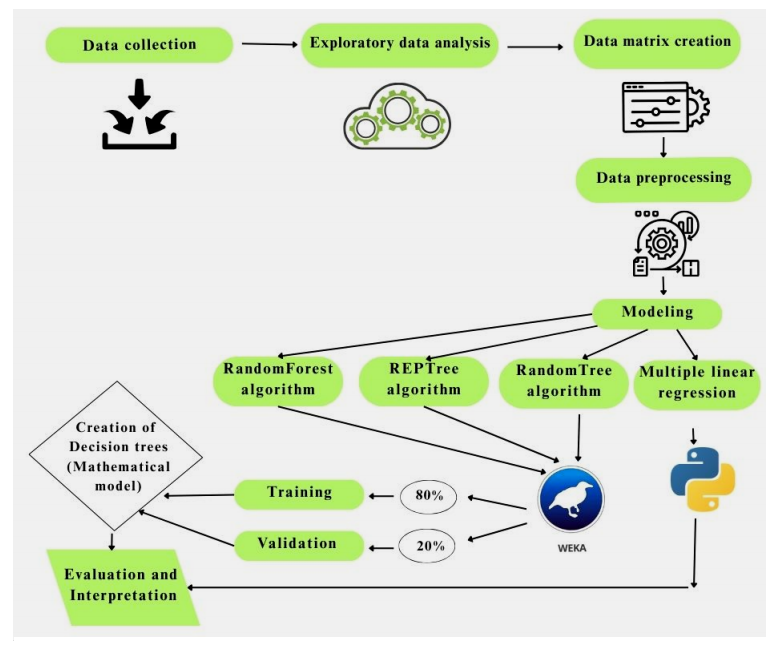
Nitrous oxide (N2O) emissions from nitrogen-fertilized agricultural soils represent a critical yet poorly quantified component of the greenhouse gas balance in Peruvian coffee systems. This study developed and compared machine learning (ML) and multiple linear regression models for predicting N2O fluxes from coffee soils under five contrasting nitrogen fertilization treatments in Chirinos, San Ignacio, Cajamarca, Peru. A dataset of 135 observations (n = 135), integrating edaphic and meteorological variables, was assembled from field measurements using static closed chambers and gas chromatography. Models were trained on 80% of the data and validated on the remaining 20% using holdout cross-validation. Random Tree and Random Forest consistently outperformed traditional regression approaches, both achieving R2 = 0.94, whereas REPTree reached R2 = 0.44, and multiple linear regression showed limited predictive capacity (R2 ≤ 0.50). The best-performing model, Random Tree Model IV, achieved a mean absolute error (MAE) of 14.79 mg N2O–N m−2 d−1. Variable importance analysis identified nitrogen source, soil temperature, relative air humidity, porosity, and water-filled pore space as the primary drivers of emission variability, consistent with established microbial mechanisms of nitrification and denitrification. These findings demonstrate that ML-based approaches substantially outperform conventional linear methods for modeling the nonlinear dynamics of N2O in coffee soils and provide actionable evidence for nitrogen management strategies that prioritize organic sources as mitigation options in high-rainfall environments. Limitations include the one-month evaluation period and the absence of microbiological variables, which future studies should address to improve model transferability.
References
1. Manco A, Giaccone M, Zenone T, et al. An Overview of N2O Emissions from Cropping Systems and Current Strategies to Improve Nitrogen Use Efficiency. Horticulturae. 2024; 10(7): 754. doi: 10.3390/horticulturae10070754
2. Hassan MU, Aamer M, Mahmood A, et al. Management Strategies to Mitigate N2O Emissions in Agriculture. Life. 2022; 12(3): 439. doi: 10.3390/life12030439
3. Wang F, Harindintwali JD, Wei K, et al. Climate change: Strategies for mitigation and adaptation. The Innovation Geoscience. 2023; 1(1): 100015. doi: 10.59717/j.xinn-geo.2023.100015
4. Wójcik-Gront E. Analysis of Sources and Trends in Agricultural GHG Emissions from Annex I Countries. Atmosphere. 2020; 11(4): 392. doi: 10.3390/atmos11040392
5. Butterbach-Bahl K, Baggs EM, Dannenmann M, et al. Nitrous oxide emissions from soils: how well do we understand the processes and their controls? Philosophical Transactions of the Royal Society B: Biological Sciences. 2013; 368(1621): 20130122. doi: 10.1098/rstb.2013.0122
6. Yin Y, Wang Z, Tian X, et al. Evaluation of variation in background nitrous oxide emissions: A new global synthesis integrating the impacts of climate, soil, and management conditions. Global Change Biology. 2022; 28(2): 480–492. doi: 10.1111/gcb.15860
7. Nidhya MS, Shah PK. Acquiring Knowledge by Performing Classification and Clustering of Datasets using WEKA: Intelligence through MLP, RF, DT, and RepTree. In: Proceedings of the 2023 International Conference on Communication, Security and Artificial Intelligence (ICCSAI); 23 November 2023; Greater Noida, India. pp. 833–837. doi: 10.1109/ICCSAI59793.2023.10421077
8. National Meteorology and Hydrology Service of Peru. Available online: https://www.gob.pe/senamhi (accessed on 19 February 2026). (in Spanish)
9. Zhu G, Shi H, Zhong L, et al. Nitrous oxide sources, mechanisms and mitigation. Nature Reviews Earth & Environment. 2025; 6(9): 574–592. doi: 10.1038/s43017-025-00707-5
10. Taboada MA, Cosentino VRN, Costantini AO. Nitrous Oxide Emissions from Agricultural Soils and Alternatives for Their Mitigation. Ciencia e Investigación. 2018. 68(5): 41–45. (in Spanish)
11. Illarze G, Del Pino A, Riccetto S, et al. Nitrous Oxide Emission, Nitrification, Denitrification, and Nitrogen Mineralization During Rice Cultivation in Two Soils of Uruguay. Revista Argentina de Microbiología. 2018; 50(1): 97–104. doi: 10.1016/j.ram.2017.05.004 (in Spanish)
12. Li L, Hong M, Zhang Y, et al. Soil N2O emissions from specialty crop systems: A global estimation and meta‐analysis. Global Change Biology. 2024; 30(3): e17233. doi: 10.1111/gcb.17233
13. Li Z, Yang Y, Wang X, et al. Linking N2O emissions and nosZ gene abundance: A meta-analysis of organic carbon amendments in agricultural soils. Plant and Soil. 2025; 515(1): 613–627. doi: 10.1007/s11104-025-07608-y
14. Fu Y, Ren X, Zhu B. Responses of Soil Nitrogen Transformation and N2O Emission to Soil pH and Hydrothermal Changes. Agronomy. 2025; 15(5): 1005. doi: 10.3390/agronomy15051005
15. Li X, Wang R, Du Y, et al. Significant increases in nitrous oxide emissions under simulated extreme rainfall events and straw amendments from agricultural soil. Soil and Tillage Research. 2025; 246: 106361. doi: 10.1016/j.still.2024.106361
16. Boullouz M, Metougui ML, El Khatri N, et al. Nitrous oxide emissions and wheat yield responses to nitrogen rate and source in contrasting rainfed cropping systems in Morocco. Farming System. 2026; 4(1): 100188. doi: 10.1016/j.farsys.2025.100188
17. Salamanca-Jimenez A, Doane TA, Horwath WR. Nitrogen Use Efficiency of Coffee at the Vegetative Stage as Influenced by Fertilizer Application Method. Frontiers in Plant Science. 2017; 8. doi: 10.3389/fpls.2017.00223
18. Noponen MRA, Edwards-Jones G, Haggar JP, et al. Greenhouse gas emissions in coffee grown with differing input levels under conventional and organic management. Agriculture, Ecosystems & Environment. 2012; 151: 6–15. doi: 10.1016/j.agee.2012.01.019
19. Tubiello FN, Cóndor-Golec RD, Salvatore M, et al. Estimating Greenhouse Gas Emissions in Agriculture. Food and Agriculture Organization of the United Nations; 2014. Available online: https://www.fao.org/climatechange/41521-0373071b6020a176718f15891d3387559.pdf
20. Burneo-Valdivieso J, Capa-Mora D, Ochoa-Cueva P. Soil Conditions and Effect of Fertilization on the Emission of Greenhouse Gases in an Andean Coffee Gradient. Agrociencia. 2023; 57(5). doi: 10.47163/agrociencia.v57i5.2359
21. Wang Y, Guo J, Vogt RD, et al. Soil pH as the chief modifier for regional nitrous oxide emissions: New evidence and implications for global estimates and mitigation. Global Change Biology. 2018; 24(2). doi: 10.1111/gcb.13966
22. García‐Marco S, Ravella SR, Chadwick D, et al. Ranking factors affecting emissions of GHG from incubated agricultural soils. European Journal of Soil Science. 2014; 65(4): 573–583. doi: 10.1111/ejss.12143
23. Bell MJ, Hinton N, Cloy JM, et al. Nitrous oxide emissions from fertilised UK arable soils: Fluxes, emission factors and mitigation. Agriculture, Ecosystems & Environment. 2015; 212: 134–147. doi: 10.1016/j.agee.2015.07.003
24. Quiñones-Huatangari L, Fernandez-Zarate FH, Huaccha-Castillo AE. Nitrous Oxide Emissions Generated in Coffee Cultivation: A Systematic Review. Nature Environment and Pollution Technology. 2022; 21(4): 1697–1703. doi: 10.46488/NEPT.2022.v21i04.023
25. Eloisa PC. Greenhouse Gas Emissions in Coffee Soils in Peru [Master’s Thesis]. Universidad Politécnica de Madrid; 2023. Available online: https://oa.upm.es/78346/ (in Spanish)
26. Ghimire U, Ashiq W, Biswas A, et al. Application of Machine Learning Algorithms in Nitrous Oxide (N2O) Emission Estimation in Data-Sparse Agricultural Landscapes. Atmosphere. 2025; 16(6): 703. doi: 10.3390/atmos16060703
27. Venterea RT, Petersen SO, De Klein CAM, et al. Global Research Alliance N2O chamber methodology guidelines: Flux calculations. Journal of Environmental Quality. 2020; 49(5): 1141–1155. doi: 10.1002/jeq2.20118
28. Liu C, Zhang Y, Liu H, et al. Fertilizer stabilizers reduce nitrous oxide emissions from agricultural soil by targeting microbial nitrogen transformations. Science of The Total Environment. 2022; 806: 151225. doi: 10.1016/j.scitotenv.2021.151225
29. Vazquez GG. Strategies to Mitigate Greenhouse Gas and Nitric Oxide Emissions in Rainfed and Irrigated Agro-Ecosystems [PhD Thesis]. Universidad Politécnica de Madrid; 2017. Available online: https://oa.upm.es/47329/1/GUILLERMO_GUARDIA_VAZQUEZ.pdf
30. Cassman NA, Soares JR, Pijl A, et al. Nitrification inhibitors effectively target N2O‐producing Nitrosospira spp. in tropical soil. Environmental Microbiology. 2019; 21(4): 1241–1254. doi: 10.1111/1462-2920.14557
31. Wyngaard N, Crespo C, Iglesias MP, et al. Impact of a Nitrification Inhibitor on Nitrogen Losses in Contrasting Soils and Water Regimes. Journal of Soil Science and Plant Nutrition. 2026; 26(1): 1693–1704. doi: 10.1007/s42729-025-02957-0
32. Quispe K, Hermoza N, Mejia S, et al. Spatial Analysis of Soil Acidity and Available Phosphorus in Coffee-Growing Areas of Pichanaqui: Implications for Liming and Site-Specific Fertilization. Agriculture. 2025; 15(15): 1632. doi: 10.3390/agriculture15151632
33. Seshan S, Poinapen J, Zandvoort MH, et al. Forecasting nitrous oxide emissions from a full-scale wastewater treatment plant using LSTM-based deep learning models. Water Research. 2025; 268: 122754. doi: 10.1016/j.watres.2024.122754
34. Pedersen AR, Petersen SO, Schelde K. A comprehensive approach to soil‐atmosphere trace‐gas flux estimation with static chambers. European Journal of Soil Science. 2010; 61(6): 888–902. doi: 10.1111/j.1365-2389.2010.01291.x
35. Qiao C, Liu L, Hu S, et al. How inhibiting nitrification affects nitrogen cycle and reduces environmental impacts of anthropogenic nitrogen input. Global Change Biology. 2015; 21(3): 1249–1257. doi: 10.1111/gcb.12802
36. Gómez-Fernández D, Atalaya-Marin N, Arce-Inga M, et al. Territorial zoning as a strategy for sustainable natural resource management in Cajamarca, Northwestern Peru. Ecological Informatics. 2025; 92: 103440. doi: 10.1016/j.ecoinf.2025.103440
37. Lussich F, Ackett R, Dhaliwal JK, et al. Enhancing predictions of nitrous oxide emissions from agricultural soils using a classification‐swap machine learning approach. Journal of Environmental Quality. 2026; 55(1): e70126. doi: 10.1002/jeq2.70126
38. Dhaliwal JK, Panday D, Robertson GP, et al. Machine learning reveals dynamic controls of soil nitrous oxide emissions from diverse long‐term cropping systems. Journal of Environmental Quality. 2025; 54(1): 132–146. doi: 10.1002/jeq2.20637
39. Search Results for Chirinos. Available online: https://es.climate-data.org/search/?q=chirinos (accessed on 12 November 2025). (in Spanish)
40. Climate Map of Peru. Available online: https://www.senamhi.gob.pe/?p=mapa-climatico-del-peru (accessed on 12 November 2025). (in Spanish)
41. Instituto Nacional de Recursos Naturales (INRENA). Soil Map of Peru: 1:5,000,000. INRENA; 1996. (in Spanish)
42. Bentzon-Tarp A, Helgadóttir D, Van Den Meersche K, et al. Spatial-temporal variations of nitrous oxide emissions in coffee agroforestry systems in Costa Rica. Agriculture, Ecosystems & Environment. 2023; 343: 108257. doi: 10.1016/j.agee.2022.108257
43. Ren J, Wang Y, Luo M, et al. Mitigating Nitrous Oxide Emissions from Agricultural Soils with Biochar: A Scientometric and Visual Analysis. Agronomy. 2025; 15(5): 1115. doi: 10.3390/agronomy15051115
44. Lewicka-Szczebak D, Lewicki MP, Well R. N2O isotope approaches for source partitioning of N2O production and estimation of N2O reduction-validation with the 15N gas-flux method in laboratory and field studies. Biogeosciences. 2020; 17(22): 5513–5537. doi: 10.5194/bg-17-5513-2020
45. Ekeberg D, Ogner G, Fongen M, et al. Determination of CH4, CO2 and N2O in air samples and soil atmosphere by gas chromatography mass spectrometry, GC-MS. Journal of Environmental Monitoring. 2004; 6(7): 621–623. doi: 10.1039/B401315H
46. Dunn OJ. Multiple Comparisons among Means. Journal of the American Statistical Association. 1961; 56(293): 52–64. doi: 10.1080/01621459.1961.10482090
47. Intergovernmental Panel on Climate Change (IPCC). 2019 Refinement to the 2006 IPCC Guidelines for National Greenhouse Gas Inventories. IPCC; 2019. Available online: https://www.ipcc-nggip.iges.or.jp/public/2019rf/pdf/0_Overview/19R_V0_00_Cover_Foreword_Preface_Dedication.pdf
48. Salman HA, Kalakech A, Steiti A. Random Forest Algorithm Overview. Babylonian Journal of Machine Learning. 2024; 2024: 69–79. doi: 10.58496/BJML/2024/007
49. Philibert A, Loyce C, Makowski D. Prediction of N2O emission from local information with Random Forest. Environmental Pollution. 2013; 177: 156–163. doi: 10.1016/j.envpol.2013.02.019
50. Witten IH, Frank E, Hall MA. Data Mining: Practical Machine Learning Tools and Techniques. Elsevier; 2011. doi: 10.1016/C2009-0-19715-5
51. Sharma A, Sajjad H, Saha TK, et al. Analyzing trend and forecasting of temperature and rainfall in Shimla district of Himachal Pradesh, India using non-parametric and bagging REPTree machine learning approaches. Journal of Atmospheric and Solar-Terrestrial Physics. 2024; 265: 106352. doi: 10.1016/j.jastp.2024.106352
52. Wright S. Correlation and Causation. Journal of Agricultural Research. 1921; 20: 557–585.
53. Montgomery DC. Design and Analysis of Experiments. John Wiley & Sons; 2017.
54. Ocaña-Zuñiga C, Quiñones-Huatangari L, Barboza E, et al. Coffee Rust Severity Analysis in Agroforestry Systems Using Deep Learning in Peruvian Tropical Ecosystems. Agriculture. 2024; 15(1): 39. doi: 10.3390/agriculture15010039
55. Palomino Ojeda JM, Quiñones Huatangari L, Cayatopa Calderón BA. Employing Data Mining Techniques for Engineering Soil Classification: A Unified Soil Classification System Approach. Mathematical Modelling of Engineering Problems. 2023; 10(6): 1994–2002. doi: 10.18280/mmep.100609
56. Tukey JW. Exploratory Data Analysis. Addison-Wesley; 1997.
57. Salgado CM, Azevedo C, Proença H, et al. Missing Data. In: Secondary Analysis of Electronic Health Records. Springer International Publishing; 2016. pp. 143–162. doi: 10.1007/978-3-319-43742-2_13
58. Silva SHG, Teixeira AFDS, Menezes MDD, et al. Multiple linear regression and random forest to predict and map soil properties using data from portable X-ray fluorescence spectrometer (pXRF). Ciência e Agrotecnologia. 2017; 41(6): 648–664. doi: 10.1590/1413-70542017416010317
59. Breiman L. Random Forests. Machine Learning. 2001; 45(1): 5–32. doi: 10.1023/A:1010933404324
60. Witten IH, Frank E, Hall MA, et al. Data Mining: Practical Machine Learning Tools and Techniques. Elsevier; 2016. doi: 10.1016/C2015-0-02071-8
61. San Martin Ruiz M, Reiser M, Kranert M. Nitrous Oxide Emission Fluxes in Coffee Plantations during Fertilization: A Case Study in Costa Rica. Atmosphere. 2021; 12(12): 1656. doi: 10.3390/atmos12121656
62. Ortiz-Gonzalo D, De Neergaard A, Vaast P, et al. Multi-scale measurements show limited soil greenhouse gas emissions in Kenyan smallholder coffee-dairy systems. Science of The Total Environment. 2018; 626: 328–339. doi: 10.1016/j.scitotenv.2017.12.247
63. Feng J, Li F, Deng A, et al. Integrated assessment of the impact of enhanced-efficiency nitrogen fertilizer on N2O emission and crop yield. Agriculture, Ecosystems & Environment. 2016; 231: 218–228. doi: 10.1016/j.agee.2016.06.038
64. Reay DS, Davidson EA, Smith KA, et al. Global agriculture and nitrous oxide emissions. Nature Climate Change. 2012; 2(6): 410–416. doi: 10.1038/nclimate1458
65. Soares JR, Cantarella H, Menegale MLDC. Ammonia volatilization losses from surface-applied urea with urease and nitrification inhibitors. Soil Biology and Biochemistry. 2012; 52: 82–89. doi: 10.1016/j.soilbio.2012.04.019
66. Scheer C, Fuchs K, Pelster DE, et al. Estimating global terrestrial denitrification from measured N2O:(N2O + N2) product ratios. Current Opinion in Environmental Sustainability. 2020; 47: 72–80. doi: 10.1016/j.cosust.2020.07.005
67. Saha D, Basso B, Robertson GP. Machine learning improves predictions of agricultural nitrous oxide (N2O) emissions from intensively managed cropping systems. Environmental Research Letters. 2021; 16(2): 024004. doi: 10.1088/1748-9326/abd2f3
68. Mirzaei M, Gorji Anari M, Taghizadeh-Toosi A, et al. Soil Nitrous Oxide Emissions Following Crop Residues Management in Corn-Wheat Rotation Under Conventional and No-Tillage Systems. Air, Soil and Water Research. 2022; 15: 11786221221128789. doi: 10.1177/11786221221128789
69. Belleville P, Keuper F, Ferchaud F, et al. Crop residues moderately influence cumulative N2O emissions through their carbon to nitrogen ratio in a 12-year experiment in northern France. Agronomy for Sustainable Development. 2026; 46(1): 5. doi: 10.1007/s13593-025-01072-9
70. Pan B, Lam SK, Wang E, et al. New approach for predicting nitrification and its fraction of N2O emissions in global terrestrial ecosystems. Environmental Research Letters. 2021; 16(3): 034053. doi: 10.1088/1748-9326/abe4f5
71. Li L, Lu C, Winiwarter W, et al. Enhanced nitrous oxide emission factors due to climate change increase the mitigation challenge in the agricultural sector. Global Change Biology. 2024; 30(8): e17472. doi: 10.1111/gcb.17472
72. Zeng Y, Chen S, Li Y, et al. Using Machine Learning to Assess the Effects of Biochar-Based Fertilizers on Crop Production and N2O Emissions in China. Agronomy. 2025; 15(5): 1238. doi: 10.3390/agronomy15051238
73. Gregorutti B, Michel B, Saint-Pierre P. Correlation and variable importance in random forests. Statistics and Computing. 2017; 27(3): 659–678. doi: 10.1007/s11222-016-9646-1
74. Wang B, Huang X, He H, et al. Carbon dynamics, emission mitigation, and yield optimization in farmlands: A machine learning framework for multi-variable prediction. Agricultural and Forest Meteorology. 2025; 373: 110740. doi: 10.1016/j.agrformet.2025.110740
75. Li T, Li Y, Cheng W, et al. Predicting Nitrous Oxide Emissions from China’s Upland Fields Under Climate Change Scenarios with Machine Learning. Agronomy. 2025; 15(6): 1447. doi: 10.3390/agronomy15061447
76. Necpálová M, Anex RP, Fienen MN, et al. Understanding the DayCent model: Calibration, sensitivity, and identifiability through inverse modeling. Environmental Modelling & Software. 2015; 66: 110–130. doi: 10.1016/j.envsoft.2014.12.011
77. Drago C, Arnone M, Leogrande A. A Machine Learning and Panel Data Analysis of N2O Emissions in an ESG Framework. Sustainability. 2025; 17(10): 4433. doi: 10.3390/su17104433
78. Gnisia G, Weik J, Ruser R, et al. Machine learning-based prediction of nitrous oxide emissions from arable farming: Exploring management practices as predictor variables. Ecological Indicators. 2025; 172: 113233. doi: 10.1016/j.ecolind.2025.113233
79. Ge X, Xie D, Mulder J, et al. Reevaluating the Drivers of Fertilizer-Induced N2O Emission: Insights from Interpretable Machine Learning. Environmental Science & Technology. 2024; 58(35): 15672–15680. doi: 10.1021/acs.est.4c04574
80. LaHue GT, Van Kessel C, Linquist BA, et al. Residual Effects of Fertilization History Increase Nitrous Oxide Emissions from Zero‐N Controls: Implications for Estimating Fertilizer‐Induced Emission Factors. Journal of Environmental Quality. 2016; 45(5): 1501–1508. doi: 10.2134/jeq2015.07.0409
81. Wang C, Amon B, Schulz K, et al. Factors That Influence Nitrous Oxide Emissions from Agricultural Soils as Well as Their Representation in Simulation Models: A Review. Agronomy. 2021; 11(4): 770. doi: 10.3390/agronomy11040770
82. Mathivanan GP, Eysholdt M, Zinnbauer M, et al. New N2O emission factors for crop residues and fertiliser inputs to agricultural soils in Germany. Agriculture, Ecosystems & Environment. 2021; 322: 107640. doi: 10.1016/j.agee.2021.107640
83. Shu X, Wang Yanqun, Wang Yaling, et al. Response of soil N2O emission and nitrogen utilization to organic matter in the wheat and maize rotation system. Scientific Reports. 2021; 11(1): 4396. doi: 10.1038/s41598-021-83832-7
84. Jiang Y, Zhu Y, Lin W, et al. Urea Fertilization Significantly Promotes Nitrous Oxide Emissions from Agricultural Soils and Is Attributed to the Short-Term Suppression of Nitrite-Oxidizing Bacteria during Urea Hydrolysis. Microorganisms. 2024; 12(4): 685. doi: 10.3390/microorganisms12040685
85. Motasim AM, Samsuri AW, Nabayi A, et al. Urea application in soil: Processes, losses, and alternatives—A review. Discover Agriculture. 2024; 2(1): 42. doi: 10.1007/s44279-024-00060-z
86. Nair D, Abalos D, Philippot L, et al. Soil and temperature effects on nitrification and denitrification modified N2O mitigation by 3,4-dimethylpyrazole phosphate. Soil Biology and Biochemistry. 2021; 157: 108224. doi: 10.1016/j.soilbio.2021.108224
87. Rummel PS, Englert P, Beule L, et al. N2O flux dynamics and production pathways modulated by soil organic matter and litter turnover. Biology and Fertility of Soils. 2025; 61(7): 1235–1251. doi: 10.1007/s00374-025-01925-1
88. Wolf I. Different pathways of formation of N2O, N2 and NO in black earth soil. Soil Biology and Biochemistry. 2000; 32(2): 229–239. doi: 10.1016/S0038-0717(99)00151-0
89. Hess LJT, Hinckley ELS, Robertson GP, et al. Rainfall intensification increases nitrate leaching from tilled but not no-till cropping systems in the U.S. Midwest. Agriculture, Ecosystems & Environment. 2020; 290: 106747. doi: 10.1016/j.agee.2019.106747
90. Velmourougane K. Impact of Organic and Conventional Systems of Coffee Farming on Soil Properties and Culturable Microbial Diversity. Scientifica. 2016; 2016: 1–9. doi: 10.1155/2016/3604026
91. Chemura A. The growth response of coffee (Coffea arabica L) plants to organic manure, inorganic fertilizers and integrated soil fertility management under different irrigation water supply levels. International Journal of Recycling of Organic Waste in Agriculture. 2014; 3(2): 59. doi: 10.1007/s40093-014-0059-x
92. European Union (EU). Regulation (EU) 2018/848 of the European Parliament and of the Council of 30 May 2018 on Organic Production and Labelling of Organic Products and Repealing Council Regulation (EC) No 834/2007. EU; 2018. Available online: https://eur-lex.europa.eu/eli/reg/2018/848/oj/eng
93. Fairtrade International. 2023 Annual Report. Fairtrade International; 2024. Available online: https://www.fairtrade.net/en/get-involved/library/2023-annual-report.html
94. Merbah N, Benito-Hernández S. Consumer Willingness-to-Pay for Sustainable Coffee: Evidence from a Choice Experiment on Fairtrade and UTZ Certification. Sustainability. 2024; 16(8): 3222. doi: 10.3390/su16083222
95. Gomes VM, Miranda Júnior MS, Silva LJ, et al. A Global Meta-Analysis of Soil Carbon Stock in Agroforestry Coffee Cultivation. Agronomy. 2025; 15(2): 480. doi: 10.3390/agronomy15020480
96. Vallejos-Torres G, Gaona-Jimenez N, Pichis-García R, et al. Carbon reserves in coffee agroforestry in the Peruvian Amazon. Frontiers in Plant Science. 2024; 15: 1410418. doi: 10.3389/fpls.2024.1410418
Downloads
Published
How to Cite
Issue
Section
License
Copyright (c) 2026 Jorge Antonio Fernandez Jibaja, Jhon Franklin Oblitas Troyes, Wendy Laurent Díaz Saavedra, Jose Manuel Palomino Ojeda, Milton Ríos Julcapoma, Kerin Lizbeth Diaz Vasquez, Annick Estefany Huaccha Castillo, Guillermo Guardia Vázquez, Manuel Emilio Milla Pino

This work is licensed under a Creative Commons Attribution 4.0 International License.





.jpg)
.jpg)