Optimal energy management model of a micro-CHP through combined multi-objective PSO–FL–AHP with realistic residential load profile
DOI:
https://doi.org/10.18686/cest615Keywords:
energy management , net present value , fuzzy logic , micro-combined heat and power (CHP) , particle swarm optimization , following electrical loadAbstract
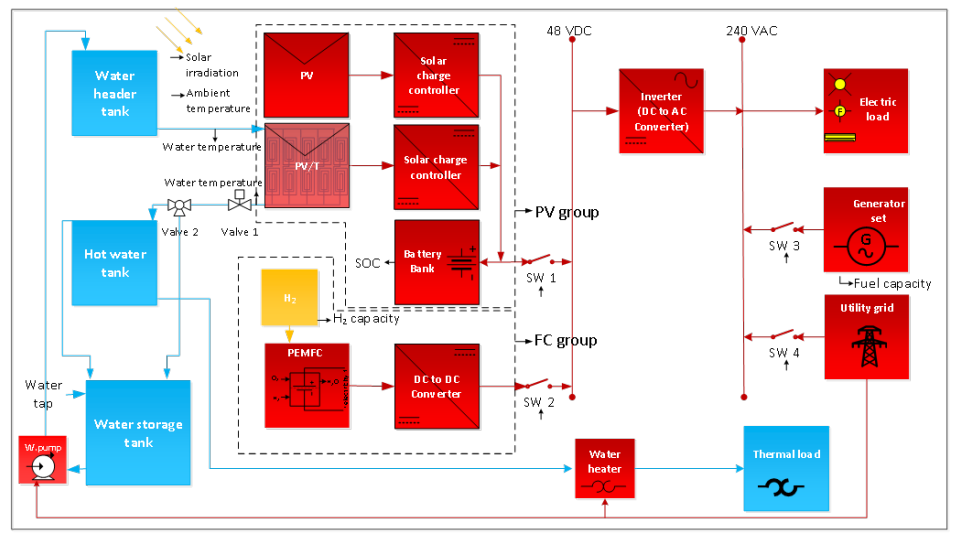
The strength of combined heat and power (CHP) systems in covering the electricity and heat demands has been proven over the last two decades. However, due to their complexity, CHP systems overcome challenges in optimally managing energy sources. This study aims to develop the best energy management model for a residential micro-CHP system that combines photovoltaics, thermal, and fuel cells, employing particle swarm optimization to optimize the model and incorporating fuzzy constraints to reduce power losses. To confirm its superiority, the proposed management model was compared to the conventional following-electrical-load approach. At the same time, the best candidate was selected using the Analytical Hierarchy Process. The results indicate that particle swarm optimization (PSO) significantly enhanced source operations and improved all objective criteria—primary energy saving (PES) (86.4%), net present value (NPV) (101.0%), and CO₂ reduction (5.1%)—compared to the conventional load-following approach; however, it exhibited a loss of power supply probability (LPSP) of approximately 41.7%. Additionally, the fuzzy constraints on the PSO model (PSO–FL (fuzzy logic)) have successfully eliminated the LPSP (0%) while maintaining all criteria at their best values. It has improved the PES, NPV, and CO2 by approximately 9.9%, 47.1%, and 7.1%, respectively. The analytical hierarchy process (AHP) with the best weights of 0.3, 0.4, and 0.3 for the PES, NPV, and CO2 criteria was chosen as the best solution. Prospects for the real implementation of the best model were validated through the operation of a real micro-CHP system.
References
1. Luo L, Cristofari C, Levrey S. Cogeneration: Another way to increase energy efficiency of hybrid renewable energy hydrogen chain—A review of systems operating in cogeneration and of the energy efficiency assessment through exergy analysis. Journal of Energy Storage. 2023; 66: 107433.
2. Ma H, Sun Q, Chen L, et al. Cogeneration transition for energy system decarbonization: From basic to flexible and complementary multi-energy sources. Renewable and Sustainable Energy Reviews. 2023; 187(C): 113709.
3. Franco A, Bellina F. Methods for optimized design and management of CHP systems for district heating networks (DHN). Energy Conversion and Management. 2018; 172: 21–31.
4. De Souza R, Casisi M, Micheli D, et al. A review of small–medium combined heat and power (CHP) technologies and their role within the 100% renewable energy systems scenario. Energies. 2021; 14(17): 5338.
5. Firouzmakan P, Hooshmand RA, Bornapour M, et al. A comprehensive stochastic energy management system of micro-CHP units, renewable energy sources and storage systems in microgrids considering demand response programs. Renewable and Sustainable Energy Reviews. 2019; 108: 355–368.
6. Kang L, Yang J, An Q, et al. Effects of load following operational strategy on CCHP system with an auxiliary ground source heat pump considering carbon tax and electricity feed in tariff. Applied Energy. 2017; 194: 454–466.
7. Soheyli S, Mehrjoo M, Mayam MHS. Modeling and optimal resources allocation of a novel tri-distributed generation system based on sustainable energy resources. Energy Conversion and Management. 2017; 143: 1–22.
8. Gu W, Wang Z, Wu Z, et al. An online optimal dispatch schedule for CCHP microgrids based on model predictive control. IEEE Transactions on Smart Grid. 2016; 8(5): 2332–2342.
9. Erixno O, Abd Rahim N, Ramadhani F, et al. Energy management of renewable energy-based combined heat and power systems: A review. Sustainable Energy Technologies and Assessments. 2022; 51: 101944.
10. Lefebvre K. Load-Following Heat, Hot Water and Power Distributed Generation Using an Integrated Solid Oxide Fuel Cell, Compressed Air Energy Storage and Solar Panel Array System [Master's Thesis]. McMaster University; 2015.
11. Yang J, Qin S, Zhang W, et al. Improving the load-following capability of a solid oxide fuel cell system through the use of time delay control. International Journal of Hydrogen Energy. 2017; 42(2): 1221–1236.
12. Cardoso D, Nunes D, Faria J, et al. Intelligent micro-cogeneration systems for residential grids: A sustainable solution for efficient energy management. Energies. 2023; 16(13): 5215.
13. Huang Y, Wang Y, Liu N. A two-stage energy management for heat-electricity integrated energy system considering dynamic pricing of Stackelberg game and operation strategy optimization. Energy. 2022; 244: 122576.
14. Li R, SaeidNahaei S. Optimal operation of energy hubs integrated with electric vehicles, load management, combined heat and power unit and renewable energy sources. Journal of Energy Storage. 2022; 48: 103822.
15. Nosratabadi SM, Jahandide M, Guerrero JM. Robust scenario-based concept for stochastic energy management of an energy hub contains intelligent parking lot considering convexity principle of CHP nonlinear model with triple operational zones. Sustainable Cities and Society. 2021; 68: 102795.
16. Hernández J, Sanchez-Sutil F, Muñoz-Rodríguez F, et al. Optimal sizing and management strategy for PV household-prosumers with self-consumption/sufficiency enhancement and provision of frequency containment reserve. Applied Energy. 2020; 277: 115529.
17. Gomez-Gonzalez M, Hernandez JC, Vera D, et al. Optimal sizing and power schedule in PV household-prosumers for improving PV self-consumption and providing frequency containment reserve. Energy. 2020; 191: 116554.
18. Salari A, Ahmadi SE, Marzband M, et al. Fuzzy Q-learning-based approach for real-time energy management of home microgrids using cooperative multi-agent system. Sustainable Cities and Society. 2023; 95: 104528.
19. Rosales-Asensio E, Icaza D, Gonzalez-Cobos N, et al. Peak load reduction and resilience benefits through optimized dispatch, heating and cooling strategies in buildings with critical microgrids. Journal of Building Engineering. 2023; 68: 106096.
20. Erixno O, Ramadhani F, Abd Rahim N, et al. Realistic operation and strategic energy, economic and environmental analyses of a hybrid renewable energy based-micro combined heat and power. Solar Energy. 2024; 272: 112467.
21. Kennedy J, Eberhart R. Particle swarm optimization. In: Proceedings of ICNN'95-international conference on neural networks; 27 November–1 December 1995; Perth, Australia. pp. 1942–1948.
22. Cogeneration of heat and power. Available online: https://energy.ec.europa.eu/topics/energy-efficiency/cogeneration-heat-and-power_en (accessed on 18 November 2025).
23. Fiaschi D, Manfrida G, Mendecka B, et al. A comparison of different approaches for assessing energy outputs of combined heat and power geothermal plants. Sustainability. 2021; 13(8): 4527.
24. Frangopoulos CA. A method to determine the power to heat ratio, the cogenerated electricity and the primary energy savings of cogeneration systems after the European Directive. Energy. 2012; 45(1): 52–61.
25. CO2 Avoidance. Available online: https://www.seda.gov.my/statistics-monitoring/co2-avoidance/ (accessed on 18 November 2025).
26. How to Properly Size a Commercial Generator for Your Facility’s Power Needs. Available online: https://www.globalpwr.com/blog/how-to-properly-size-a-commercial-generator/ (accessed on 18 November 2025).
27. Saaty TL. Decision Making for Leaders: The Analytic Hierarchy Process for Decisions in a Complex World. RWS Publications; 2001.
28. Mousavi SA, Zarchi RA, Astaraei FR, et al. Decision-making between renewable energy configurations and grid extension to simultaneously supply electrical power and fresh water in remote villages for five different climate zones. Journal of Cleaner Production. 2021; 279: 123617.
29. Fan L, Tu Z, Luo X, et al. MW cogenerated proton exchange membrane fuel cell combined heat and power system design for eco-neighborhoods in North China. International Journal of Hydrogen Energy. 2022; 47(6): 4033–4046.
30. Zahedi R, Ahmadi A, Sadeh M. Investigation of the load management and environmental impact of the hybrid cogeneration of the wind power plant and fuel cell. Energy Reports. 2021; 7: 2930–2939.
31. Mei S, Lu X, Zhu Y, et al. Thermodynamic assessment of a system configuration strategy for a cogeneration system combining SOFC, thermoelectric generator, and absorption heat pump. Applied Energy. 2021; 302: 117573.
32. Löbberding L, Madlener R. Techno-economic analysis of micro fuel cell cogeneration and storage in Germany. Applied Energy. 2019; 235: 1603–1613.
33. Peláez-Peláez S, Colmenar-Santos A, Pérez-Molina C, et al. Techno-economic analysis of a heat and power combination system based on hybrid photovoltaic-fuel cell systems using hydrogen as an energy vector. Energy. 2021; 224: 120110.
34. Kotowicz J, Uchman W. Analysis of the integrated energy system in residential scale: Photovoltaics, micro-cogeneration and electrical energy storage. Energy. 2021; 227: 120469.
35. Kamran M, Mudassar M, Fazal MR, et al. Implementation of improved Perturb & Observe MPPT technique with confined search space for standalone photovoltaic system. Journal of King Saud University—Engineering Sciences. 2018; 32(7), 432–441. doi: 10.1016/j.jksues.2018.04.006
36. Li Z, Zhou W, Yang H. One Novel Optimum Sizing Method for Solar Lighting System by Using Genetic Algorithm. In: Proceedings of the 2009 International Conference on Energy and Environment Technology; 16–18 October 2009; Washington, DC, USA. pp. 225–228.
37. Ould Bilal B, Sambou V, Ndiaye PA, et al. Optimal design of a hybrid solar–wind-battery system using the minimization of the annualized cost system and the minimization of the loss of power supply probability (LPSP). Renewable Energy. 2010; 35(10): 2388–2390. doi: 10.1016/j.renene.2010.03.004
38. Ramadhani F, Bakar KA, Shafer MG. Optimization of standalone street light system with consideration of lighting control. In: Proceedings of the Technological Advances in Electrical, Electronics and Computer Engineering (TAEECE 2013); 9–11 May 2013; Konya, Turkey. pp. 583–588.
Downloads
Published
How to Cite
Issue
Section
License
Copyright (c) 2026 Farah Ramadhani, Oon Erixno, Marintan Simbolon, Efri Suhartono, Norridah Amin

This work is licensed under a Creative Commons Attribution 4.0 International License.





.jpg)
.jpg)