Unlocking green power:How do institutional quality,innovative technologies and foreign aid drive clean energy in Pakistan?
DOI:
https://doi.org/10.18686/cest652Keywords:
affordable and clean energy (SDG 7) , renewable energy , innovative technologies (SDG 9) , foreign aid , institutional quality (SDG 16)Abstract
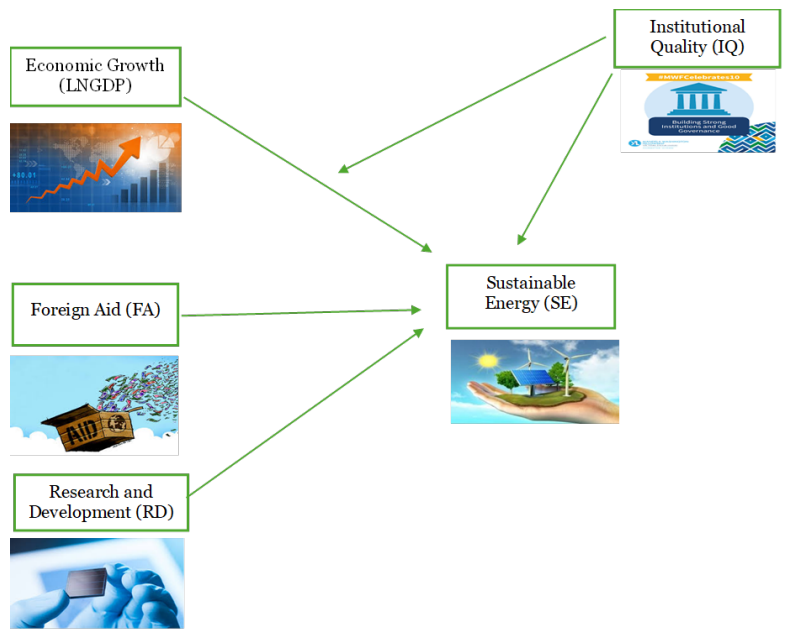
Affordable and clean energy (Sustainable Development Goals, SDG 7) is taking center stage in Pakistan, where the country is experiencing increasing energy deficits, electricity demand and serious environmental degradation. Thus, it will be essential to identify the factors that will push towards the use of clean energy to realize long-term sustainability. Therefore, this study explored the long-term relationship between clean energy (SE) as dependent variable and Economic growth, Institutional Quality (IQ), Innovative Technology (IT), Foreign Aid (FA) as independent variables and internation of IQ and Gross Domestic Product (GDP) in Pakistan. For empirical results, this study employed Autoregressive Distributed Lag (ARDL) Bond test approach from 1996 to 2024. The findings from this study validate the long-term relationship between the variables; however, the results reveal that GDP, IQ and FA have significant negative impact on SE in Pakistan, indicating that current macroeconomic and institutional framework of Pakistan is ineffective in transforming economic expansion into clean energy, along with external funds allocation directed towards more general projects instead of energy-specific ones. In contrast, IT poses a significant positive impact on SE, underscoring the importance of technological advancements in supporting clean energy. Although IT has positive effects on adoption of clean energy, inconsistency in regulation because of poor institutional quality sabotages all these relations and leads to fragmentation and inconsistent policies that will perpetuate subsidies on fossil production and hence, curtails the adoption of mass adoption of clean energy resources. This study highlights the urgent need for governance reforms, sector-specific foreign aid allocation, and investment in innovative technologies to strengthen institutional capacity and transparent foreign aid allocation to strengthen clean energy infrastructure.
References
1. Choi HJ, Qayyum S, Koo BB. Pakistan Energy Survey: Insights into the True Energy Access Situation in Pakistan Based on the Multi-Tier Framework. World Bank; 2024. Available online: https://openknowledge.worldbank.org/entities/publication/44f99069-fb65-4e62-9b6e-15d4f81dbcb9
2. Gardiner B. Pakistan’s Solar Revolution Is Bringing Power to the People. Yale Environment 360; 2025. Available online: https://e360.yale.edu/features/pakistan-solar-boom
3. Pakistan CPI 2024—Deep-rooted corruption persists. Available online: https://www.brecorder.com/news/40347807 (accessed on 3 January 2026).
4. Abdul D, Jiang W. Identifying and prioritization barriers to renewable energy diffusion in developing countries: A novel spherical fuzzy AHP approach and application. Energy Efficiency. 2024;17(5): 40.
5. Anjum A, Chauhan J, Enam M, et al. Emerging Issues in Energy Sustainability: A Systematic Review and Research Agenda. Nature Environment and Pollution Technology. 2024; 23(3): 1333–1344.
6. David R, Daniels C. Greening Technical and Vocational Education and Training for Energy Transition in Nigeria. Journal of Education for Sustainable Development. 2024; 18(2): 101–121.
7. Parveen Z, Salman V, Jamil F. Examining the challenges and drivers of solar photovoltaic adoption in the twin cities of Pakistan. Utilities Policy. 2025; 96: 102005. doi: 10.1016/j.jup.2025.102005
8. Doğan B, Tiwari S, Bergougui B, et al. Green innovation and fiscal spending: Decoding the path to sustainable development. Sustainable Development. 2025; 33(4): 6307–6327. doi: 10.1002/sd.3464
9. Riaz MN, Perdhana SM. Challenges in implementing renewable energy initiatives in Pakistan. World. 2024; 24(1): 581–584. Available online: https://repofeb.undip.ac.id/id/eprint/15333
10. Shahzad K, Lu B, Abdul D. Entrepreneur barrier analysis on renewable energy promotion in Pakistan using the Pythagorean fuzzy AHP method. Environmental Science and Pollution Research. 2022; 29: 54756–54768. doi: 10.1007/s11356-022-19680-3
11. Gardezi MA, Qayyum A, Zaib A, et al. Investigating the linkages: Energy consumption, institutional quality, and environmental quality in Pakistan. International Journal of Social Science Archives. 2024; 7(1): 303–317.
12. OHCHR, UNDP, UNODC. Global Progress Report on Sustainable Development Goal 16: Indicators on Peaceful, Just and Inclusive Societies, 2nd ed. United Nations Development Programme; 2025. Available online: https://www.undp.org/publications/global-progress-report-sustainable-development-goal-16-indicators-peaceful-just-and-inclusive-societies
13. Huang W, Shao S. Research on sustainable economic development models based on clean energy. Journal of Environmental & Earth Sciences. 2025; 7(4): 246–265. doi: 10.30564/jees.v7i4.8395
14. Ali S, Yan Q, Razzaq A, et al. Modeling factors of biogas technology adoption: A roadmap towards environmental sustainability and green revolution. Environmental Science and Pollution Research. 2023; 30(5): 11838–11860.
15. Abbas A, Khan MA, Tahir MM, et al. Development of a data-driven techno-economic and environmental framework for solar energy deployment in the energy mix: A case study of Pakistan. International Journal of Energy Research. 2025; 2025(1): 1473144.
16. Yang X, Long L. Renewable energy transition and its implications for natural resource management and sustainable economic recovery. Resources Policy. 2024; 89: 104624.
17. Batra G. Renewable energy economics: Achieving harmony between environmental protection and economic goals. Social Science Chronicle. 2023; 3(1): 1–32.
18. Spiller PT, Tommasi M. The institutions of regulation: An application to public utilities. In: Ménard C, Shirley MM (editors). Handbook of New Institutional Economics. Springer; 2005. pp. 515–543.
19. Khan K, Su CW, Rehman AU, et al. Is technological innovation a driver of renewable energy? Technology in Society. 2022; 70: 102044. doi: 10.1016/j.techsoc.2022.102044
20. Ullah S, Lin B. Clean energy initiatives in Pakistan: Driving sustainable development and lowering carbon emissions through environmental innovation and policy optimization. Journal of Environmental Management. 2024; 373: 123647. doi: 10.1016/j.jenvman.2024.123647
21. Government of Pakistan. Policy for Development of Renewable Energy for Power Generation: Employing Small Hydro, Wind, and Solar Technologies. Government of Pakistan; 2006. Available online: https://www.ppib.gov.pk/policies/REpolicy2006.pdf
22. Government of Pakistan, Ministry of Water & Power. National Power Policy, 2013. Government of Pakistan, Ministry of Water & Power; 2013. Available online: https://policy.asiapacificenergy.org/sites/default/files/National%20Power%20Policy%202013.pdf
23. Government of Pakistan, Ministry of Energy (Power Division). Alternative and Renewable Energy Policy 2019. Government of Pakistan, Ministry of Energy (Power Division); 2020. Available online: https://www.ppib.gov.pk/policies/ARE_Policy_2019_-_Gazette_Notified.pdf
24. Kumar L, Naqvi SA, Deitch MJ, et al. Opportunities and constraints for cleaner production policy in the developing world: A case study of Sindh Region, Pakistan. Environment, Development and Sustainability. 2024; 26(2): 4391–4434. doi: 10.1007/s10668-022-02889-0
25. Chien F, Ajaz T, Andlib Z, et al. The role of technology innovation, renewable energy, and globalization in reducing environmental degradation in Pakistan. Renewable Energy. 2021; 177: 308–317. doi: 10.1016/j.renene.2021.05.101
26. Joyo FH, Groppi D, Kumar L, et al. Achieving energy sustainability of Pakistan’s power sector through long-term scenario modeling and analysis. Energy. 2025; 328: 136549. doi: 10.1016/j.energy.2025.136549
27. Malik S, Qasim M, Saeed H. Green Finance for Pakistan: Barriers and Solutions. Asian Development Bank Institute; 2018. Available online: https://www.adb.org/publications/green-finance-pakistan-barriers-and-solutions
28. Flamant G, Grange B, Wheeldon J, et al. Opportunities and challenges in using particle circulation loops for concentrated solar power applications. Progress in Energy and Combustion Science. 2023; 94: 101056. doi: 10.1016/j.pecs.2022.101056
29. Bashir F, Awan AG. Impact of Green Innovation, Institutional Quality, Natural Resources and GDP on Sustainable Development in Pakistan. Journal of Asian Development Studies; 2025. 14(2): 538–553. doi: 10.62345/jads.2025.14.2.43
30. Ansari A, Sajid M, Khan SN, et al. Unveiling the effect of renewable energy and financial inclusion towards a sustainable environment: Does the interaction of digital finance and institutional quality matter? Sustainable Futures. 2024; 7: 100196. doi: 10.1016/j.sftr.2024.100196
31. Azimi MN, Rahman MM, Maraseni T. Powering progress: The interplay of energy security and institutional quality in driving economic growth. Applied Energy. 2025; 378: 124835. doi: 10.1016/j.apenergy.2024.124835
32. Hussain S, Wang X, Maqbool R, et al. The influence of government support, organizational innovativeness, and community participation in renewable energy project success: Evidence from Pakistan. Energy. 2022; 239: 122172. doi: 10.1016/j.energy.2021.122172
33. Shahzad Q, Aruga K. Energy policy evolution in Pakistan: Balancing security, efficiency, and sustainability. Energies. 2025; 18(14): 3821. doi: 10.3390/en18143821
34. Wang Q, Liu T, Li R. Artificial Intelligence and Environmental Sustainability: Investigating the AI-EKC Nexus for SDG 7 and SDG 13. Sustainable Development. 2025; 34(1): 1141–1166. doi: 10.1002/sd.70294
35. Wang Q, Wang X, Li R. Rethinking sustainability: Human development and ecological footprint under deglobalization pressures. Sustainable Development. 2025; 34(S1): 1524–1557.
36. Zhang F, Li R, Wang Q. Does AI Technology Innovation Drive Carbon Emission Efficiency? A Machine Learning–Based Meta-Frontier Analysis Across 75 Countries. Sustainable Development. 2025; 34(S1): 1310–1349. doi: 10.1002/sd.70312
37. Iqbal A, Zhang W, Jahangir S. Artificial intelligence and sustainable development: A global nonlinear analysis of the moderating roles of human capital and renewable energy. Sustainability. 2025; 17(3): 990. doi: 10.3390/su17030990
38. Wang Q, Zhang S, Li R. Artificial intelligence in the renewable energy transition: The critical role of financial development. Renewable and Sustainable Energy Reviews. 2026; 226: 116280.
39. Aziz Y, Janjua AK, Hassan M, et al. Techno-economic analysis of PV systems installed using innovative strategies for smart sustainable agriculture farms. Environment, Development and Sustainability. 2023; 26: 5003–5024. doi: 10.1007/s10668-023-02919-5
40. Paddison L. How Pakistan pulled off one of the fastest solar revolutions in the world. CNN Climate; 2025. Available online: https://www.cnn.com/2025/05/01/climate/pakistan-solar-boom
41. Abbas EK, Aqeel AN, Ashraf S, et al. Unlocking the power of nature: A state-of-the-art analysis of optimal wind and solar sites in Pakistan for sustainable power generation. Dialogue Social Science Review. 2025; 3(3): 789–810.
42. Tahir MM, Abbas A, Dickson R. Green hydrogen and chemical production from solar energy in Pakistan: A geospatial, techno-economic, and environmental assessment. International Journal of Hydrogen Energy. 2025; 116: 613–626.
43. Gul A, Rehman A, Chandio AA, et al. Factors influencing the adoption of solar energy tube-wells technology on rice production in Sindh Pakistan: A novel investigation. The International Journal of Justice and Sustainability. 2025; 31(4): 543–564.
44. Luo Z, Lin X, Wu Y, et al. Role of energy value chain in carbon neutrality: A review. Clean Energy Science and Technology. 2024; 2(4): 192. doi: 10.18686/cest.v2i4.192
45. Pesaran MH, Shin Y, Smith RJ. Bounds testing approaches to the analysis of level relationships. Journal of Applied Econometrics. 2001;16(3): 289–326. doi: 10.1002/jae.616
46. Aiken LS, West SG, Reno RR. Multiple regression: Testing and interpreting interactions. sage; 1991.
47. Suhrab M, Soomro J, Ullah S, et al. The effect of GDP, urbanization, trade openness, financial development, and renewable energy on CO₂ emissions. Environmental Science and Pollution Research. 2022; 30: 22985–22991. doi: 10.1007/s11356-022-23761-8
Downloads
Published
How to Cite
Issue
Section
License
Copyright (c) 2026 Saima Sajid, Shareen Qayyum, Sania Ahmad, Syed Saqlain Ul Hassan, Hamid Waqas

This work is licensed under a Creative Commons Attribution 4.0 International License.





.jpg)
.jpg)