Enhanced generator scheduling through the lambda iteration method with clone-based optimization and Lévy flight integration
DOI:
https://doi.org/10.18686/cest735Keywords:
artificial intelligence; calculus-based; cloning; generator scheduling; Lévy flightAbstract
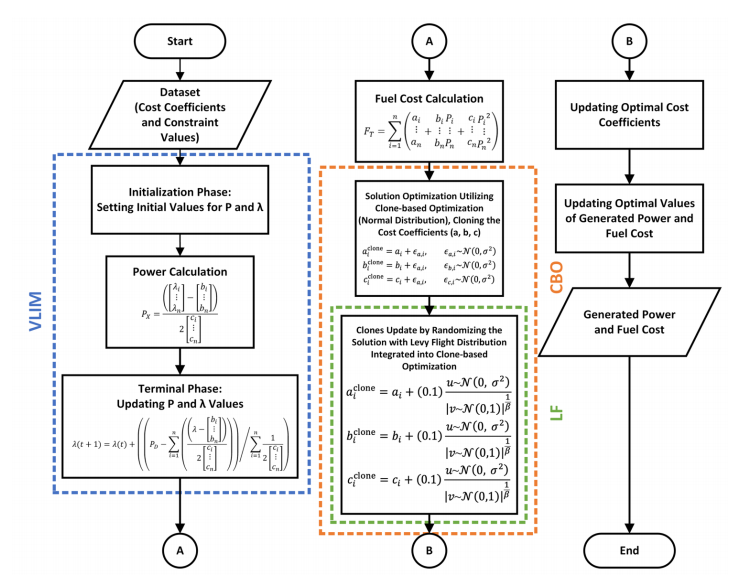
One of the hardest parts of running a power system is economic dispatch (ED), which means finding the cheapest way to meet demand and operational limits. To alleviate these limitations, this study presents a hybrid methodology known as Vectorized Lambda Iteration Method–Clone-Based Optimization with Lévy flight (VLIM-CBO-LF). The contribution comprises the synchronized amalgamation of three complementary strategies. The VLIM-CBO-LF improves the accuracy of dispatch calculations, clone-based optimization improves local search by using adaptive cloning, selection, and Lévy flight improves global exploration by letting movements happen over long distances from time to time. The suggested method was tested on a 42-unit economic dispatch system over a 24-h period, running it 30 times to make sure it worked each time. The results show that VLIM-CBO-LF has the lowest average daily fuel cost of IDR 3.9096 × 10¹⁰. This is better than the artificial bee colony, particle swarm optimization, grey wolf optimization, and whale optimization algorithm. The cost goes down from IDR 1.050 × 10⁹ to 3.666 × 10⁹ per day, but the performance stays the same, with a standard deviation of 6.50 × 10⁷ IDR. The ANOVA test (F = 19.004, p = 1.820 × 10⁻⁷) and the Friedman test (χ2 = 60, p = 9.358 × 10⁻14) both show that the results are statistically significant. The Wilcoxon signed-rank test (W⁺ = 0) shows that the results are strictly better than all other benchmark methods. Future research may investigate the applicability of the VLIM-CBO-LF model to more complex electrical market mechanisms.
References
1. Dehbalaee MRG, Shaeisi GH, Valizadeh M. A Proposed Improved Hybrid Hill Climbing Algorithm with the Capability of Local Search for Solving the Nonlinear Economic Load Dispatch Problem. International Journal of Engineering, Transactions A: Basics. 2020; 33(4): 575–585. doi: 10.5829/ije.2020.33.04a.09
2. Feili M, Taghi Ameli M. The Stochastic P2P Energy Management Scheme for Integrated Energy Microgrid Considering P2G and Electricity Network Fee. International Journal of Industrial Electronics, Control and Optimization (IECO). 2025; 8(1), 1–23. doi: 10.22111/ieco.2024.49044.1583
3. Guo B, Li F, Yang J, et al. The application effect of the optimized scheduling model of virtual power plant participation in the new electric power system. Heliyon. 2024; 10(11), e31748.
4. Singh S, Singh S. Advancements and Challenges in Integrating Renewable Energy Sources into Distribution Grid Systems: A Comprehensive Review. Journal of Energy Resources Technology. 2024; 146(9), 090801. doi: 10.1115/1.4065503
5. Esmaeili Shayan M, Petrollese M, Rouhani SH, et al. An innovative two-stage machine learning-based adaptive robust unit commitment strategy for addressing uncertainty in renewable energy systems. International Journal of Electrical Power & Energy Systems. 2024; 160: 110087. doi: 10.1016/j.ijepes.2024.110087
6. Aditya IA, Simaremare AA, Raharjo J, et al. Komodo Mlipir Algorithm to Solve Generator Scheduling Problems. In: 2022 2nd International Conference on Electronic and Electrical Engineering and Intelligent System (ICE3IS), Proceedings of the 2nd International Conference on Electronic and Electrical Engineering and Intelligent System; 4–5 November 2022; Yogyakarta, Indonesia. IEEE; 2022. pp. 84–88. doi: 10.1109/ICE3IS56585.2022.10010294
7. Puspitasari KMD, Raharjo J, Sastrosubroto AS, et al. Generator Scheduling Optimization Involving Emission to Determine Emission Reduction Costs. International Journal of Engineering, Transactions B: Applications. 2022; 35(8), 1468–1478. doi: 10.5829/IJE.2022.35.08B.02
8. Cheng L, Peng P, Lu W, et al. Study of Flexibility Transformation in Thermal Power Enterprises under Multi-Factor Drivers: Application of Complex-Network Evolutionary Game Theory. Mathematics. 2024; 12(16), 2537. doi: 10.3390/math12162537
9. Das T, Roy R, Mandal KK. Evolutionary computation based wind energy integrated multi-objective optimal reactive power dispatch and economic load dispatch problem. Computers and Electrical Engineering. 2025; 127: 110587. doi: 10.1016/j.compeleceng.2025.110587
10. Ye X, Yang P. Economic Optimal Dispatch of Networked Hybrid Renewable Energy Microgrid. Systems. 2025; 13(2), 109. doi: 10.3390/systems13020109
11. Kumar PV, Shilaja C. A swank raccoon yin yang pair optimization (RYi-YaP) model for solving economic load dispatch (ELD) and combined emission dispatch (CED) problems. Computers and Electrical Engineering. 2025; 123: 110149. doi: 10.1016/j.compeleceng.2025.110149
12. Lotfi H. Multi-Area Economic Dispatch under Renewable Integration: Optimization Challenges and Research Perspectives. Processes. 2025; 13(12), 3766. doi: 10.3390/pr13123766
13. Sharifian Y, Abdi H. Multi-area dynamic economic dispatch considering the demand response and price uncertainty. Energy. 2025; 322: 135532. doi: 10.1016/j.energy.2025.135532
14. Bai C, Li Q, Zhou W, et al. Fast distributed gradient descent method for economic dispatch of microgrids via upper bounds of second derivatives. Energy Reports. 2022; 8(S13): 1051–1060. doi: https://doi.org/10.1016/j.egyr.2022.08.110
15. Chen SD, Chen JF. A direct Newton–Raphson economic emission dispatch. International Journal of Electrical Power & Energy Systems. 2003; 25(5): 411–417. doi: 10.1016/S0142-0615(02)00075-3
16. Lin CE, Chen ST, Huang CL. A direct Newton-Raphson economic dispatch. IEEE Transactions on Power Systems. 1992; 7(3): 1149–1154. doi: 10.1109/59.207328
17. Qin J, Wan Y, Yu X, et al. A Newton Method-Based Distributed Algorithm for Multi-Area Economic Dispatch. IEEE Transactions on Power Systems. 2020; 35(2): 986–996. doi: 10.1109/TPWRS.2019.2943344
18. Xu T, Wu W, Zheng W, et al. Fully Distributed Quasi-Newton Multi-Area Dynamic Economic Dispatch Method for Active Distribution Networks. IEEE Transactions on Power Systems. 2018; 33(4): 4253–4263. doi: 10.1109/TPWRS.2017.2771950
19. Balbo AR, da S Souza MA, Baptista EC, et al. Predictor-Corrector Primal-Dual Interior Point Method for Solving Economic Dispatch Problems: A Postoptimization Analysis. Mathematical Problems in Engineering. 2012; 2012(1): 376546. doi: 10.1155/2012/376546
20. Subathra MSP, Selvan SE, Victoire TAA, et al. A Hybrid With Cross-Entropy Method and Sequential Quadratic Programming to Solve Economic Load Dispatch Problem. IEEE Systems Journal. 2015; 9(3): 1031–1044. doi: 10.1109/JSYST.2013.2297471
21. Rehman K, Ahmad A. A novel hybrid moth flame optimization with sequential quadratic programming algorithm for solving economic load dispatch problem. Mehran University Research Journal Of Engineering & Technology. 2019; 38(1): 129–142. doi: 10.22581/muet1982.1901.11
22. McLarty D, Panossian N, Jabbari F, et al. Dynamic economic dispatch using complementary quadratic programming. Energy. 2019; 166: 755–764. doi: 10.1016/j.energy.2018.10.087
23. Xu B, Zhang Y, Liu J, et al. Economic Dispatch of Micro-grid Based on Sequential Quadratic Programming-Model and Formulation. E3S Web of Conferences. 2019; 136, 01010.
24. Montoya OD, Gil-González W, Garces A. A Sequential Quadratic Programming Model for the Economic–Environmental Dispatch in MT-HVDC. In: 2019 IEEE Workshop on Power Electronics and Power Quality Applications (PEPQA), Proceedings of the 2019 IEEE Workshop on Power Electronics and Power Quality Applications; 30–31 May 2019; Pereira, Colombia. IEEE; 2019. pp. 1–6. doi: 10.1109/PEPQA.2019.8851570
25. Chen J, Zhang Y. A lagrange relaxation-based alternating iterative algorithm for non-convex combined heat and power dispatch problem. Electric Power Systems Research. 2019; 177: 105982. doi: 10.1016/j.epsr.2019.105982
26. Qader MR. Power management in a hydrothermal system considering maintenance using Lagrangian relaxation and augmented Lagrangian methods. Alexandria Engineering Journal. 2022; 61(10): 8177–8188. doi: 10.1016/j.aej.2022.01.025
27. Ananduta W, Ocampo-Martinez C, Nedić A. A Distributed Augmented Lagrangian Method Over Stochastic Networks for Economic Dispatch of Large-Scale Energy Systems. IEEE Transactions on Sustainable Energy. 2021; 12(4): 1927–1934. doi: 10.1109/TSTE.2021.3073510
28. Zuo Y. Research on time-varying economic dispatch of smart grid based on Lagrangian pairing. E3S Web of Conferences. 2023; 375, 03010. doi: 10.1051/e3sconf/202337503010
29. Tang C, Xu J, Tan Y, et al. Lagrangian Relaxation With Incremental Proximal Method for Economic Dispatch With Large Numbers of Wind Power Scenarios. IEEE Transactions on Power Systems. 2019; 34(4): 2685–2695. doi: 10.1109/TPWRS.2019.2891227
30. Basu M. Fuel constrained economic emission dispatch using nondominated sorting genetic algorithm-II. Energy. 2014; 78: 649–664. doi: 10.1016/j.energy.2014.10.052
31. Talaq J. A Pareto Optimal Solution for Environmental/Economic Power Dispatch using Multi-objective Genetic Algorithm. International Journal of Engineering Sciences. 2019; 11(4), 121–149. doi: 10.36224/ijes.110401
32. Wong LI, Sulaiman MH, Mohamed MR, et al. Grey Wolf Optimizer for solving economic dispatch problems. In: 2014 IEEE International Conference on Power and Energy (PECon), Proceedings of the 2014 IEEE International Conference on Power and Energy; 1–3 December 2014; Kuching, Malaysia. IEEE; 2014. pp. 150–154. doi: 10.1109/PECON.2014.7062431
33. Sakthivel VP, Sathya PD. Squirrel search optimization for non-convex multi-area economic dispatch. International Journal of Engineering, Transactions A: Basics. 2021; 34(1): 120–127. doi: 10.5829/IJE.2021.34.01A.14
34. Ikhsan RRN, Raharjo J, Rahmat B. Vectorized Lambda Iteration Method for Swift Economic Dispatch Analysis. Evergreen. 2024; 11(1): 435–447. doi: 10.5109/7172306
35. Rodriguez JS, Parker RB, Laird CD, et al. Scalable Parallel Nonlinear Optimization with PyNumero and Parapint. INFORMS Journal on Computing. 2023; 35(2): 509–517. doi: 10.1287/ijoc.2023.1272
36. Diamond S, Boyd S. CVXPY: A Python-Embedded Modeling Language for Convex Optimization. Journal of Machine Learning Research. 2016; 17(2016), 1–5. Available online: https://web.stanford.edu/~boyd/papers/pdf/cvxpy_paper.pdf
37. He X, Huang J, Rao Y, et al. Chaotic Teaching-Learning-Based Optimization with Lévy Flight for Global Numerical Optimization. Computational Intelligence and Neuroscience. 2016; 2016(1), 8341275.
38. Yang XS, Deb S, He X. Eagle strategy with flower algorithm. In: 2013 International Conference on Advances in Computing, Communications and Informatics (ICACCI), Proceedings of the 2013 International Conference on Advances in Computing, Communications and Informatics; 22–25 August 2013; Mysore, India. IEEE; 2013. pp. 1213–1217. doi: 10.1109/ICACCI.2013.6637350
39. Li J, An Q, Lei H, et al. Survey of Lévy Flight-Based Metaheuristics for Optimization. Mathematics. 2022; 10(15), 2785. doi: 10.3390/math10152785
40. Nabila HS, Islam SF. Improved Energy Valley Optimizer with Levy Flight for Optimization Problems. IgMin Research. 2024; 2(4): 245–254. doi: 10.61927/igmin172
41. Nasir ANK, Jusof MFM, Ahmad MR, et al. Adaptive Levy Flight Distribution Algorithm for Solving a Dynamic Model of an Electric Heater. In: 2023 IEEE 13th Symposium on Computer Applications & Industrial Electronics (ISCAIE), Proceedings of the 2023 IEEE 13th Symposium on Computer Applications & Industrial Electronics; 20–21 May 2023; Penang, Malaysia. IEEE; 2023. pp. 140–144. doi: 10.1109/ISCAIE57739.2023.10165009
42. Luo W, Wu H, Peng J. Improvement of Electric Fish Optimization Algorithm for Standstill Label Combined with Levy Flight Strategy. Biomimetics. 2024; 9(11), 677. doi: 10.3390/biomimetics9110677
43. Cheng L, Zhang M, Wang K, et al. Evolutionary smart contracts for virtual power plant trading: Integrating prospect theory and multi-stage negotiation in cross-regional energy markets. International Journal of Electrical Power & Energy Systems. 2025; 173(21): 111453. doi: 10.1016/j.ijepes.2025.111453
Downloads
Published
How to Cite
Issue
Section
License
Copyright (c) 2026 Rifki Rahman Nur Ikhsan, Jangkung Raharjo, Ardiansyah Ramadhan, Lindiasari Martha Yustika

This work is licensed under a Creative Commons Attribution 4.0 International License.





.jpg)
.jpg)