Case-specific modelling and experimental validation of a two-stage anaerobic digestion system for food waste using a modified ADM1 framework
DOI:
https://doi.org/10.18686/cest737Keywords:
two-stage anaerobic digestion; ADM1; food waste; methane production; dynamic modelling; process optimizationAbstract
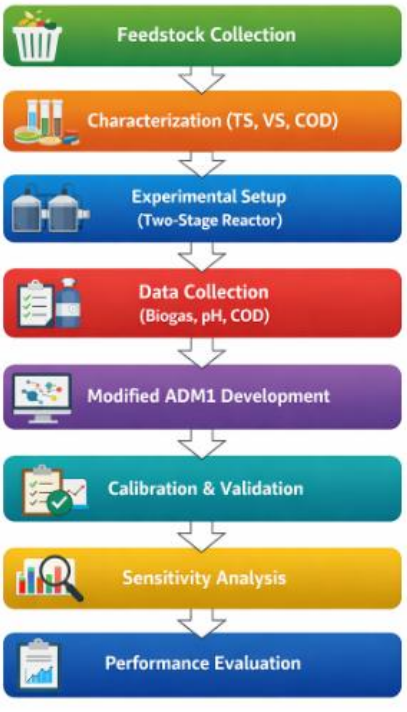
This study presents a case-specific adaptation and experimental validation of a modified Anaerobic Digestion Model No. 1 (ADM1) for a laboratory-scale two-stage anaerobic digestion system treating food waste. The system separates acidogenic and methanogenic phases to improve process understanding under controlled conditions. Comprehensive substrate characterization, including total solids (TS), volatile solids (VS), chemical oxygen demand (COD), and biochemical composition, was incorporated into the model framework to ensure realistic simulation inputs. A dynamically coupled ADM1 model was developed in MATLAB/Simulink and calibrated using experimental data obtained from a custom-designed two-stage reactor. Model performance was evaluated using Root Mean Square Error (RMSE), R2, and Normalized Mean Bias Error (NMBE), demonstrating good agreement within the calibration domain (R2 ≈ 0.97). The effects of key operational parameters, organic loading rate (OLR), hydraulic retention time (HRT), temperature, and reactor volume ratio were analysed. Results indicate that stable operation occurs within a moderate OLR range, while excessive loading leads to volatile fatty acid accumulation and reduced methane productivity. The optimal conditions identified (OLR ≈ 4–4.5 kg VS/m3·day, HRT ≈ 15–20 days) are specific to the studied system and should not be generalized without further validation. The study highlights limitations related to model simplifications and short validation periods. The findings contribute to improved understanding of two-stage digestion behaviour and provide a basis for future model refinement, extended validation, and scale-up studies.
References
1. Alexandropoulou M, Antonopoulou G, Trably E, et al. Continuous Biohydrogen Production from a Food Industry Waste: Influence of Operational Parameters and Microbial Community Analysis. Journal of Cleaner Production. 2018; 174: 1054–1063.
2. Alexandropoulou M, Antonopoulou G, Lyberatos G. A Novel Approach of Modeling Continuous Dark Hydrogen Fermentation. Bioresource Technology. 2018; 250: 784–792.
3. Angelidaki I, Ellegaard L, Ahring BK. Applications of the anaerobic digestion process. In: Birgitte K, Ahring BK, Ahring I, et al. (editors). Biomethanation II: Advances in Biochemical Engineering/Biotechnology. Springer; 2003. 82, pp. 1–33.
4. Appels L, Baeyens J, Degrève J, et al. Principles and potential of anaerobic digestion of waste-activated sludge. Progress in Energy and Combustion Science. 2008; 34(6): 755–781.
5. Batstone DJ, Keller J, Angelidaki I, et al. Anaerobic digestion model No. 1 (ADM1). Water Science and Technology. 2002; 45(10): 65–73.
6. Batstone DJ, Pind PF, Angelidaki I. Kinetics of thermophilic digestion. Biotechnology and Bioengineering. 2003; 83(6): 699–710.
7. Chen Y, Cheng JJ, Creamer KS. Inhibition of anaerobic digestion. Bioresource Technology. 2008; 99(10): 4044–4064.
8. Couto PT, Eng F, Naessens W, et al. Modelling Sugarcane Vinasse Processing in an Acidogenic Reactor to Produce Hydrogen with an ADM1-Based Model. International Journal of Hydrogen Energy. 2020; 45(11): 6217–6230.
9. Cavalcante WA, Leitão RC, Gehring TA, et al. Anaerobic Fermentation for n-Caproic Acid Production: A Review. International Journal of Hydrogen Energy. 2017; 54: 106–119.
10. Esposito G, Frunzo L, Liotta F, et al. Bio-methane potential tests to measure the biogas production from the digestion and co-digestion of complex organic substrates. The Open Environmental Engineering Journal. 2012; 5: 1–8.
11. Gaida D. Dynamic Real-Time Substrate Feed Optimization of Anaerobic Co-Digestion Plants [PhD Thesis]. Universiteit Leiden; 2014.
12. Koch K, Drewes JE. Alternative approach to estimate the rate constant of particulate material from batch data. Applied Energy. 2014; 120: 11–15.
13. Segura T, Zanoni P, Brémond U, et al. Modelling anaerobic digestion of agricultural waste: From lab to full scale. Waste Management. 2025; 200: 114739. doi: 10.1016/j.wasman.2025.114739
14. Li Y, Park SY, Zhu J. Solid-state anaerobic digestion for methane production from organic waste. Renewable and Sustainable Energy Reviews. 2011; 15(1): 821–826.
15. Mata-Alvarez J, Dosta J, Romero-Güiza MS, et al. A critical review on anaerobic co-digestion achievements between 2010 and 2013. Renewable and Sustainable Energy Reviews. 2014; 36: 412–427.
16. Trucchia A, Frunzo L. Surrogate based Global Sensitivity Analysis of ADM1-based Anaerobic Digestion Model. Journal of Environmental Management. 2021; 282: 111456. doi: 10.1016/j.jenvman.2020.111456
17. Pavlostathis SG, Giraldo-Gomez E. Kinetics of anaerobic treatment: A critical review. Critical Reviews in Environmental Control. 1991; 21(5–6): 411–490.
18. Rajendran K, Aslanzadeh S, Taherzadeh MJ. Household biogas digesters—A review. Energies. 2012; 5(8): 2911–2942.
19. Schoen MA, Sperl D, Gadermaier M, et al. Population dynamics at digester overload conditions. Bioresource Technology. 2009; 100(23): 5648–5655. doi: 10.1016/j.biortech.2009.06.033
20. Tisocco S, Weinrich S, Lyons G, et al. Application of a simplified ADM1 for full-scale anaerobic co-digestion of cattle slurry and grass silage: Assessment of input variability. Frontiers of Environmental Science & Engineering. 2024; 18: 50. doi: 10.1007/s11783-024-1810-9
21. Ward AJ, Hobbs PJ, Holliman PJ, et al. Optimization of anaerobic digestion of agricultural resources. Bioresource Technology. 2008; 99(17): 7928–7940.
22. Zhang C, Su H, Baeyens J, et al. Reviewing the anaerobic digestion of food waste for biogas production. Renewable and Sustainable Energy Reviews. 2014; 38: 383–392.
23. Ramirez I, Volcke EIP, Rajinikanth R, et al. Modeling microbial diversity in anaerobic digestion through an extended ADM1 model. Water Research. 2009; 43(11): 2787–2800. doi: 10.1016/j.watres.2009.03.034
24. Ponsá S, Ferrer I, Vázquez F, et al. Optimization of the hydrolytic–acidogenic anaerobic digestion stage (55 °C) of sewage sludge: Influence of pH and solid content. Water Research. 2008; 42(14): 3972–3980. doi: 10.1016/j.watres.2008.07.002
25. Nguyen HH. Modelling of Food Waste Digestion Using ADM1 Integrated with Aspen Plus [PhD Thesis]. University of Southampton; 2014.
26. Ghimire A, Frunzo L, Pirozzi F, et al. A review on dark fermentative biohydrogen production from organic biomass: Process parameters and use of by-products. Applied Energy. 2015; 144: 73–95. doi: 10.1016/j.apenergy.2015.01.045
27. Jimenez J, Latrille É, Harmand J, et al. Instrumentation and control of anaerobic digestion processes: A review and some research challenges. Reviews in Environmental Science and Bio/Technology. 2015; 14(4): 615–648. doi: 10.1007/s11157-015-9382-6
28. Jurado E, Antonopoulou G, Lyberatos G, et al. Continuous anaerobic digestion of swine manure: ADM1-based modelling and effect of addition of swine manure fibers pretreated with aqueous ammonia soaking. Applied Energy. 2016; 172: 190–198. doi: 10.1016/j.apenergy.2016.03.072
29. Poggio D, Walker M, Nimmo W, et al. Modelling the anaerobic digestion of solid organic waste: Substrate characterisation method for ADM1 using a combined biochemical and kinetic parameter estimation approach. Waste Management. 2016; 53: 40–54. doi: 10.1016/j.wasman.2016.04.024
30. Xie S, Hai FI, Zhan X, et al. Anaerobic co-digestion: A critical review of mathematical modelling for performance optimization. Bioresource Technology. 2016; 222: 498–512. doi: 10.1016/j.biortech.2016.10.015
31. Charnier C, Latrille É, Jimenez J, et al. Fast ADM1 implementation for the optimization of feeding strategy using near infrared spectroscopy. Water Research. 2017; 122: 27–35. doi: 10.1016/j.watres.2017.05.051
32. Gioannis GD, Muntoni A, Polettini A, et al. Energy recovery from one- and two-stage anaerobic digestion of food waste. Waste Management. 2017; 68: 595–602. doi: 10.1016/j.wasman.2017.06.013
33. Puyol D, Flores-Alsina X, Segura Y, et al. Exploring the effects of zero-valent iron addition on resource recovery in the anaerobic digestion process. Chemical Engineering Journal. 2018; 335: 703–711. doi: 10.1016/j.cej.2017.11.029
34. Pastor-Poquet V, Papirio S, Steyer JP, et al. High-solids anaerobic digestion model for homogenized reactors. Water Research. 2018; 142: 501–511. doi: 10.1016/j.watres.2018.06.016
35. Bayen T, Gajardo P. On the steady-state optimization of the biogas production in a two-stage anaerobic digestion model. Journal of Mathematical Biology. 2019; 78(4): 1067–1087. doi: 10.1007/s00285-018-1301-3
36. Baldi F, Pecorini I, Iannelli R. Comparison of single-stage and two-stage anaerobic co-digestion of food waste and activated sludge for hydrogen and methane production. Renewable Energy. 2019; 143: 1755–1765. doi: 10.1016/j.renene.2019.05.122
37. Huang Y, Ma Y, Wan J, et al. Mathematical modelling of the internal circulation anaerobic reactor by Anaerobic Digestion Model No. 1 simultaneously combined with hydrodynamics. Scientific Reports. 2019; 9(1): 6249. doi: 10.1038/s41598-019-42755-0
38. Borisov M, Denchev D, Simeonov I. Mathematical modelling of a two-stage anaerobic digestion process with hydrogen and methane production using ADM1. Ecological Engineering and Environment Protection. 2020; 1: 18–29. doi: 10.32006/eeep.2020.1.1829
39. Rubio JÁ, Morales JL, Romero LI, et al. Modelization of anaerobic processes during co-digestion of slowly biodegradable substrates. Chemosphere. 2020; 250: 126222. doi: 10.1016/j.chemosphere.2020.126222
40. Huang Y, Ma Y, Wan J, et al. Modeling the performance of full-scale anaerobic biochemical system treating deinking pulp wastewater based on modified Anaerobic Digestion Model No. 1. Frontiers in Microbiology. 2021; 12: 755398. doi: 10.3389/fmicb.2021.755398
41. Kunatsa T, Xia X. A review on anaerobic digestion with focus on the role of biomass co-digestion, modelling and optimisation on biogas production and enhancement. Bioresource Technology. 2021; 344: 126311. doi: 10.1016/j.biortech.2021.126311
42. Lv N, Cai G, Pan X, et al. pH and hydraulic retention time regulation for anaerobic fermentation: Focus on volatile fatty acids production, microbial succession, and interactive correlation. Bioresource Technology. 2022; 347: 126310. doi: 10.1016/j.biortech.2021.126310
43. Béchara R. Improvements to the ADM1-based process simulation model: Reaction segregation, parameter estimation and process optimization. Heliyon. 2022; 8(12): e11793. doi: 10.1016/j.heliyon.2022.e11793
44. Hellmann S, Hempel AJ, Streif S, et al. Observability and identifiability analyses of process models for agricultural anaerobic digestion plants. Journal Title. arXiv preprint. 2023. doi: 10.48550/arXiv.2301.05068
45. Gallipoli A, Angelini F, Angelini S, et al. Thermally enhanced solid–liquid separation process in food waste biorefinery: Modelling the anaerobic digestion of solid residues. Frontiers in Bioengineering and Biotechnology. 2024; 12: 1343396. doi: 10.3389/fbioe.2024.1343396
46. Kurniawan A, Wirasembada YC, Sibag M, et al. Incorporating inhibition effects and hydrolysis biokinetics into the mathematical model of anaerobic fermentation. Jurnal Presipitasi. 2024; 21(1): 26–40. doi: 10.14710/presipitasi.v21i1.26-40
47. Mihi M, Ouhammou B, Aggour M, et al. Modeling and forecasting biogas production from anaerobic digestion process for sustainable resource energy recovery. Heliyon. 2024; 10(19): e38472. doi: 10.1016/j.heliyon.2024.e38472
48. Tsapekos P, Lovato G, Rodrigues JAD, et al. Amendments to model frameworks to optimize anaerobic digestion and support the green transition. Renewable and Sustainable Energy Reviews. 2024; 197: 114413. doi: 10.1016/j.rser.2024.114413
49. Bekrit L, Ogwu FJ. Kinetic modeling and performance evaluation of food waste anaerobic digestion using ADM1: Insights into energy yield, process stability, and sensitivity. Journal Title. Preprints. 2025. doi: 10.20944/preprints202508.1334.v1
50. Simeonov I, Chorukova E, Kabaivanova L. Two-stage anaerobic digestion for green energy production: A review. Processes. 2025; 13(2): 294. doi: 10.3390/pr13020294
51. Ahmed GM, Hassoon AS, Hussien FM. Integrated numerical modeling of co-anaerobic digestion using hybrid ADM1–ADM2 framework to evaluate the thermo-biochemical performance of lipid-rich food waste for enhanced biogas production. Discover Energy. 2026; 6(1), 17. doi: 10.1007/s43937-026-00128-5
52. Liu Y, Jiang Y, Nasar N, et al. Improving ADM1 predictions via Bayesian analysis for continuous anaerobic digestion. Journal of Environmental Management. 2026; 398: 128537. doi: 10.1016/j.jenvman.2025.128537
Downloads
Published
How to Cite
Issue
Section
License
Copyright (c) 2026 Jasim Abdullah Ali Al Shehhi, Nitin Raut, Madan Jagtap

This work is licensed under a Creative Commons Attribution 4.0 International License.





.jpg)
.jpg)