Implementation of advanced turbulence models for aerodynamic performance prediction of S818-NR airfoil in wind turbine applications
DOI:
https://doi.org/10.18686/cest749Keywords:
Navier-Stokes equations; SST model; COMSOL Multiphysics; computational experiment; S818-NR; turbulent flowAbstract
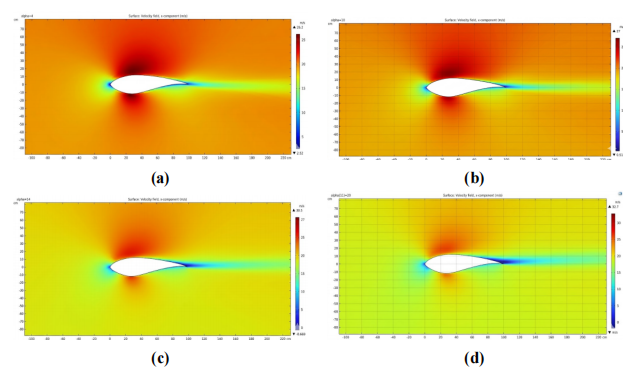
This research presents a comprehensive numerical analysis of the airflow around the S818-NR (subsonic) airfoil, designed for use as wind turbine blades. Numerical simulations were produced using the Finite Element Analysis (FEA) method with the COMSOL Multiphysics simulation software package to determine how subsonic airflow behaves around the S818-NR airfoil. To accurately simulate the turbulence in the airflow around wind turbines, the two-equation Shear Stress Transport (SST) k-omega (k-ω) model was used, it provides a good representation of near-wall and free-stream turbulent flow conditions. The analysis of aerodynamic characteristics enables the evaluation of key parameters, including pressure distribution along the airfoil surface, flow-field velocity components, and lift force coefficients, at different angles of attack. Furthermore, the aerodynamic performance and turbulence structure development of the S818-NR airfoil blade were compared across various Reynolds numbers to determine the influence of flow conditions on these parameters. The aerodynamic validation of the S818-NR airfoil using both FEA simulations and experimental data was within acceptable error limits. Additionally, another focus was on improving our method for determining the various numerical simulation parameters, including mesh refinement level, boundary condition formulation, solver configuration settings, and post-processing methods, to ultimately provide good, stable numerical results with low error throughout the entire numerical process. Ultimately, these findings provide essential insights for accurately predicting turbulent flow around airfoils. This enables developers to create blade designs that maximize aerodynamic performance, significantly improving the energy efficiency and overall reliability of the global renewable energy sector.
References
1. Jaffar HM, Al-Sadawi LA, Khudhair AA, et al. Aerodynamic Characteristics Evaluation of S-Series Airfoils. Engineering and Technology Journal. 2023; 41: 1–13.
2. Guerri O, Bouhadef K, Harhad A. Turbulent flow simulation of the NREL S809 airfoil. Wind Engineering. 2006; 30(4): 287–302.
3. Orozco Murillo W, Palacio-Fernande JA, Patiño Arcila ID, et al. Analysis of a Jet Pump Performance under Different Primary Nozzle Positions and Inlet Pressures Using Two Approaches: One Dimensional Analytical Model and Three Dimensional CFD Simulations. Journal of Applied and Computational Mechanics. 2020; 6: 1228–1244.
4. Feng J, Lin Y, Zhu G, et al. Effect of synthetic jet parameters on flow control of an aerofoil at high Reynolds number. Sādhanā. 2019; 44: 190.
5. Hadad K, Eidi HR, Mokhtari J. VOC level control by ventilation improvement of Flexography printing room using CFD modeling. Journal of Applied and Computational Mechanics. 2017; 3(3): 171–177.
6. Zhang S, Yuan X, Ye D. Analysis of turbulent separated flows for the NREL airfoil using anisotropic two-equation models at higher angles of attack. Wind Engineering. 2001; 25: 41–53.
7. Bertagnolio F, Sørensen N, Johansen J, et al. Wind Turbine Airfoil Catalogue. RISO; 2001.
8. Guilmineau E, Piquet J, Quentey P. Two-dimensional turbulent viscous flow simulation past airfoils at fixed incidence. Computers and Fluids. 1997; 26: 135–162.
9. Hu D, Hua O, Du Z. A study on stall-delay for horizontal axis wind turbine. Renewable Energy. 2006; 31: 821–836.
10. Chaviaropoulos PK, Hansen MOL. Investigating Three-Dimensional and Rotational Effects on Wind Turbine Blades by Means of a Quasi-3D Navier-Stokes Solver. ASME Journal of Fluids Engineering. 2000; 122: 330–336.
11. Maani RE, Radi B, El Hami A. CFD Analysis of the Transonic Flow over a NACA 0012 Airfoil. Uncertainties and Reliability of Multiphysical Systems. 2018; 2(2). doi: 10.21494/ISTE.OP.2018.0307
12. Steenwijk B, Druetta P. Numerical Study of Turbulent Flows over a NACA 0012 Airfoil: Insights into Its Performance and the Addition of a Slotted Flap. Applied Sciences. 2023; 13(13): 7890. doi: 10.3390/app13137890
13. Abdolahifar A, Zanj A. A review of available solutions for enhancing aerodynamic performance in Darrieus vertical-axis wind turbines: A comparative discussion. Energy Conversion and Management. 2025; 327: 119575. doi: 10.1016/j.enconman.2025.119575
14. Kassa BY, Baheta AT, Beyene A. Current Trends and Innovations in Enhancing the Aerodynamic Performance of Small-Scale, Horizontal Axis Wind Turbines: A Review. ASME Open Journal of Engineering. 2024; 3: 031001. doi: 10.1115/1.4064141
15. Dave M, Franck JA. Analysis of dynamic stall development on a cross-flow turbine blade. Physical Review Fluids. 2023; 8: 074702. doi: 10.1103/PhysRevFluids.8.074702
16. Ardaneh F, Abdolahifar A, Karimian S. Numerical analysis of the pitch angle effect on the performance improvement and flow characteristics of the 3-PB Darrieus vertical axis wind turbine. Energy. 2022; 239: 122339.
17. Menter FR. Two-Equation Eddy-Viscosity Turbulence Models for Engineering Applications. AIAA Journal. 1994; 32(8): 1598–1605.
18. NASA. Turbulence Modeling Resource. Available online: http://turbmodels.larc.nasa.gov (accessed on 13 February 2026).
19. Abdolahifar A, Azizi M, Zanj A. Flow structure and performance analysis of Darrieus vertical axis turbines with swept blades: A critical case study on V-shaped blades. Ocean Engineering. 2023; 280: 114857. doi: 10.1016/j.oceaneng.2023.114857
20. Burtsev A, He W, Zhang K, et al. Linear modal instabilities around post-stall swept finite wings at low Reynolds numbers. Journal of Fluid Mechanics. 2022; 944: A6. doi: 10.1017/jfm.2022.420
21. Shashikumar C, Madav V. Numerical and experimental investigation of modified V-shaped turbine blades for hydrokinetic energy generation. Renewable Energy. 2021; 177: 1170–1197. doi: 10.1016/j.renene.2021.05.086
22. Hosseini Rad S, Ghafoorian F, Taraghi M, et al. A systematic study on the aerodynamic performance enhancement in H-type Darrieus vertical axis wind turbines using vortex cavity layouts and deflectors. Physics of Fluids. 2024; 36: 125170. doi: 10.1063/5.0243164
23. Akhlaghi M, Asadbeigi M, Ghafoorian F. Novel CFD and DMST dual method parametric study and optimization of a Darrieus vertical axis wind turbine. Journal of Applied Fluid Mechanics. 2023; 17(1): 205–218. doi: 10.47176/jafm.17.1.1985
24. Farzadi R, Zanj A, Bazargan M. Effect of baffles on efficiency of darrieus vertical axis wind turbines equipped with J-type blades. Energy. 2024; 305: 132305. doi: 10.1016/j.energy.2024.132305
25. Hamdamov MM, Ishnazarov AI, Mamadaliev KA. Numerical modeling of vertical axis wind turbines using ANSYS Fluent software. In: Koucheryavy Y, Aziz A (editors). Lecture Notes in Computer Science. Springer; 2023. 13772, pp. 156–170.
26. Hamdamov M, Muzaffarov S. Simulation of turbulent flow around a thin rectangle using k-ε turbulence and environment models in COMSOL Multiphysics. AIP Conference Proceedings. 2025; 3265: 060013. doi: 10.1063/5.0265168
27. Hamdamov MM, Fayziyev RA, Muzaffarov SS. Numerical simulation of wind turbines conducted using COMSOL software. E3S Web of Conferences. 2024; 541: 01001. doi: 10.1051/e3sconf/202454101001
28. Hand B, Kelly G, Cashman A. Aerodynamic Design and Performance Parameters of a Lift-Type Vertical Axis Wind Turbine: Comprehensive Review. Renewable and Sustainable Energy Reviews. 2021; 139: 110699. doi: 10.1016/j.rser.2020.110699
29. Ravshanov S, Aminov K, Rahmonova N. Simulation of Flow Dynamics in a Gas Network Pipe. AIP Conference Proceedings. 2025; 3265: 060007.
30. Khojiqulov S. Numerical method for solving pipeline transport equations of real fluid under given laws of change of pressure at inlet and mass flow at outlet of pipeline. AIP Conference Proceedings. 2025; 3265: 060004. doi: 10.1063/5.0265139
31. Abdolahifar A, Zanj A. Addressing VAWT Aerodynamic Challenges as the Key to Unlocking Their Potential in the Wind Energy Sector. Energies. 2024; 17(20): 5052. doi: 10.3390/en17205052
Downloads
Published
How to Cite
Issue
Section
License
Copyright (c) 2026 Ismatulla Khujaev, Muzaffar Hamdamov, Sardorbek Muzaffarov, Khushvaqt Maratov

This work is licensed under a Creative Commons Attribution 4.0 International License.





.jpg)
.jpg)