State of charge estimation using extended Kalman filtering approach with sensitivity and energy management assessment for battery electric vehicles
DOI:
https://doi.org/10.18686/cest777Keywords:
extended Kalman filter (EKF); state of charge estimation; battery electric vehicles (BEVs); equivalent circuit model; robust estimation; energy management strategyAbstract
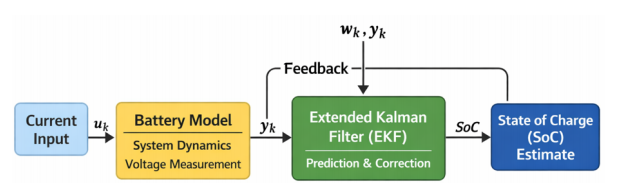
The accurate estimation of State of Charge (SoC) is critical for safe, reliable, and optimistic operation of Battery Electric Vehicles (BEVs). Nevertheless, achieving robust SoC estimation is a big challenge because of nonlinear battery dynamics, parameter variability, sensor noise, and uncertain initial conditions. Standard techniques for measuring the state of charge (SoC), e.g., Coulomb Counting (CC) and Open Circuit Voltage (OCV), tend to drift and are not flexible in rapidly changing operating conditions. In this paper, we propose a model-based SoC estimation framework using an Extended Kalman Filter (EKF) and a second-order Thevenin equivalent circuit model. Previous works propose more sophisticated and hybrid estimation algorithms; the main contribution of this work is a systematic and reproducible assessment of classical EKF performance under various controlled scenarios with respect to disturbances caused by sensor noise, bias, and initialization errors. The EKF implementation is tested on the standardized driving cycles based on the Worldwide Harmonized Light-Duty Vehicle Test Procedure (WLTP), the Urban Dynamometer Driving Schedule (UDDS), and the Highway Fuel Economy Driving Schedule (HWFET) in a MATLAB-based simulation platform. A comparative study with Coulomb Counting is performed under identical disturbance conditions, which enables the identification of regions of operation where the EKF offers robustness benefits. Findings show that Coulomb Counting performs well under ideal conditions but degrades under realistic disturbances, whereas the EKF maintains stable and accurate state estimation, making it more reliable for BEV energy management.
References
1. Ali MU, Zafar A, Nengroo SH, et al. Towards a Smarter Battery Management System for Electric Vehicle Applications: A Critical Review of Lithium-Ion Battery State of Charge Estimation. Energies. 2019; 12(3): 446. doi: 10.3390/en12030446
2. Hannan MA, Lipu MSH, Hussain A, et al. A review of lithium-ion battery state of charge estimation and management system in electric vehicle applications: Challenges and recommendations. Renewable and Sustainable Energy Reviews. 2017; 78: 834–854. doi: 10.1016/j.rser.2017.05.001
3. Suganya R, Joseph LMIL, Kollem S. Understanding lithium-ion battery management systems in electric vehicles: Environmental and health impacts, comparative study, and future trends: A review. Results in Engineering. 2024; 24: 103047. doi: 10.1016/j.rineng.2024.103047
4. Yu DX, Gao YX. SOC Estimation of Lithium-Ion Battery Based on Kalman Filter Algorithm. In: Proceedings of the 2nd International Conference on Computer Science and Electronics Engineering (ICCSEE 2013); 22–23 March 2013; Hangzhou, China. doi: 10.2991/iccsee.2013.580
5. Mossaddek M, Laadissi EM, Bouzaid S, et al. Efficient SOC estimation for electric vehicles: Extended Kalman filter approach for lithium-ion battery systems. International Journal of Power Electronics and Drive Systems (IJPEDS). 2025; 16(1): 440. doi: 10.11591/ijpeds.v16.i1.pp440-447
6. Zhang Y, Wu H, Ye C. Estimation of SoC of lithium batteries based on IFA-EKF. Energy Storage Sci. Technol. 2020; 9(1): 117–123. Available online: https://esst.cip.com.cn/CN/10.12028/j.issn.2095-4239.2019.0127 (in Chinese)
7. Chang Z, Yin Q, Gan J, et al. Review of SOC estimation methods for lithium battery based on EKF. In: Proceedings of the 2021 IEEE 4th Advanced Information Management, Communicates, Electronic and Automation Control Conference (IMCEC); 18–20 June 2021; Chongqing, China. pp. 1319–1326. doi: 10.1109/IMCEC51613.2021.9482085
8. Monirul IM, Qiu L, Ruby R, et al. Accurate SOC estimation in power lithium-ion batteries using adaptive extended Kalman filter with a high-order electrical equivalent circuit model. Measurement. 2025; 249: 117081. doi: 10.1016/j.measurement.2025.117081
9. Fu Y, Zhai B, Shi Z, et al. State of Charge Estimation of Lithium-Ion Batteries Based on an Adaptive Iterative Extended Kalman Filter for AUVs. Sensors. 2022; 22(23): 9277. doi: 10.3390/s22239277
10. Zuo Z, Wang J, Liu Z, et al. A joint estimation method for state of charge in lithium-ion batteries based on physics-informed neural network and improved intelligent adaptive Kalman filtering. Journal of Energy Storage. 2026; 144: 119805. doi: 10.1016/j.est.2025.119805
11. Li C. SOC estimation of lithium battery based on EKF and UKF. Food-Energy-Water Nexus. 2025; 1(2): 1–11. doi: 10.63808/fewn.v1i2.191
12. Yang Q, Ma K, Xu L, et al. A Joint Estimation Method Based on Kalman Filter of Battery State of Charge and State of Health. Coatings. 2022; 12(8): 1047. doi: 10.3390/coatings12081047
13. Wang H, Zheng Y, Yu Y. Lithium-Ion Battery SOC Estimation Based on Adaptive Forgetting Factor Least Squares Online Identification and Unscented Kalman Filter. Mathematics. 2021; 9(15): 1733. doi: 10.3390/math9151733
14. Wang Y, Wang S, Fan Y, et al. A Novel Adaptive Back Propagation Neural Network-Unscented Kalman Filtering Algorithm for Accurate Lithium-Ion Battery State of Charge Estimation. Metals. 2022; 12(8): 1369. doi: 10.3390/met12081369
15. Zhu M, Wang Y, Wang D. SOC Prediction of Li-Ion Battery Based on EKF and CNN-BiLSTM-Attention. ACS Omega. 2025; 10(47): 57157–57168. doi: 10.1021/acsomega.5c06451
16. Fandi G, Novák J, Chyský J. Modeling electric Vehicle’s and improving battery lifetime using AI tools case study: Postal cars. Heliyon. 2024; 10(15): e34792. doi: 10.1016/j.heliyon.2024.e34792
17. Ping G. Modeling and Simulation of Pure Electric Passenger Vehicle Based on MATLAB and AVL CRUISE. Journal of Engineering Research and Reports. 2023; 25(5): 41–54. doi: 10.9734/jerr/2023/v25i5910
18. Palwe RB, Kodgire SP, Borole AS, et al. Simulation of Battery Monitoring System for the Estimation of Battery Health and Average Soc of Battery Pack. Journal of Electrical Systems. 2024; 18(2): 272–277. doi: 10.52783/jes.9173
19. Paglan AJL, Ewo RCGN, Naoussi SRD. Co-simulation methodology for electric vehicles using Matlab and Webots : Case of a golf car. Advances in Electrical Engineering, Electronics and Energy. 2024; 10: 100848. doi: 10.1016/j.prime.2024.100848
20. Nandedkar V, Chaudhary D, Savalkar V, et al. MATLAB-Based Simulation and Design of Electric Vehicle Battery Pack: SOC and SOH Estimation. GRENZE International Journal of Engineering and Technology. 2025; 11: 327–333.
21. Hitesh S, Sunanda C. Modeling and performance analysis of an electric vehicle with MATLAB/Simulink. International Research Journal of Engineering and Technology (IRJET). 2020; 7(6). Available online: https://www.irjet.net/archives/V7/i6/IRJET-V7I6204.pdf
22. Wankhade AV. Simulation for Battery Electric Vehicle using MATLAB. International Journal for Research in Applied Science and Engineering Technology. 2021; 9(VI): 2100–2103. doi: 10.22214/ijraset.2021.35446
23. Zhou J, Shen X, Liu D. Modeling and simulation for electric vehicle powertrain controls. In: Proceedings of the 2014 IEEE Conference and Expo Transportation Electrification Asia-Pacific (ITEC Asia-Pacific); 31 August–3 September 2014; Beijing, China. pp. 1–4. doi: 10.1109/ITEC-AP.2014.6940824
24. Berecibar M, Gandiaga I, Villarreal I, et al. Critical review of state of health estimation methods of Li-ion batteries for real applications. Renewable and Sustainable Energy Reviews. 2016; 56: 572–587. doi: 10.1016/j.rser.2015.11.042
25. Dineva A. Evaluation of Advances in Battery Health Prediction for Electric Vehicles from Traditional Linear Filters to Latest Machine Learning Approaches. Batteries. 2024; 10(10): 356. doi: 10.3390/batteries10100356
26. Wang W, Li J, Liu G, et al. Simulation Study on Vehicle Ride Comfort Based on Finite Element Model and Pseudo-Excitation Method. International Journal of Automotive Technology. 2023; 24(4): 1163–1174. doi: 10.1007/s12239-023-0095-5
27. Yang B, Wang Y, Zhan Y. Lithium Battery State-of-Charge Estimation Based on a Bayesian Optimization Bidirectional Long Short-Term Memory Neural Network. Energies. 2022; 15(13): 4670. doi: 10.3390/en15134670
28. Shen P, Ouyang M, Lu L, et al. The Co-estimation of State of Charge, State of Health, and State of Function for Lithium-Ion Batteries in Electric Vehicles. IEEE Transactions on Vehicular Technology. 2018; 67(1): 92–103. doi: 10.1109/TVT.2017.2751613
29. Hu L, Hu R, Ma Z, et al. State of Charge Estimation and Evaluation of Lithium Battery Using Kalman Filter Algorithms. Materials. 2022; 15(24): 8744. doi: 10.3390/ma15248744
30. Pei S, Yang J. Multi-objective Velocity Trajectory Optimization Method for Autonomous Mining Vehicles. International Journal of Automotive Technology. 2023; 24(6): 1627–1641. doi: 10.1007/s12239-023-0131-5
Downloads
Published
How to Cite
Issue
Section
License
Copyright (c) 2026 Mazhar Hussain Shaik, Shafiq Ul Rehman, Imran Mohd Ibrahim

This work is licensed under a Creative Commons Attribution 4.0 International License.





.jpg)
.jpg)