Predictive modeling of terrestrial radiation for optimizing solar-powered irrigation under limited data in Adrar region (Algeria)
DOI:
https://doi.org/10.18686/cest783Keywords:
terrestrial radiation; machine learning; random forest; solar irrigation; Adrar region; hyper arid agriculture; renewable energyAbstract
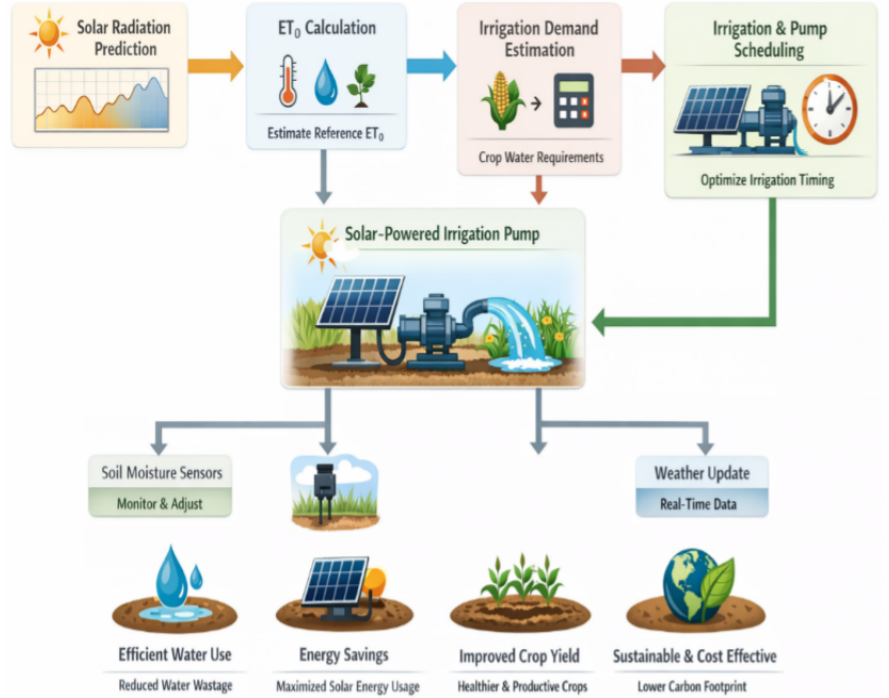
An accurate estimation of the radiation is a prerequisite for the net radiation balance, evapotranspiration modeling, and optimal scheduling of water extraction by solar-powered irrigation, especially in the water-scarce Saharan zone. In this study, we developed a predictive model to estimate daily terrestrial radiation at the surface of the Adrar region in Algeria. We used a training set of 25 years of data (2000–2025) from 10 stations (Adrar, Tamantit, Sidi Ahmed Timmi, Fenoughil, Zaouiet Kounta, Reggane, Gharmianou, Tittaf, Ikiss, Kassbet Lahrar) with only three features: soil temperature (0–7 cm), air temperature (2 m), and vapor pressure deficit. The robustness of the models was ensured by a time-based split. The random forest (RF), gradient boosting (GB), and extra trees (ET) tree-based models were evaluated on the generalization set. RF and ET exhibited the best performance (R = 0.92, rootean square error—RMSE = 31.85 W/m2, Nash–Sutcliffe efficiency—NSE = 0.84 for RF; R = 0.92, RMSE = 32.33 W/m2, NSE = 0.84 for ET), whereas GB exhibited poor performance (R = 0.90, RMSE = 36.67 W/m2, NSE = 0.79). Finally, we proposed a map for solar-powered irrigation optimization. In particular, we demonstrated that the southern part of the Adrar region (Reggane, Zaouiet Kounta) has high potential for solar-powered irrigation (more than 350 W/m2). This study contributes to hyper-arid agricultural regions in Algeria through water conservation and the utilization of renewable energy.
References
1. Mezouane H, Hank D, Delli R. Agricultural Water Management under Water Scarcity in Algeria: Practices and Future Perspectives. The Open Agriculture Journal. 2026; 20: e18743315442659. doi: 10.2174/0118743315442659251120053241
2. Bouregaa T. Trends in climatic variables and machine learning based reference evapotranspiration predictions in key cereal producing regions of Algeria. Theoretical and Applied Climatology. 2025; 156: 351. doi: 10.1007/S00704-025-05561-5
3. Agadi R, Sakhraoui K, von Hirschhausen C, et al. Sustainable Farming through Decentralized Energy Systems: Opportunities and barriers—The Promise of the WEF nexus approach in Algeria's Energy Transformation. E3S Web of Conferences. 2023; 433: 03001. doi: 10.1051/e3sconf/202343303001
4. Burney J, Woltering L, Burke M, et al. Solar-powered drip irrigation enhances food security in the Sudano-Sahel. Proceedings of the National Academy of Sciences. 2010; 107(5): 1848–1853. doi: 10.1073/pnas.0909678107
5. Benatallah M, Bailek N, Bouchouicha K, et al. Solar Radiation Prediction in Adrar, Algeria: A Case Study of Hybrid Extreme Machine-Based Techniques. International Journal of Engineering Research in Africa. 2024; 68: 151–164. doi: 10.4028/p-VH0u4y
6. Raza A, Fahmeed R, Syed NR, et al. Performance Evaluation of Five Machine Learning Algorithms for Estimating Reference Evapotranspiration in an Arid Climate. Water. 2023; 15(21): 3822. doi: 10.3390/W15213822
7. Ahmad MW, Reynolds J, Rezgui Y. Predictive modelling for solar thermal energy systems: A comparison of support vector regression, random forest, extra trees and regression trees. Journal of Cleaner Production. 2018; 203: 810–821. doi: 10.1016/j.jclepro.2018.08.207
8. Voyant C, Notton G, Kalogirou S, et al. Machine learning methods for solar radiation forecasting: A review. Renewable and Sustainable Energy Reviews. 2017; 105: 569–582. doi: 10.1016/j.renene.2016.12.095
9. Benmedjahed M, Dahbi A, Hadidi A, et al. Adrar initial state investigation for the use of renewable energies in irrigation systems. International Journal of Sustainable Development and Planning. 2023; 18(6): 1671–1680. doi: 10.18280/ijsdp.180603
10. Lakhdari AS, Bouselsal B, Saibi H, et al. Assessment of groundwater quality and hydrogeochemical properties in the Adrar Continental Intercalaire aquifer of the Algerian Sahara. Applied Water Science. 2025; 15: 175. doi: 10.1007/s13201-025-02552-9
11. Sabater JM. ERA5-Land Hourly Data from 1950 to Present. Climate Data Store; 2019. doi: https://doi.org/10.24381/cds.e2161bac
12. Jiang H, Yang Y, Bai Y, et al. Evaluation of the total, direct, and diffuse solar radiations from the ERA5 reanalysis data in China. IEEE Geoscience and Remote Sensing Letters. 2020; 17(1): 47–51. doi: 10.1109/LGRS.2019.2916410
13. Hersbach H, Bell B, Berrisford P, et al. The ERA5 global reanalysis. Quarterly Journal of the Royal Meteorological Society. 2020; 146(730): 1999–2049. doi: 10.1002/qj.3803
14. Muñoz-Sabater J, Dutra E, Agustí-Panareda A, et al. ERA5-Land: A state-of-the-art global reanalysis dataset for land applications. Earth System Science Data. 2021; 13(9): 4349–4383. doi: 10.5194/essd-13-4349-2021
15. Fan J, Zheng J, Wu L, et al. Estimation of daily maize transpiration using support vector machines, extreme gradient boosting, artificial and deep neural networks models. Agricultural Water Management. 2021; 245: 106547. doi: 10.1016/j.agwat.2020.106547
16. Roberts DR, Bahn V, Ciuti S, et al. Cross-validation strategies for data with temporal, spatial, hierarchical, or phylogenetic structure. Ecography. 2017; 40(8): 913–929. doi: 10.1111/ecog.02881
17. Zhou L, Dickinson RE, Tian Y, et al. Impact of vegetation removal and soil aridation on diurnal temperature range in a semiarid region: Application to the Sahel. Proceedings of the National Academy of Sciences (PNAS). 2007; 104(46): 17937–17942. doi: 10.1073/pnas.0700290104
18. Moriasi DN, Arnold JG, Van Liew MW, et al. Model evaluation guidelines for systematic quantification of accuracy in watershed simulations. Transactions of the ASABE. 2007; 50(3): 885–900. doi: 10.13031/2013.23153
19. Wu L, Fan J. Comparison of neuron-based, kernel-based, tree-based and curve-based machine learning models for predicting daily reference evapotranspiration. Plos One. 2019; 5: e0217520. doi: 10.1371/journal.pone.0217520
20. Navarro-González FJ, Manzano J, Pardo M. Sizing optimisation under irradiance uncertainty of irrigation systems powered by off-grid solar panels. Computers and Electronics in Agriculture. 2025; 232: 110034. doi: 10.1016/j.compag.2025.110034
21. Lorite IJ, Ramírez-Cuesta JM, Cruz-Blanco M, et al. Using weather forecast data for irrigation scheduling under semi-arid conditions. Irrigation Science. 2015; 33: 411–427. doi: 10.1007/s00271-015-0478-0
22. Awais M, Mahum R, Zhang H, et al. Short-term photovoltaic energy generation for solar powered high efficiency irrigation systems using LSTM with Spatio-temporal attention mechanism. Scientific Reports. 2024; 14: 10042. doi: 10.1038/s41598-024-60672-9
23. Das S, Kaur S, Raheja A, et al. Development of machine learning-based reference evapotranspiration models for for the semi-arid region of Punjab, India. Research Square. 2023; doi: 10.21203/rs.3.rs-1908594/v1
24. Sezen İ, Karahan A, Akpınar Külekçi E, et al. Effect of limited irrigation on growth parameters of Antirrhinum majus plants. Journal of Tekirdag Agricultural Faculty. 2024; 21(4): 1017–1032. doi: 10.33462/jotaf.1402676
25. Sezen I, Yağanoğlu S, Akpınar Külekçi E, et al. Effect of deficit irrigation on growth parameters of the Salvia splendens L. plant. Water. 2023; 15(23): 4187. doi: 10.3390/w15234187
26. Bouzidi B. Viability of solar or wind for water pumping systems in the Algerian Sahara regions—Case study Adrar. Renewable and Sustainable Energy Reviews. 2011; 15(9): 4436–4442. doi: 10.1016/j.rser.2011.07.108
27. Bediar S, Harrouz A, Belatrache D. Design and simulation of solar pumping system using PVsyst, case study: TSABIT–ADRAR in Algeria. Algerian Journal of Signals and Systems. 2024; 9(2): 47–56. doi: 10.51485/ajss.v9i2.210
28. Campana PE, Li H, Zhang J, et al. Economic optimization of photovoltaic water pumping systems for irrigation. Energy Conversion and Management. 2015; 95: 32–41. doi: 10.1016/j.enconman.2015.01.066
Downloads
Published
How to Cite
Issue
Section
License
Copyright (c) 2026 Assia Meziani, Nabil Mega, Abdelmonen Miloudi, António Canatário Duarte

This work is licensed under a Creative Commons Attribution 4.0 International License.





.jpg)
.jpg)