International cooperation, energy transition and green growth in the MENA region: A panel data analysis
DOI:
https://doi.org/10.18686/cest790Keywords:
international cooperation , energy transition , green growth , MENA countries , panel ARDLAbstract
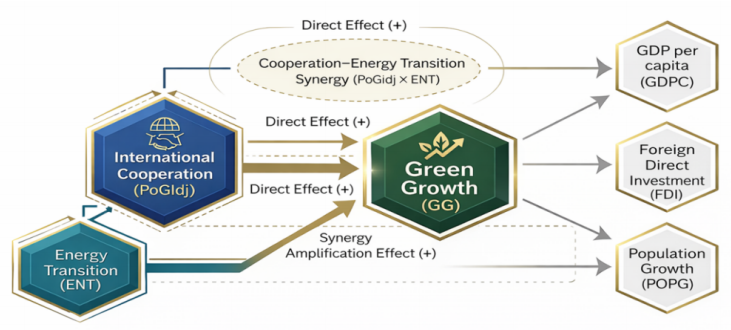
This paper examines the effects of international cooperation and energy transition on green growth in 15 Middle East and North Africa (MENA) countries over the period 1990–2023. Green growth is proxied by production-based CO2 emissions, where higher emissions indicate lower green growth performance; consequently, a positive coefficient on any explanatory variable indicates an increase in emissions, whereas a negative coefficient indicates the opposite. The panel Autoregressive Distributed Lag (ARDL) framework is employed, using Mean Group (MG), Pooled Mean Group (PMG), and Dynamic Fixed Effects (DFE) estimators to capture both short- and long-run dynamics. The Hausman test favors the PMG estimator as the most appropriate specification. The empirical results confirm a long-run cointegrating relationship between green growth, political globalization (international cooperation), renewable energy consumption (energy transition), Gross Domestic Product (GDP) per capita, Foreign Direct Investment (FDI) and population growth. In the long-run, both international cooperation and energy transition make significant positive contributions to green growth. economic growth and population growth similarly contribute to emissions reduction, suggesting that structural change and technological advancement have improved environmental performance. FDI, by contrast, does not exhibit a significant long-run effect. Short-run responses are largely insignificant, confirming that environmental improvements materialize gradually through structural and institutional changes. Overall, the findings underscore that advancing green growth in MENA countries requires sustained international cooperation, accelerated renewable energy deployment, and long-term economic structure reform. The results carry important policy implications for sustainable development and low-carbon transitions across the region.
References
1. International Energy Agency. World Energy Outlook 2023. Available online: https://www.iea.org/reports/world-energy-outlook-2023 (accessed on 2 February 2026).
2. Albaker A, Abbasi KR, Haddad AM, et al. Analyzing the impact of renewable energy and green innovation on carbon emissions in the MENA region. Energies. 2023; 16(16): 6053. doi: 10.3390/en16166053
3. Hickel J, Kallis G. Is Green Growth Possible? New Political Economy. 2020; 25(4): 469486.
4. Peng S, Qian J, Xing X, et al. Technological cooperation for sustainable development under the Belt and Road Initiative and the Sustainable Development Goals: Opportunities and challenges. Sustainability. 2025; 17(2): 657. doi: 10.3390/su17020657
5. Neffati M, Kaddachi H. The impact of environmental policies, research and development, and legal regulations on promoting economic green growth in OECD countries. International Journal of Environmental Impacts. 2026; 9(1): 200–215. doi: 10.56578/ijei090116
6. Gielen D, Francisco B, Saygin D, et al. The role of renewable energy in the global energy transformation. Energy Strategy Reviews. 2019; 24: 38–50. doi: 10.1016/j.esr.2019.01.006
7. Gygli S, Haelg F, Potrafke N, et al. The KOF Globalisation Index-revisited. The Review of International Organizations. 2019; 14(3): 543–574. doi: 10.1007/s11558-019-09344-2
8. Keohane RO. After Hegemony: Cooperation and Discord in the World Political Economy. Princeton University Press; 1984.
9. Belabbas R, Zaghdoud O, Lefilef A, et al. Decoupling Economic Expansion from Environmental Degradation: A Panel ARDL Analysis of Renewable Energy’s Role in Arab MENA Countries. International Journal of Environmental Impacts. 2025; 8(1): 173–183. doi: 10.18280/ijei.080117
10. Wang M, Hossain MR, Si Mohammed K, et al. Heterogeneous Effects of Circular Economy, Green Energy and Globalization on CO₂ Emissions: Policy based analysis for sustainable development. Renewable Energy. 2023; 211: 789–801. doi: 10.1016/j.renene.2023.05.033
11. Neffati M, Khemiri I. Examining the factors enhancing green growth in BRICS economies: interplay between economic globalization, renewable energy use, and government efficiency. International Journal of Energy Economics and Policy. 2025; 15(2): 735–745. doi: 10.32479/ijeep.18428
12. Romer P. Endogenous Technological Change. Journal of Political Economy. 1990; 98(2): 71–102. doi: 10.1086/261725
13. OECD. Towards Green Growth. OECD Publishing; 2011. doi: 10.1787/9789264111318-en
14. World Bank. Inclusive Green Growth: The Pathway to Sustainable Development. World Bank; 2012.
15. United Nations Environment Programme. Towards a Green Economy: Pathways to Sustainable Development and Poverty Eradication—A Synthesis for Policy Makers. UNEP; 2011. Available online: https://wedocs.unep.org/20.500.11822/32245
16. Bayer P, Aklin M. The European Union Emissions Trading System Reduced CO2 Emissions Despite Low Prices. Proceedings of the National Academy of Sciences. 2020; 117(16): 8804–8812. doi: 10.1073/pnas.1918128117
17. Bernauer T, Böhmelt T. Are Economically ‘Kinder, Gentler Societies’ Also Greener? Environmental Science & Technology. 2013; 47(21): 11993–12001.
18. Steckel JC, Jakob M, Flachsland C, et al. From climate finance toward sustainable development finance. WIREs Climate Change. 2017; 8(1): e437. doi: 10.1002/wcc.437
19. Weikmans R, Roberts JT. The international climate finance accounting muddle: is there hope on the horizon? Climate and Development. 2019; 11(2): 97–111. doi: 10.1080/17565529.2017.1410087
20. Morin JF, Laurens N, Brandi C, et al. Using Trade Provisions to Make Environmental Agreements More Dynamic. International Studies Quarterly. 2025; 69(1). Available online: https://academic.oup.com/isq/article-pdf/69/1/sqaf010/62051659/sqaf010.pdf
21. Pienknagura S. Climate Policies as a Catalyst for Green FDI. International Monetary Fund Working Paper. 2024; 2024(46). doi: 10.5089/9798400269448.001
22. Hasna Z, Jaumotte F, Kim J, et al. Green innovation and diffusion: Policies to accelerate them and expected impact on macroeconomic and firm-level performance. International Monetary Fund Staff Discussion Note. 2023; 2023(8). doi: 10.5089/9798400256950.006
23. Li W, Wu D. Sustainability through business model innovation and climate finance in developing countries. Humanities and Social Sciences Communications. 2025; 12: 66. doi: 10.1057/s41599-024-04297-3
24. Shi Y, Yang B. Green finance instruments and empowering sustainability in East Asian economies. Humanities and Social Sciences Communications. 2025; 12(11). doi: 10.1057/s41599-024-04324-3
25. Abbas Q, HongXing Y, Ramzan M, et al. BRICS and the climate challenge: Navigating the role of factor productivity and institutional quality in CO₂ emissions. Environmental Science and Pollution Research. 2024; 31(3): 4348–4364. doi: 10.1007/s11356-023-31321-x
26. Lu Y, Ahmad S, Noureen S, et al. Green Growth and Sustainable Energy Transitions: evaluating the critical role of technology, resource efficiency, and innovation in Europe’s low-carbon future. Humanities and Social Sciences Communications. 2025; 12: 1527. doi: 10.1057/s41599-025-05823-7
27. Wang S, Tian G. Does renewable energy consumption reduce the energy security risk? Energy. 2025; 320(10): 135182. doi: 10.1016/j.energy.2025.135182
28. Abankwah SA, Afriyie SO. Modelling Sustainable Energy Transition in BRICS+ Countries: A Smoothed Common Correlated Effects Instrumental Variable Quantile Regression Approach. MPRA Paper 123758. University Library of Munich; 2025. Available online: https://mpra.ub.uni-muenchen.de/123758/1/MPRA_paper_123758.pdf
29. Xia S. The link and spillovers between clean energy and fossil fuels market: a systematic literature review. Journal of Accounting Literature. 2022; 44(2–3): 177–191. doi: 10.1108/JAL-08-2022-0087
30. Zhang W, Zhu B, Li Y, et al. Revisiting the Porter hypothesis: a multi-country meta-analysis of the relationship between environmental regulation and green innovation. Humanities and Social Sciences Communications. 2024; 11(1): 232. doi: 10.1057/s41599-024-02671-9
31. Mealy P, Teytelboym A. Economic complexity and the green economy. Research Policy. 2022; 51(8): 103948.
32. Aklin M, Urpelainen J. Renewable: The Politics of a Global Energy Transition. MIT Press; 2018. doi: 10.7551/mitpress/11112.001.0001
33. Meckling J, Allan BB. The evolution of ideas in global climate policy. Nature Climate Change. 2020; 10: 434–438. doi: 10.1038/s41558-020-0739-7
34. Bhattacharya M, Paramati SR, Ozturk I, et al. The effect of renewable energy consumption on economic growth: Evidence from top 38 countries. Applied Energy. 2016; 162: 733–741. doi: 10.1016/j.apenergy.2015.10.104
35. Newell P, Srivastava S, Naess LO, et al. Towards Transformative Climate Justice: Key Challenges and Future Directions for Research. IDS Working Paper 540. Institute of Development Studies; 2020.
36. Buchner B, Wetherbee C, Stout S. Global Landscape of Climate Finance 2023. Climate Policy Initiative; 2023. Available online: https://www.climatepolicyinitiative.org/publication/global-landscape-of-climate-finance-2023
37. Baloch AM, Ozturk I, Bekun VF, et al. Modeling the dynamic linkage between financial development, energy innovation, and environmental quality: Does globalization matter? Business Strategy and the Environment. 2021; 30(1): 176–184. doi: 10.1002/bse.2615
38. Acheampong AO, Shahbaz M, Dzator J, et al. Effects of income inequality and governance on energy poverty alleviation: Implications for sustainable development policy. Utilities Policy. 2022; 78: 101403. doi: 10.1016/j.jup.2022.101403
39. Ristanovic V, Primorac D, Kanizaj HI. Economic Growth, Green Competitiveness and Institutional Quality in Post-2004 EU States: Panel ARDL-PMG Analysis. Economies. 2025; 13(12): 337. doi: 10.3390/economies13120337
40. Omar SM, Khalifa WMS, Oz T. From Fossil Dependence on Sustainability: The Effects of Energy Transition, Green Growth, and Financial Inclusion on Environmental Degradation in the MENA Region. Energies. 2025; 18(14): 3668. doi: 10.3390/en18143668
41. Priyadi U, Susantun I, Shidiqie JSA. The Impact of Policy Quality and Political Stability on Foreign Direct Investment in ASEAN Countries: An Institutional Economics Analysis. Journal of Ecohumanism. 2024; 3(6): 1561–1572. doi: 10.62754/joe.v3i6.4104
42. Al-Sarihi A, Mansouri N. Renewable Energy Development in the Gulf Cooperation Council Countries: Status, Barriers, and Policy Options. Energies. 2022; 15(5): 1923. doi: 10.3390/en15051923
43. Stern DI. The Environmental Kuznets Curve after 25 years. Journal of Bioeconomics. 2017; 19(1): 7–28. doi: 10.1007/s10818-017-9243-1
44. Shahbaz M, Nasreen S, Abbas F, et al. Does foreign direct investment impede environmental quality in high-, middle-, and low-income countries? Energy Economics. 2015; 51: 275–287. doi: 10.1016/j.eneco.2015.06.014
45. Tomashuk I, Baldynyuk V, Boltovska L. Green Economy As A Factor Of Sustainable Development. Baltic Journal of Economic Studies. 2023; 9(3): 194–206. doi: 10.30525/2256-0742/2023-9-3-194-206
46. Khemiri I, Neffati M. The Impact of Digital Economy on Green Growth in the Kingdom of Saudi Arabia. Economics-Innovative and Economics Research Journal. 2025; 13(3): 261–282. doi: 10.2478/eoik-2025-0065
47. Nathaniel SP, Alam MS, Murshed M, et al. The roles of nuclear energy, renewable energy, and economic growth in the abatement of carbon dioxide emissions in the G7 countries. Environmental Science and Pollution Research. 2021; 28(35): 47957–47972. doi: 10.1007/s11356-021-13728-6
48. Wang Z, Zhu Y. Do energy technology innovations contribute to CO2 emissions abatement? A spatial perspective. Science of the Total Environment. 2020; 726: 138574. doi: 10.1016/j.scitotenv.2020.138574
49. Pesaran MH, Smith RP. Estimating long-run relationships from dynamic heterogeneous panels. Journal of Econometrics. 1995; 68(1): 79–113. doi: 10.1016/0304-4076(94)01644-F
50. Pesaran MH, Shin Y, Smith RP. Pooled mean group estimation of dynamic heterogeneous panels. Journal of the American Statistical Association. 1999; 94(446): 621–634. doi: 10.1080/01621459.1999.10474156
51. World Bank. World Bank Open Data. World Bank; 2023. Available online: https://data.worldbank.org
52. Wooldridge JM. Econometric Analysis of Cross Section and Panel Data. MIT Press; 2010. Available online: http://www.jstor.org/stable/j.ctt5hhcfr
53. Pesaran MH. A simple panel unit root test in the presence of cross-section dependence. Journal of Applied Econometrics. 2007; 22(2): 265–312. doi: 10.1002/jae.951
54. Pedroni P. Critical Values for Cointegration Tests in Heterogeneous Panels with Multiple Regressors. Oxford Bulletin of Economics and Statistics. 1999; 61(S1): 653–670.
55. Pedroni P. Panel Cointegration: Asymptotic and Finite Sample Properties of Pooled Time Series Tests with an Application to the PPP Hypothesis. Econometric Theory. 2004; 20(3): 597–625.
56. Kao C. Spurious Regression and Residual-Based Tests for Cointegration in Panel Data. Journal of Econometrics. 1999; 90(1): 1–44. doi: 10.1016/S0304-4076(98)00023-2
57. Markard J, Raven R, Truffer B. Sustainability transitions: An emerging field of research and its prospects. Research Policy. 2012; 41(6): 955–967. doi: 10.1016/j.respol.2012.02.013
58. Oberthür S, Stokke OS. Managing Institutional Complexity: Regime Interplay and Global Environmental Change. MIT Press; 2011.
59. Dechezleprêtre A, Glachant M, Haščič I, et al. Invention and Transfer of Climate Change-Mitigation Technologies: A Global Analysis. Review of Environmental Economics and Policy. 2011; 5(1): 109–130. doi: 10.1093/reep/req023
60. Ahmad M, Wu Y. Combined Role of Green Productivity Growth, Economic Globalization, and Eco-Innovation in Achieving Ecological Sustainability for OECD Economies. Journal of Environmental Management. 2022; 302(A): 113980. doi: 10.1016/j.jenvman.2021.113980
61. Apergis N, Payne JE. Renewable energy consumption and economic growth: Evidence from a panel of OECD countries. Energy Policy. 2010; 38(1): 656–660. doi: 10.1016/j.enpol.2009.09.002
62. Grossman GM, Krueger AB. Economic growth and the environment. The Quarterly Journal of Economics. 1995; 110(2): 353–377. doi: 10.2307/2118443
63. York R, Rosa EA, Dietz T. STIRPAT, IPAT and ImPACT: Analytic tools for unpacking the driving forces of environmental impacts. Ecological Economics. 2003; 46(3): 351–365. doi: 10.1016/S0921-8009(03)00188-5
64. Cole MA, Elliott RJR. FDI and the capital intensity of dirty sectors: A missing piece of the pollution haven puzzle. Review of Development Economics. 2005; 9(4): 530–548. doi: 10.1111/j.1467-9361.2005.00292.x
65. Barrett S. Environment and Statecraft: The Strategy of Environmental Treaty-Making. Oxford University Press; 2003.
Downloads
Published
How to Cite
Issue
Section
License
Copyright (c) 2026 Sahbi Gabsi, Mohamed Neffati

This work is licensed under a Creative Commons Attribution 4.0 International License.





.jpg)
.jpg)