Environmental sustainability in Asian economies: The role of ICT trade, energy transition, and sustainable development
DOI:
https://doi.org/10.18686/cest791Keywords:
ICT-trade openness; renewable energy consumption; energy efficiency; clean cooking fuel access; sustainable development; environmental quality; Asian countriesAbstract
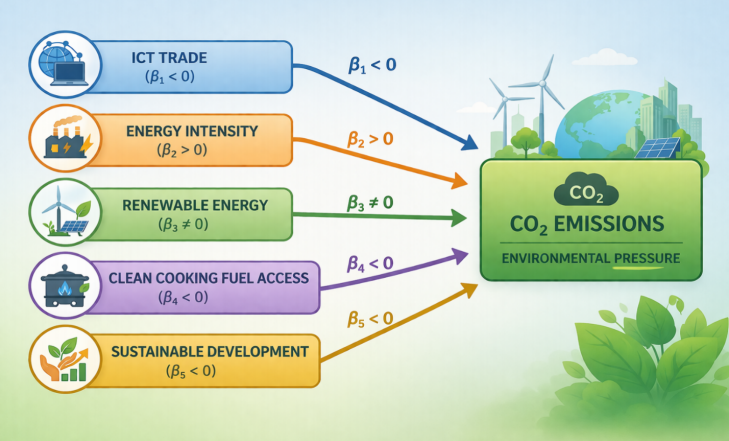
This study examines the determinants of environmental pressure in selected Asian economies, with a focus on the roles of Information and Communication Technology (ICT) trade openness, energy intensity, renewable energy consumption, access to clean cooking fuels, and sustainable development. Using a balanced panel dataset and estimation techniques robust to cross-sectional dependence and heterogeneity, namely Panel Corrected Standard Errors and Feasible Generalized Least Squares, CO₂ emissions per capita are employed as a proxy for environmental pressure. The empirical results indicate a differentiated pattern of environmental dynamics. The ICT trade is found to be negatively associated with emissions, suggesting that technological diffusion improves production efficiency and reduces environmental pressure. In contrast, energy intensity exhibits a strong positive relationship with emissions, confirming that inefficient energy use remains a central driver of environmental degradation. Renewable energy consumption shows a positive association with emissions, reflecting the dominance of scale effects and the limited substitution away from fossil fuels in the early stages of energy transition. Access to clean cooking fuels contributes to lower emissions, highlighting the importance of household-level energy transition. Sustainable development is also associated with reduced environmental pressure, although its effect appears gradual and context-dependent. The findings suggest that environmental sustainability in Asian economies depends on the interaction between technological openness, energy structure, and structural transformation. Policies should prioritize improving energy efficiency, ensuring effective substitution toward clean energy, strengthening absorptive capacity for technological adoption, and promoting inclusive access to modern energy services.
References
1. Hou K, Waqas M. Assess the economic and environmental impacts of the energy transition in selected Asian economies. Energies. 2024; 17(20): 5103. doi: 10.3390/en17205103
2. Pandey A, Asif M. Assessment of energy and environmental sustainability in South Asia in the perspective of the Sustainable Development Goals. Renewable and Sustainable Energy Reviews. 2022; 165: 112492. doi: 10.1016/j.rser.2022.112492
3. Zhang Y. The impact of energy transition and eco-innovation on environmental sustainability: A solution for sustainable cities and communities of top ten Asian countries. Engineering Economics. 2023; 34(1): 32–45. doi: 10.5755/j01.ee.34.1.32161
4. Li K, Lin B. Impacts of urbanization and industrialization on energy consumption/CO₂ emissions: OES the level of development matter? Energy Economics. 2015; 52: 1107–1122. doi: 10.1016/j.rser.2015.07.185
5. Avom D, Nkengfack H, Fotio HK, et al. ICT and environmental quality in Sub-Saharan Africa: Effects and transmission channels. Technological Forecasting and Social Change. 2020; 155: 120028. doi: 10.1016/j.techfore.2020.120028
6. Akram R, Chen F, Khalid F, et al. Heterogeneous effects of energy efficiency and renewable energy on carbon emissions: Evidence from developing countries. Journal of Cleaner Production. 2020; 247: 119122. doi: 10.1016/j.jclepro.2019.119122
7. Dogan E, Seker F, Bulbul S. Investigating the impacts of energy consumption, real GDP, tourism and trade on CO₂ emissions by accounting for cross-sectional dependence: A panel study of OECD countries. Current Issues in Tourism. 2017; 20(16): 1701–1719.
8. Khan I, Hou F, Le HP. The impact of natural resources, energy consumption, and population growth on environmental quality: Fresh evidence from the United States of America. Science of the Total Environment. 2020; 754: 142222. doi: 10.1016/j.scitotenv.2020.142222
9. Qudrat-Ullah H, Nevo CM. The impact of Renewable energy consumption and environmental sustainability on economic growth in Africa. Environmental Science and Pollution Research. 2023; 7: 3877–3886.
10. Ul Haq I, Nusratillayevich SO, Kuruppuge RH. Energy intensity, tourism development, and environmental degradation: Further evidence from Small Island State in South Asia. International Journal of Energy Technology and Policy. 2022; 18(2): 163–178. doi: 10.1504/IJETP.2022.124370
11. Mughal N, Arif A, Jain V, et al. The role of technological innovation in environmental pollution, energy consumption and sustainable economic growth: Evidence from South Asian economies. Energy Strategy Reviews. 2022; 39: 100745. doi: 10.1016/j.esr.2021.100745
12. Javed A, Rapposelli A. Unleashing the asymmetric impact of ICT, technological innovation, and the renewable energy transition on environmental sustainability: Evidence from Western and Eastern European nations. Environment, Development and Sustainability. 2025; 27(11): 27353-27391. doi: 10.1007/s10668-024-04840-x
13. Zeeshan M, Han J, Rehman A, et al. Exploring the role of information communication technology and renewable energy in environmental quality of South-East Asian emerging economies. Frontiers in Environmental Science. 2022; 10: 917468. doi: 10.3389/fenvs.2022.917468
14. Zhao S, Hafeez M, Faisal CMN. Does ICT diffusion lead to energy efficiency and environmental sustainability in emerging Asian economies?. Environmental Science and Pollution Research. 2022; 29(8): 12198–12207. doi: 10.1007/s11356-021-16560-0
15. Li W, Cao N, Xiang Z. Drivers of renewable energy transition: The role of ICT, human development, financialization, and R&D investment in China. Renewable Energy. 2023; 206: 441–450. doi: 10.1016/j.renene.2023.02.027
16. Gao L, Wen H. Digital economy and environmental sustainability: Analysis of Cross-Country Coordination. Sustainability. 2025; 17(5): 1840. doi: 10.3390/su17051840
17. Kapsalyamova Z, Mishra R, Kerimray A, et al. Why energy access matters is not enough for choosing clean cooking fuels? Evidence from the multinomial logit model. Energy Policy. 2021; 290: 112539. doi: 10.1016/j.jenvman.2021.112539
18. Kilinc-Ata N, Proskuryakova LN. The contribution of energy policies to green energy transition in the Asia-Pacific region. Renewable Energy. 2024; 237: 121797. doi: 10.1016/j.renene.2024.121797
19. Wang B, Wang J, Dong K, et al. Is the digital economy conducive to the development of renewable energy in Asia? Energy Policy. 2023; 173: 113381. doi: 10.1016/j.enpol.2022.113381
20. Wei S, Jiandong W, Saleem H. The impact of renewable energy transition, green growth, green trade and green innovation on environmental quality: Evidence from top 10 green future countries. Frontiers in Environmental Science. 2023; 10: 1076859. doi: 10.3389/fenvs.2022.1076859
21. Onifade ST, Alola AA. Energy transition and environmental quality prospects in leading emerging economies: The role of environmental‐related technological innovation. Sustainable Development. 2022; 30(6): 1766–1778. doi: 10.1002/sd.2346
22. Ilyas M, Mu Z, Akhtar S, et al. Renewable energy, economic development, energy consumption and its impact on environmental quality: New evidence from South East Asian countries. Renewable Energy. 2024; 223: 119961. doi: 10.1016/j.renene.2024.119961
23. World Bank. World Development Indicators. 2022. Available online: https://databank.worldbank.org/source/world-development-indicators
24. Liu X, Bae J. Urbanization and industrialization impact of CO₂ emissions in China. Journal of Cleaner Production. 2018; 172: 178–186. doi: 10.1016/j.jclepro.2017.10.156
25. Pesaran MH. General diagnostic tests for cross-sectional dependence in panels. Empirical Economics. 2021; 60,13–50.
26. Pesaran MH. A simple panel unit root test in the presence of cross-section dependence. Journal of Applied Econometrics. 2007; 22(2): 265–312. doi: 10.1002/jae.951
Downloads
Published
How to Cite
Issue
Section
License
Copyright (c) 2026 Pham Van Phong, Pham My Dung, Luong Van Lieu, Nguyen Cong Tay

This work is licensed under a Creative Commons Attribution 4.0 International License.





.jpg)
.jpg)