Asymmetric-function-gated utilization of environmental heat energy to produce electricity without requiring a temperature gradient: A type-B energy technology
DOI:
https://doi.org/10.18686/cest800Keywords:
type-B energetic process; asymmetric function; asymmetric elec-tron-work-function-gated electricity production; electricity generation without requir-ing temperature gradient; isothermal environmental heat utilization; energy renewalAbstract
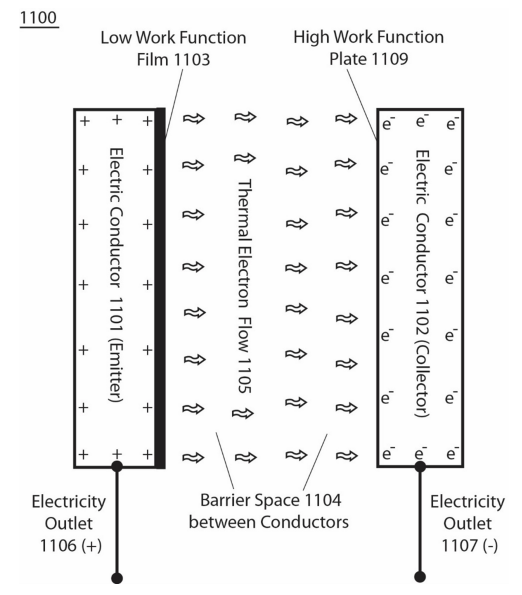
This article highlights “Type-B energy technology” isothermally utilizing environmental heat energy to generate electricity, showing its: a) basic system designs, b) equations, c) calculations, d) experimental measurements, and e) live experimental demonstrations, for an asymmetric function-gated electricity generator system comprising an exceptionally low electron-work-function surface as an electron emitter and a space gap that permits the isothermally emitted electrons to travel ballistically to a collector. The equations, calculations, experimental measurements, and live experimental demonstrations showed that the type-B energy technology can utilize the limitless environmental heat energy to generate electricity without requiring any temperature gradient as long as the electron-work function of the emitter is substantially lower than that of the collector. Using a pair of an exceptionally low electron-work-function (0.70 eV) emitter and a high work function (4.6 eV) collector at 298 K, its electricity production density could be . Its capability to ceaselessly forever power many electronic devices such as mobile phones and AI machines has paramount scientific and practical implications to help “ultimately liberate all peoples from their dependence on fossil fuel energy, thus helping to reduce greenhouse gas CO2 emissions and control climate change” towards a common shared sustainable future for humanity on Earth.
References
1. International Energy Agency (IEA). World Energy Outlook 2024. IEA; 2024. Available online: https://www.iea.org/reports/world-energy-outlook-2024
2. Murphy R. What is undermining climate change mitigation? How fossil-fuelled practices challenge low-carbon transitions. Energy Research & Social Science. 2024; 108: 103390. doi: 10.1016/j.erss.2023.103390
3. Wang J, Azam W. Natural resource scarcity, fossil fuel energy consumption, and total greenhouse gas emissions in top emitting countries. Geoscience Frontiers. 2024; 15(2): 101757. doi: 10.1016/j.gsf.2023.101757
4. Lee JW, Hawkins B, Day DM, et al. Sustainability: the capacity of smokeless biomass pyrolysis for energy pro-duction, global carbon capture and sequestration. Energy & Environmental Science. 2010; 3(11): 1695. doi: 10.1039/c004561f
5. Ahmad T, Zhang D. A critical review of comparative global historical energy consumption and future demand: The story told so far. Energy Reports. 2020; 6: 1973–1991. doi: 10.1016/j.egyr.2020.07.020
6. Nunes LJR. The Rising Threat of Atmospheric CO2: A Review on the Causes, Impacts, and Mitigation Strategies. Environments. 2023; 10(4): 66. doi: 10.3390/environments10040066
7. Kemp L, Xu C, Depledge J, et al. Climate Endgame: Exploring catastrophic climate change scenarios. Proceed-ings of the National Academy of Sciences. 2022; 119(34): e2108146119. doi: 10.1073/pnas.2108146119
8. Pourasl HH, Barenji RV, Khojastehnezhad VM. Solar energy status in the world: A comprehensive review. En-ergy Reports. 2023; 10: 3474–3493. doi: 10.1016/j.egyr.2023.10.022
9. Nijsse FJMM, Mercure JF, Ameli N, et al. The momentum of the solar energy transition. Nature Communica-tions. 2023; 14(1): 6542. doi: 10.1038/s41467-023-41971-7
10. Mdallal A, Yasin A, Mahmoud M, et al. A comprehensive review on solar photovoltaics: Navigating generation-al shifts, innovations, and sustainability. Sustainable Horizons. 2025; 13: 100137. doi: 10.1016/j.horiz.2025.100137
11. Niu X, Ma N, Bu Z, et al. Thermodynamic analysis of supercritical Brayton cycles using CO2-based binary mix-tures for solar power tower system application. Energy. 2022; 254: 124286. doi: 10.1016/j.energy.2022.124286
12. Shi Z, Chen J, Wang Y, et al. Credibility Copula-Based Robust Multistage Plan for Industrial Parks Under Exog-enous and Endogenous Uncertainties. CSEE Journal of Power and Energy Systems. 2025; 11: 987–998. doi: 10.17775/CSEEJPES.2024.09120
13. Soomar AM, Hakeem A, Messaoudi M, et al. Solar Photovoltaic Energy Optimization and Challenges. Frontiers in Energy Research. 2022; 10: 879985. doi: 10.3389/fenrg.2022.879985
14. Ullah F, Zhang X, Khan M, et al. A comprehensive review of wind power integration and energy storage tech-nologies for modern grid frequency regulation. Heliyon. 2024; 10(9): e30466. doi: 10.1016/j.heliyon.2024.e30466
15. McKenna R, Lilliestam J, Heinrichs HU, et al. System impacts of wind energy developments: Key research chal-lenges and opportunities. Joule. 2025; 9(1): 101799. doi: 10.1016/j.joule.2024.11.016
16. Llamosas C, Sovacool BK. The future of hydropower? A systematic review of the drivers, benefits and govern-ance dynamics of transboundary dams. Renewable and Sustainable Energy Reviews. 2021; 137: 110495. doi: 10.1016/j.rser.2020.110495
17. Sharmin T, Khan NR, Akram MS, et al. A State-of-the-Art Review on Geothermal Energy Extraction, Utilization, and Improvement Strategies: Conventional, Hybridized, and Enhanced Geothermal Systems. International Journal of Thermofluids. 2023; 18: 100323. doi: 10.1016/j.ijft.2023.100323
18. Lee JW. Introduction: An Overview of Advanced Biofuels and Bioproducts. In: Advanced Biofuels and Bi-oproducts. Springer; 2013. pp. 3–12. doi: 10.1007/978-1-4614-3348-4_1
19. Lee JW. Synthetic Biology for Photobiological Production of Butanol and Related Higher Alcohols from Carbon Dioxide and Water. In: Advanced Biofuels and Bioproducts; 2013. pp. 447–521. doi: 10.1007/978-1-4614-3348-4_22
20. Conrado RJ, Haynes CA, Haendler BE, et al. Electrofuels: A New Paradigm for Renewable Fuels. In: Advanced Biofuels and Bioproducts. Springer; 2013. pp. 1037–1064. doi: 10.1007/978-1-4614-3348-4_38
21. Brigham CJ, Gai CS, Lu J, et al. Engineering Ralstonia eutropha for Production of Isobutanol from CO2, H2, and O2. In: Advanced Biofuels and Bioproducts. Springer; 2013. pp. 1065–1090. doi: 10.1007/978-1-4614-3348-4_39
22. Gralla F, Abson DJ, Møller AP, et al. Energy transitions and national development indicators: A global review of nuclear energy production. Renewable and Sustainable Energy Reviews. 2017; 70: 1251–1265. doi: 10.1016/j.rser.2016.12.026
23. Qi H, Zhou Y, Zhang Z, et al. Heat Transfer Performance in Energy Piles in Urban Areas: Case Studies for Lam-beth College and Shell Centre UK. Applied Sciences. 2020; 10(17): 5974. doi: 10.3390/app10175974
24. Zhang Y, Qi H, Zhou Y, et al. Exploring the Impact of a District Sharing Strategy on Application Capacity and Carbon Emissions for Heating and Cooling with GSHP Systems. Applied Sciences. 2020; 10(16): 5543. doi: 10.3390/app10165543
25. Lei Z, Qi W, Zhang L, et al. Preparation and comprehensive performance optimization of green insulation building materials based on blast furnace slag. Journal of Building Engineering. 2025; 106: 112591. doi: 10.1016/j.jobe.2025.112591
26. Du Y, Xue Y, Wu W, et al. Coordinated Planning of Integrated Electric and Heating System Considering the Op-timal Reconfiguration of District Heating Network. IEEE Transactions on Power Systems. 2024; 39(1): 794–808. doi: 10.1109/TPWRS.2023.3242652
27. Lee JW. Proton-Electrostatics Hypothesis for Localized Proton Coupling Bioenergetics. Bioenergetics: Open Ac-cess. 2012; 1(2). doi: 10.4172/2167-7662.1000104
28. Lee JW. Proton-Electrostatic Localization: Explaining the Bioenergetic Conundrum in Alkalophilic Bacteria. Bi-oenergetics: Open Access. 2015; 4(1). doi: 10.4172/2167-7662.1000121
29. Saeed HA; Lee JW. Experimental Determination of Proton-Cation Exchange Equilibrium Constants at Wa-ter-Membrane Interface Fundamental to Bioenergetics. WATER Journal: Multidisciplinary Research Journal. 2018; 9: 116–140. Available online: https://waterjournal.org/archives/lee/
30. Lee JW. A possible electrostatic interpretation for proton localization and delocalization in chloroplast bioener-getics system. Biophysical Journal. 2005; 88: 324a–325a.
31. Lee JW. Electrostatically localized proton bioenergetics: Better understanding membrane potential. Heliyon. 2019; 5(7): e01961. doi: 10.1016/j.heliyon.2019.e01961
32. Lee JW. Electrostatically localized protons bioenergetics over Mitchells classic chemiosmotic theory. In: Pro-ceedings of the 2013 International Conference and Exhibition on Biochemical & Molecular Engineering; 7–8 October 2013; Hilton San Antonio Airport, TX, USA. Available online: https://www.walshmedicalmedia.com/proceedings/electrostatically-localized-protons-bioenergetics-over-mitchells-classic-chemiosmotic-theory-23817.html
33. Lee JW. Protonic Capacitor: Elucidating the biological significance of mitochondrial cristae formation. Scientific Reports. 2020; 10(1): 10304. doi: 10.1038/s41598-020-66203-6
34. Lee JW. Protonic capacitor cell energetics: Transmembrane-electrostatically localized protons/cations. American Journal of Physiology-Cell Physiology. 2025; 329(6): C1944–C1984. doi: 10.1152/ajpcell.00196.2024
35. Lee JW. Mitochondrial energetics with transmembrane electrostatically localized protons: Do we have a ther-motrophic feature? Scientific Reports. 2021; 11(1): 14575. doi: 10.1038/s41598-021-93853-x
36. Lee JW. Isothermal Environmental Heat Energy Utilization by Transmembrane Electrostatically Localized Pro-tons at the Liquid–Membrane Interface. ACS Omega. 2020; 5(28): 17385–17395. doi: 10.1021/acsomega.0c01768
37. Lee JW. Energy Renewal: Isothermal Utilization of Environmental Heat Energy with Asymmetric Structures. Entropy. 2021; 23(6): 665. doi: 10.3390/e23060665
38. Lee JW. Type-B Energetic Processes and Their Associated Scientific Implications. Journal of Scientific Explora-tion. 2022; 36(3): 484–492. doi: 10.31275/20222517
39. Lee JW. Type-B Energetic Processes: Their Identification and Implications. Symmetry. 2024; 16(7): 808. doi: 10.3390/sym16070808
40. Lee JW, Sheehan DP. Type-B Energetic Processes: Introduction and Invitation to Special Issue of Energies. Ener-gies. 2024; 17(23): 6076. doi: 10.3390/en17236076
41. Pisano R, Anakkar A, Pellegrino EM, et al. Thermodynamic foundations of physical chemistry: Reversible pro-cesses and thermal equilibrium into the history. Foundations of Chemistry. 2019; 21(3): 297–323. doi: 10.1007/s10698-018-09324-1
42. Nikulov A, Sheehan DP. Observations of Persistent Current at Non-Zero Resistance: Challenge to the Second Law of Thermodynamics. AIP Conference Proceedings. 2011; 1411: 122–144. doi: 10.1063/1.3665235
43. Sheehan DP. Infrared Cloaking, Stealth, and the Second Law of Thermodynamics. Entropy. 2012; 14(10): 1915–1938. doi: 10.3390/e14101915
44. Sheehan D. Maxwell Zombies: Conjuring the Thermodynamic Undead. American Scientist. 2018; 106(4): 234. doi: 10.1511/2018.106.4.234
45. Sheehan DP, Garamella JT, Mallin DJ, et al. Steady-state nonequilibrium temperature gradients in hydrogen gas–metal systems: Challenging the second law of thermodynamics. Physica Scripta. 2012; T151: 014030. doi: 10.1088/0031-8949/2012/T151/014030
46. Pal PS, Rana S, Saha A, et al. Extracting work from a single heat bath: A case study of a Brownian particle under an external magnetic field in the presence of information. Physical Review E. 2014; 90(2): 022143. doi: 10.1103/PhysRevE.90.022143
47. Sheehan D. P., Mallin DJ, Garamella JT, et al. Experimental Test of a Thermodynamic Paradox. Foundations of Physics. 2014; 44(3): 235–247. doi: 10.1007/s10701-014-9781-5
48. Serreli V, Lee CF, Kay ER, et al. A molecular information ratchet. Nature. 2007; 445(7127): 523–527. doi: 10.1038/nature05452
49. Vologodskii AV, Zhang W, Rybenkov VV, et al. Mechanism of topology simplification by type II DNA topoiso-merases. Proceedings of the National Academy of Sciences. 2001; 98(6): 3045–3049. doi: 10.1073/pnas.061029098
50. Jennings RC, Belgio E, Zucchelli G. Photosystem I, when excited in the chlorophyll Q y absorption band, feeds on negative entropy. Biophysical Chemistry. 2018; 233: 36–46. doi: 10.1016/j.bpc.2017.12.002
51. Lee JW. Localized Excess Protons and Methods of Making and Using the Same. US20170009357A1, 12 January 2017. Available online: https://patents.google.com/patent/US10501854B2/en#patentCitations
52. Lee JW. There may be Thermotrophic Type of Life on Earth. Zhejiang Agriculture University; 1983.
53. Lee JW. Isothermal Electricity for Energy Renewal. WO/2019/136037, 7 November 2019. Available online: https://patentscope.wipo.int/search/en/detail.jsf?docId=WO2019136037&_cid=P11-MOGLRX-54369-1
54. Koski JV, Maisi VF, Pekola JP, et al. Experimental realization of a Szilard engine with a single electron. Proceed-ings of the National Academy of Sciences. 2014; 111(38): 13786–13789. doi: 10.1073/pnas.1406966111
55. Battail G. Living Versus Inanimate: The Information Border. Biosemiotics. 2009; 2(3): 321–341. doi: 10.1007/s12304-009-9059-z
56. Čápek V, Bok J. A thought construction of working perpetuum mobile of the second kind. Czechoslovak Journal of Physics. 1999; 49(12): 1645–1652. doi: 10.1023/A:1022883701920
57. Nikulov AV. A problem with the conservation law observed in macroscopic quantum phenomena is a conse-quence of violation of the correspondence principle. Chinese Journal of Physics. 2024; 92: 270–283. doi: 10.1016/j.cjph.2024.09.023
58. Čápek V, Sheehan DP. Challenges to the Second Law of Thermodynamics: Theory and Experiment. Springer; 2005. doi: 10.1007/1-4020-3016-9
59. Nikulov A. The Law of Entropy Increase and the Meissner Effect. Entropy. 2022; 24(1): 83. doi: 10.3390/e24010083
60. Nikulov AV. Dynamic processes in superconductors and the laws of thermodynamics. Physica C: Superconduc-tivity and its Applications. 2021; 589: 1353934. doi: 10.1016/j.physc.2021.1353934
61. Sheehan D. Maxwell Zombies: Mulling and Mauling the Second Law of Thermodynamics. Journal of Scientific Exploration. 2020; 34(3): 513–536. doi: 10.31275/20201645
62. Saslow WM. A History of Thermodynamics: The Missing Manual. Entropy. 2020; 22(1): 77. doi: 10.3390/e22010077
63. Lee JW. Calculation of proton transmembrane-electrostatic interaction force and elucidation of the water drop-let experiment with a transient protonic front. RSC Advances. 2025; 15(26): 21108–21120. doi: 10.1039/D5RA03298A
64. Lee JW. Experimental demonstration and study of transmembrane-electrostatically localized protons prevail. WATER. 2025; 14: 35–58. Available online: https://waterjournal.org/volume-14/lee/
65. Lee JW. Application of TELC model to better elucidate neural stimulation by touch. Exploration of Neurosci-ence. 2025; 4: 100685. doi: 10.37349/en.2025.100685
66. Lee JW. TELP theory: Elucidating the major observations of Rieger et al. 2021 in mitochondria. Mitochondrial Communications. 2023; 1: 62–72. doi: 10.1016/j.mitoco.2023.09.001
67. Lee JW. From biophysics to cellular function: neural TELCs-membrane-anions capacitor transmembrane poten-tial. Frontiers in Biophysics. 2025; 3: 1648934. doi: 10.3389/frbis.2025.1648934
68. Lee JW. Transient transmembrane-electrostatically localized protons and transmembrane potential in a laser flashed bacteriorhodopsin purple membrane open flat sheet. WATER. 2025; 14: 164–178. Available online: https://waterjournal.org/volume-14/lee2/
69. Lee JW. Type-B Energy Process: Asymmetric Function-Gated Isothermal Electricity Production. Energies. 2022; 15(19): 7020. doi: 10.3390/en15197020
70. Abdul Khalid KA, Leong TJ, Mohamed K. Review on Thermionic Energy Converters. IEEE Transactions on Electron Devices. 2016; 63(6): 2231–2241. doi: 10.1109/TED.2016.2556751
71. Yoshizumi T, Hayashi K. Thermionic Electron Emission from a Mayenite Electride–Metallic Titanium Compo-site Cathode. Applied Physics Express. 2013; 6(1): 015802. doi: 10.7567/APEX.6.015802
72. Dominguez-Andrade H, Anaya J, Croot A, et al. Correlating Thermionic Emission with Specific Surface Recon-structions in a Hydrogenated Single-Crystal Diamond. ACS Applied Materials & Interfaces. 2020; 12(23): 26534–26542. doi: 10.1021/acsami.0c01677
73. Zavadil K, Battaile C, Marshall A, et al. Low Work Function Material Development for the Microminiature Thermionic Converter. U.S. Department of Energy Office of Scientific and Technical Information; 2004. doi: 10.2172/918773
74. Go DB, Haase JR, George J, et al. Thermionic Energy Conversion in the Twenty-first Century: Advances and Opportunities for Space and Terrestrial Applications. Frontiers in Mechanical Engineering. 2017; 3: 13. doi: 10.3389/fmech.2017.00013
75. Child CD. Discharge From Hot Cao. Physical Review (Series I). 1911; 32(5): 492–511. doi: 10.1103/PhysRevSeriesI.32.492
76. Langmuir I. The Effect of Space Charge and Residual Gases on Thermionic Currents in High Vacuum. Physical Review. 1913; 2(6): 450–486. doi: 10.1103/PhysRev.2.450
77. Zhu X, Yu Y, Li F. A review on thermoelectric energy harvesting from asphalt pavement: Configuration, per-formance and future. Construction and Building Materials. 2019; 228: 116818. doi: 10.1016/j.conbuildmat.2019.116818
78. Ochieng AO, Megahed TF, Ookawara S, et al. Comprehensive review in waste heat recovery in different ther-mal energy-consuming processes using thermoelectric generators for electrical power generation. Process Safety and Environmental Protection. 2022; 162: 134–154. doi: 10.1016/j.psep.2022.03.070
79. Ladd, MM, Li K, McKenney FD, et al. Method For Making Advanced Thermoelectric Devices. US6100463A, 8 August 2000. Available online: https://patents.justia.com/patent/6100463?utm_source=chatgpt.com
80. Nordman JE. Contact Potential Difference. McGraw Hill’s AccessScience; 2025. doi: 10.1036/1097-8542.158800
81. Vilitis O, Rutkis M, Busenberg J, et al. Determination of Contact Potential Difference by the Kelvin Probe (Part I) I. Basic Principles of Measurements. Latvian Journal of Physics and Technical Sciences. 2016; 53(2): 48–57. doi: 10.1515/lpts-2016-0013
82. Houston JM. Theoretical Efficiency of the Thermionic Energy Converter. Journal of Applied Physics. 1959; 30(4): 481–487. doi: 10.1063/1.1702392
83. Webster HF. Calculation of the Performance of a High-Vacuum Thermionic Energy Converter. Journal of Ap-plied Physics. 1959; 30(4): 488–492. doi: 10.1063/1.1702393
84. Block F, Eastman G, Corregan F, et al. Construction of a Thermionic Energy Converter. Proceedings of the IRE. 1960; 48(11): 1846–1852. doi: 10.1109/JRPROC.1960.287418
85. Dugan AF. Contribution of Anode Emission to Space Charge in Thermionic Power Converters. Journal of Ap-plied Physics. 1960; 31(8): 1397–1400. doi: 10.1063/1.1735850
86. Hirsch RL. Effect of Interelectrode Spacing on Cesium Thermionic Converter Performance. Journal of Applied Physics. 1960; 31(11): 2064–2065. doi: 10.1063/1.1735500
87. Salmi EW. Plasma Thermionic Converters. Journal of The Electrochemical Society. 1960; 107(12): 1013. doi: 10.1149/1.2427556
88. Carabateas EN, Pezaris SD, Hatsopoulos GN. Interpretation of Experimental Characteristics of Cesium Thermi-onic Converters. Journal of Applied Physics. 1961; 32(3): 352–358. doi: 10.1063/1.1736010
89. Ingold JH. Calculation of the Maximum Efficiency of the Thermionic Converter. Journal of Applied Physics. 1961; 32(5): 769–772. doi: 10.1063/1.1736103
90. Carabateas EN. Electron Space-Charge-Limited Operation of Cesium Thermionic Converters. Journal of Ap-plied Physics. 1962; 33(4): 1445–1449. doi: 10.1063/1.1728752
91. Hatsopoulos GN. Transport effects in cesium thermionic converters. Proceedings of the IEEE. 1963; 51(5): 725–733. doi: 10.1109/PROC.1963.2265
92. McIntyre RG. Effect of anode emission of electrons on space-charge theory of the plasma thermionic converter. Proceedings of the IEEE. 1963; 51(5): 760–768. doi: 10.1109/PROC.1963.2269
93. Rasor NS. Emission physics of the thermionic energy converter. Proceedings of the IEEE. 1963; 51(5): 733–747. doi: 10.1109/PROC.1963.2266
94. Schneider RT, Dunlop JD. Spectroscopic investigation of a thermionic capillary cesium energy converter. Ap-plied Physics Letters. 1963; 3(5): 73–75. doi: 10.1063/1.1753874
95. Chapman RA, Caulfield HJ, Hemstreet HW. Measurement of Electron Temperature in Low-Pressure Cesium Thermionic Energy Converters. Journal of Applied Physics. 1964; 35(10): 2813–2825. doi: 10.1063/1.1713113
96. Badareu E, Musa G, Popescu D. Investigations on the caesium thermionic converter with an auxiliary discharge. British Journal of Applied Physics. 1965; 16(6): 845–850. doi: 10.1088/0508-3443/16/6/310
97. Wilkins DR, Gyftopoulos EP. Thermionic Converters Operating in the Ignited Mode. Part II: A Qua-si-Equilibrium Model for the Interelectrode Plasma. Journal of Applied Physics. 1966; 37(7): 2892–2899. doi: 10.1063/1.1782146
98. Bullis RH, Hansen LK, Warner C, et al. The Plasma Physics of Thermionic Converters. Journal of Applied Phys-ics. 1967; 38(9): 3425–3438. doi: 10.1063/1.1710144
99. Levine JD, Gelhaus FE. Oxygen as a Beneficial Additive in Cesium Thermionic Energy Converters. Journal of Applied Physics. 1967; 38(2): 892–893. doi: 10.1063/1.1709440
100. Nighan WL. Electron-Transport Phenomena in Thermionic Converter Plasmas. Journal of Applied Physics. 1968; 39(1): 223–230. doi: 10.1063/1.1655736
101. Andersen RJ. Electron density and temperature measurements of the ignited mode plasma in a thermionic converter. IEEE Transactions on Electron Devices. 1969; 16(8): 698–703. doi: 10.1109/T-ED.1969.16841
102. Rouklove P. Metallurgical study of thermionic converters. IEEE Transactions on Electron Devices. 1969; 16(8): 672–678. doi: 10.1109/T-ED.1969.16837
103. Smith JR, Smith AL. Empirical Formulation of Thermionic Converter Electrode Performance. Journal of Applied Physics. 1972; 43(2): 723–724. doi: 10.1063/1.1661184
104. Sumida I, Suzuki K, Tabuchi H, et al. Preliminary Test of Thermionic Converter/Heat Pipe Assembly. Journal of Nuclear Science and Technology. 1974; 11(7): 308–310. doi: 10.1080/18811248.1974.9730666
105. Oettinger PE, Hussman FN. Experiments with Enhanced Mode Thermionic Converters. IEEE Transactions on Plasma Science. 1978; 6(1): 83–88. doi: 10.1109/TPS.1978.4317090
106. Holmlid L, Möller K. Experimental thermionic energy converter without enclosure: A molecular beam supplied converter. Applied Physics A Solids and Surfaces. 1984; 33(3): 199–204. doi: 10.1007/BF00618756
107. Lundgren L. A comparison between arc drops in ignited thermionic converters with and without ion reflections at the emitter. Journal of Applied Physics. 1985; 58(1): 142–145. doi: 10.1063/1.335699
108. Wriedt S, Möller K, Holmlid L. Emitter tests in an open thermionic converter with vapor injection through the collector. Journal of Applied Physics. 1986; 60(12): 4133–4135. doi: 10.1063/1.337494
109. Gubbels GHM, Wolff LR, Metselaar R. A thermionic energy converter with polycrystalline molybdenum elec-trodes. Journal of Applied Physics. 1988; 64(3): 1508–1512. doi: 10.1063/1.341825
110. Gubbels GHM, Wolff LR, Metselaar R. A thermionic energy converter with a molybdenum-alumina cermet emitter. Journal of Applied Physics. 1990; 68(11): 5856–5865. doi: 10.1063/1.346960
111. Lundin J, Holmlid L. Electron excitation energy transfer from highly excited cesium atoms forming high Ry-dberg state atoms and molecules. The Journal of Physical Chemistry. 1991; 95(3): 1029–1034. doi: 10.1021/j100156a003
112. Rasor NS. Thermionic energy conversion plasmas. IEEE Transactions on Plasma Science. 1991; 19(6): 1191–1208. doi: 10.1109/27.125041
113. Van Hagan TH, Smith JN, Schuller M. Thermionic/AMTEC cascade converter concept for high-efficiency space power. IEEE Aerospace and Electronic Systems Magazine. 1997; 12(7): 10–15. doi: 10.1109/62.596648
114. Kobyakov VP, Kalandarishvili AG. Effectiveness of the use of oxygen-containing niobium in thermionic energy converters. Technical Physics. 1998; 43(8): 997–1003. doi: 10.1134/1.1259116
115. Kaibyshev VZ, Lysikov AV. Influence of the Collector Emission Properties on the Efficiency of a Thermionic En-ergy Converter in the Arc Regime. Atomic Energy. 2000; 89(3): 709–715. doi: 10.1023/A:1009456132025
116. Koryukin VA. Change in the properties of the electrodes of thermionic single-element EGC at the initial stage of operation. Atomic Energy. 2000; 89(1): 555–564. doi: 10.1007/BF02673515
117. Kobyakov VP, Kalandarishvili AG. Performance of thermionic energy converters with oxygen-containing emitter and collector. Technical Physics. 2004; 49(6): 775–778. doi: 10.1134/1.1767890
118. Moyzhes BY, Geballe TH. The thermionic energy converter as a topping cycle for more efficient heat en-gines—New triode designs with a longitudinal magnetic field. Journal of Physics D: Applied Physics. 2005; 38(5): 782–786. doi: 10.1088/0022-3727/38/5/017
119. Robinson VS, Fisher TS, Michel JA, et al. Work function reduction of graphitic nanofibers by potassium interca-lation. Applied Physics Letters. 2005; 87(6): 061501. doi: 10.1063/1.2009052
120. Tanner PG, Fraser DA, Irving AD. Developments in thermionic energy converters. IEE Proceedings—Science, Measurement and Technology. 2005; 152(1): 1–6. doi: 10.1049/ip-smt:20051050
121. Islam M, Inal OT, Luke JR. Development of electron reflection suppression materials for improved thermionic energy converter performance using thin film deposition techniques. Journal of Applied Physics. 2006; 100(8): 084903. doi: 10.1063/1.2356785
122. Wu DM, Hagelstein PL, Chen P, et al. Quantum-coupled single-electron thermal to electric conversion scheme. Journal of Applied Physics. 2009; 106(9): 094315. doi: 10.1063/1.3257402
123. Schwede JW, Bargatin I, Riley DC, et al. Photon-enhanced thermionic emission for solar concentrator systems. Nature Materials. 2010; 9(9): 762–767. doi: 10.1038/nmat2814
124. Shefsiek P. Describing and Correlating the Performance of the Thermionic Converter: A Historical Perspective. IEEE Transactions on Plasma Science. 2010; 38(8): 2041–2047. doi: 10.1109/TPS.2010.2050910
125. Littau KA, Sahasrabuddhe K, Barfield D, et al. Microbead-separated thermionic energy converter with enhanced emission current. Physical Chemistry Chemical Physics. 2013; 15(34): 14442. doi: 10.1039/c3cp52895b
126. Segev G, Kribus A, Rosenwaks Y. High performance isothermal photo-thermionic solar converters. Solar Energy Materials and Solar Cells. 2013; 113: 114–123. doi: 10.1016/j.solmat.2013.02.002
127. Hagelstein PL, Kuckerov YR. Thermal Diode for Energy Conversion. WO2001069657A2, 20 September 2001. Available online: https://patents.google.com/patent/WO2001069657A2/zh
128. Nemanich RJ, Koeck FAM. Thermionic Electron Emitters/Collectors Have a Doped Diamond Layer with Varia-ble Doping Concentrations. US20110221328A1, 15 September 2011. Available online: https://patents.google.com/patent/US8188456
Downloads
Published
How to Cite
Issue
Section
License
Copyright (c) 2026 James Weifu Lee

This work is licensed under a Creative Commons Attribution 4.0 International License.





.jpg)
.jpg)