Comparative analysis of proactive tracking strategies for mobile PV systems: From discrete brute-force to continuous metaheuristic optimization
DOI:
https://doi.org/10.18686/cest822Keywords:
solar electric vehicles; particle swarm optimization (PSO); proactive tracking; GPS trajectory; computational efficiency; renewable energyAbstract
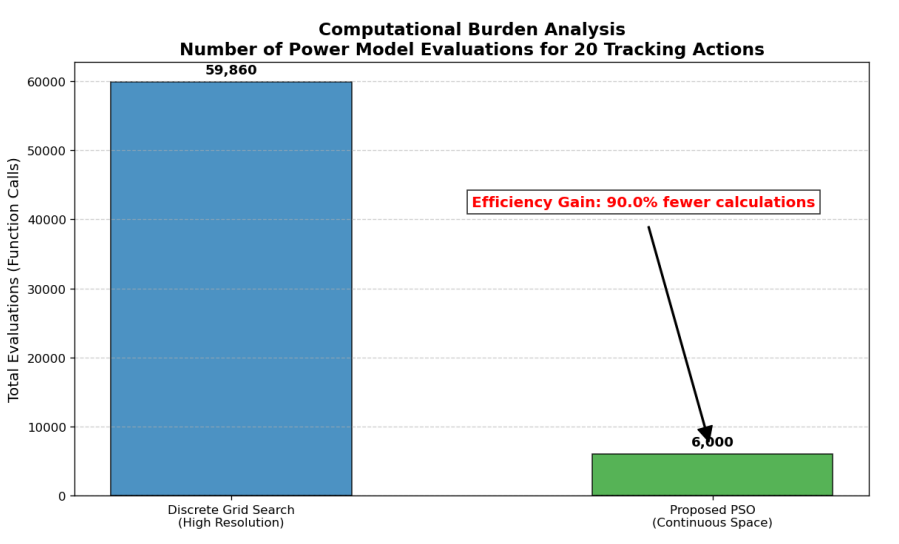
The efficiency of energy harvesting in Solar Electric Vehicles (SEVs) is significantly constrained by dynamic vehicle movement and the limited area of the roof. Conventional tracking techniques are often reactive, thus requiring substantial computing resources and causing high energy losses associated with constant changes. A new idea of a solar tracking system with a proactive approach, using both GPS trajectory data and Particle Swarm Optimization for the sake of optimizing the total net energy gain while minimizing computation, has been introduced in this study. In comparison with the exhaustive search approach, the journey is divided into proactive segments with the use of Particle Swarm Optimization within the dynamically varying search domain. In a simulation process done under the Python programming environment and considering the real trajectory of the path within a period of 10 h from Karak, Jordan, the PSO technique showed total energy gain amounting to 1,701.9 Wh. Even though there was only a minor improvement in terms of the total energy gained as compared with the benchmark values of energy gain (0.27%), the biggest advantage in this case can be seen in a computational decrease of 90% and 96% of the energy used by the embedded control device.
References
1. Li H, Hao Y, Xie C, et al. Emerging technologies and policies for carbon–neutral transportation. International Journal of Transportation Science and Technology. 2023; 12(1): 329–334. doi: 10.1016/j.ijtst.2022.09.002
2. Jankovec M, Brecl K, Bokalič M, et al. Monitoring solar irradiance and PV module performance in mobile applications. Solar Energy Materials and Solar Cells. 2024; 277: 113101. doi: 10.1016/j.solmat.2024.113101
3. Almajali Z. Optimizing Solar Car Performance: GPS-Enhanced Dual-Axis Precision and Single-Axis Southward Orientation in Solar Tracking Solutions. International Journal of Engineering Trends and Technology. 2025; 73(7). doi: 10.14445/22315381/IJETT-V73I7P119
4. Lu N, Qin J. Global optimization of photovoltaic tilt angles: reducing solar power losses using reanalysis data. Environmental Research Letters. 2025; 20(3): 034054. doi: 10.1088/1748-9326/adbb05
5. Sadeghi R, Parenti M, Memme S, et al. A Review and Comparative Analysis of Solar Tracking Systems. Energies. 2025; 18(10): 2553. doi: 10.3390/en18102553
6. Al Garni HZ, Awasthi A. Solar PV power plant site selection using a GIS-AHP based approach with application in Saudi Arabia. Applied Energy. 2017; 206: 1225–1240. doi: 10.1016/j.apenergy.2017.10.024
7. Ku J, Kim SM, Park HD. Energy-saving path planning navigation for solar-powered vehicles considering shadows. Renewable Energy. 2024; 236: 121424. doi: 10.1016/j.renene.2024.121424
8. Xie Z, Wu Z. A flexible power point tracking algorithm for photovoltaic system under partial shading condition. Sustainable Energy Technologies and Assessments. 2022; 49: 101747. doi: 10.1016/j.seta.2021.101747
9. Ding Z, Chen B, Zhang L, et al. Segment travel time route guidance strategy in advanced traveler information systems. Physica A: Statistical Mechanics and its Applications. 2019; 534: 120432. doi: 10.1016/j.physa.2019.01.001
10. Roman CD. Routing Choices in Intelligent Transport Systems [PhD Thesis]. University of Warwick; 2021.
11. Mercorelli P. Techniques of Control for Energy Optimization in Actuators, Motors, and Power Generation Systems. Energies. 2025; 18(15): 4036. doi: 10.3390/en18154036
12. Nishanth JR, Deshmukh MA, Kushwah R, et al. Particle Swarm Optimization of Hybrid Renewable Energy Systems. In: Advances in Civil and Industrial Engineering. IGI Global; 2023. pp. 291–308. doi: 10.4018/979-8-3693-0044-2.ch016
13. Houssein EH, Gad AG, Hussain K, et al. Major Advances in Particle Swarm Optimization: Theory, Analysis, and Application. Swarm and Evolutionary Computation. 2021; 63: 100868. doi: 10.1016/j.swevo.2021.100868
14. Gardashov ER, Gardashov RH, Eminov MSh, et al. Road-Based Simulation and Visualizations of Solar Car Motion. In: Handbook of Climate Change Mitigation and Adaptation. Springer; 2024. pp. 1–51. doi: 10.1007/978-1-4614-6431-0_182-1
15. Bouquet P, Jackson I, Nick M, et al. AI-based forecasting for optimised solar energy management and smart grid efficiency. International Journal of Production Research. 2024; 62(13): 4623–4644. doi: 10.1080/00207543.2023.2269565
16. Bosques-Perez MA, Rishe N, Yan T, et al. Effects of Clouds and Shadows on the Use of Independent Component Analysis for Feature Extraction. Remote Sensing. 2025; 17(15): 2632. doi: 10.3390/rs17152632
17. Dutton EG, Michalsky JJ, Stoffel T, et al. Measurement of Broadband Diffuse Solar Irradiance Using Current Commercial Instrumentation with a Correction for Thermal Offset Errors. Journal of Atmospheric and Oceanic Technology. 2001; 18(3): 297–314. doi: 10.1175/1520-0426(2001)018%3C0297:MOBDSI%3E2.0.CO;2
18. Ham AG, Nafornita C, Vesa VC, et al. Grid Search and Genetic Algorithm Optimization of Neural Networks for Automotive Radar Object Classification. Sensors. 2025; 25(19): 6017. doi: 10.3390/s25196017
19. Surianarayanan C, Lawrence JJ, Chelliah PR, et al. A Survey on Optimization Techniques for Edge Artificial Intelligence (AI). Sensors. 2023; 23(3): 1279. doi: 10.3390/s23031279
20. Abualigah L. Particle Swarm Optimization: Advances, Applications, and Experimental Insights. Computers, Materials & Continua. 2025; 82(2): 1539–1592. doi: 10.32604/cmc.2025.060765
21. Sohail MS, Saeed MOB, Rizvi SZ, et al. Low-Complexity Particle Swarm Optimization for Time-Critical Applications. 2014; doi: 10.48550/ARXIV.1401.0546
22. De Melo Menezes BA, Kuchen H, De Lima Neto FB. Parallelization of Swarm Intelligence Algorithms: Literature Review. International Journal of Parallel Programming. 2022; 50(5–6): 486–514. doi: 10.1007/s10766-022-00736-3
23. Madhanakkumar N, Vijayaragavan M, Anbarasan P, et al. Smart energy management for plug-in hybrid electric vehicles: Integration of waterwheel plant algorithm and dual stream spectrum deconvolution neural network. Journal of Energy Storage. 2024; 102: 113867. doi: 10.1016/j.est.2024.113867
24. Yao Y, Hu Y, Gao S, et al. A multipurpose dual-axis solar tracker with two tracking strategies. Renewable Energy. 2014; 72: 88–98. doi: 10.1016/j.renene.2014.07.002
25. Fedenko V, Dzundza B. Application of solar tracking systems for enhancing the energy yield of photovoltaic modules: a review. Technology and design in electronic equipment. 2025; (1–2): 27–33. doi: 10.15222/TKEA2025.1-2.27
Downloads
Published
How to Cite
Issue
Section
License
Copyright (c) 2026 Ziyad Almajali

This work is licensed under a Creative Commons Attribution 4.0 International License.





.jpg)
.jpg)