PV array MPPT algorithm for suppressing memory inertia and voltage oscillation
DOI:
https://doi.org/10.18686/cest824Keywords:
photovoltaic systems; MPPT (maximum power point tracking); PSO (particle swarm optimization); memoryless mechanism; voltage gradient suppression; false peakAbstract
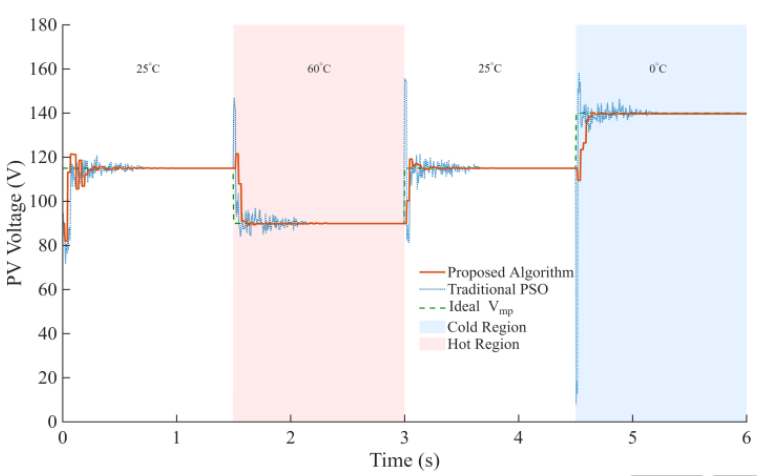
Variations in irradiation and temperature can decrease the power generated by PV systems and lead to instability in maximum power point tracking (MPPT). The traditional MPPT methods, such as conventional particle swarm optimization (PSO), perturb and observe (P&O), and incremental conductance (INC), are known to have slow convergence speed, tracking errors, voltage oscillations, and poor response under highly dynamic environmental conditions. Given these drawbacks, this paper presents a voltage-suppression PSO-MPPT algorithm for enhancing the dynamic response, tracking accuracy, and stability of the system. The proposed method eliminates the personal historical best value from the PSO structure to create a memory-less PSO. This decreases cognitive inertia and increases the adaptability of particles in tracking. Moreover, a 4-stage dynamic voltage gradient suppression mechanism is designed to control voltage transients and suppress voltage transitions. Furthermore, a dual-sentinel detection strategy is implemented to increase the steady-state accuracy and to prevent local stagnation during MPPT operation. The evaluation of the algorithm performance is conducted via Matlab/Simulink simulation under standard conditions, partial shading, and temperature change. The results indicate that, under normal conditions, the settling time is decreased by 37.5%, and the voltage oscillation is reduced by 28.6%. Partial shading results in much faster dynamic re-track speed, and the tests for temperature variation indicate a 62.7% faster response time and voltage ripple reduction. The proposed algorithm also provides good steady-state error and low RMSE compared to the conventional PSO, P&O, and INC methods. No hardware validation has been carried out yet, but the method is lightweight and requires less computational power, and can be applied to low-cost PV systems.
References
1. Abudyak YH. Grid-Forming Inverters: Comprehensive Review, Design, and Implementation of Advanced Control Methods [Master’s Thesis]. University of Central Florida; 2025. Available online: https://stars.library.ucf.edu/etd2024/88/
2. Alhusseini H, Niroomand M, Mirzaeian Dehkordi B. A Fuzzy-Based Adaptive P&O MPPT Algorithm for PV Systems With Fast Tracking and Low Oscillations Under Rapidly Irradiance Change Conditions. IEEE Access. 2024; 12: 84374–84386. doi: 10.1109/ACCESS.2024.3412848
3. Al-Tameemi ZHA, Lie TT, Foo G, et al. Control Strategies of DC Microgrids Cluster: A Comprehensive Review. Energies. 2021; 14(22): 7569. doi: 10.3390/en14227569
4. Badawi A, Elzein IM, Matter K, et al. A Comprehensive Review of Maximum Power Tracking Techniques for Photovoltaic Systems. 2025;. doi: 10.20944/preprints202510.1296.v1
5. Prasetyo SD. Meta-Analysis of Harmonics and Stability Challenges in Renewable Energy-Driven Sloppy Electrolyzers under Weak Grid Conditions. Power Engineering and Engineering Thermophysics. 2025; 4(3): 195–208. doi: 10.56578/peet040305
6. Behara RK, Saha AK. Artificial Intelligence Control System Applied in Smart Grid Integrated Doubly Fed Induction Generator-Based Wind Turbine: A Review. Energies. 2022; 15(17): 6488. doi: 10.3390/en15176488
7. Choudhury S, Sahoo GK. A critical analysis of different power quality improvement techniques in microgrid. Advances in Electrical Engineering, Electronics and Energy. 2024; 8: 100520. doi: 10.1016/j.prime.2024.100520
8. Wang F, Tuluhong A, Luo B, et al. Control Methods and AI Application for Grid-Connected PV Inverter: A Review. Technologies. 2025; 13(11): 535. doi: 10.3390/technologies13110535
9. Jately V, Bhattacharya S, Azzopardi B, et al. Voltage and Current Reference Based MPPT Under Rapidly Changing Irradiance and Load Resistance. IEEE Transactions on Energy Conversion. 2021; 36(3): 2297–2309. doi: 10.1109/TEC.2021.3058454
10. Kumar V, Sharma V, Kumar AVP, et al. A state-of-the-art review on concurrent voltage and frequency regulation problems in renewable integrated power networks. Energy Sources, Part A: Recovery, Utilization, and Environmental Effects. 2025; 47(1): 16–49. doi: 10.1080/15567036.2025.2462799
11. Li N, Zhang C, Wei D, et al. A boost converter‐based MPPT steady‐state oscillation‐free fast tracking control strategy for photovoltaic power systems. IET Power Electronics. 2023; 16(3): 483–497. doi: 10.1049/pel2.12400
12. Badawi A, Elzein IM, Matter K, et al. A State-of-the-Art Comprehensive Review on Maximum Power Tracking Algorithms for Photovoltaic Systems and New Technology of the Photovoltaic Applications. Energies. 2025; 18(24): 6555. doi: 10.3390/en18246555
13. Mu R, Zhang Y, Wu Y, et al. A Critical Review of State-of-the-Art Stability Control of PV Systems: Methodologies, Challenges, and Perspectives. Energies. 2026; 19(2): 507. doi: 10.3390/en19020507
14. Pathak PK, Yadav AK, Alvi PA. Reduced oscillations based perturb and observe solar maximum power point tracking scheme to enhance efficacy and speed of a photovoltaic system. Journal of Engineering Research. 2023; 11(2): 112–125. doi: 10.36909/jer.13569
15. Ram S, Ashwani K. A comprehensive review on harmonic reduction in integrated solar–wind energy systems using FACTS controllers. International Journal of Recent Research and Review. 2025; 18(3). Available online: https://www.ijrrr.com/papers18-3/V18-3-paper5-A%20Comprehensive%20Review%20on%20Harmonic%20Reduction%20in%20Integrated%20Solar-Wind%20Energy%20Systems%20Using%20Facts%20Controllers.pdf
16. Ramesh M, Yadav AK, Pathak PK. An extensive review on load frequency control of solar-wind based hybrid renewable energy systems. Energy Sources, Part A: Recovery, Utilization, and Environmental Effects. 2025; 47(1): 8378–8402. doi: 10.1080/15567036.2021.1931564
17. Ren J, Jiang W, Yang C. System control optimization of redox flow batteries. Future Batteries. 2026; 10: 100168. doi: 10.1016/j.fub.2026.100168
18. Roy P, He J, Zhao T, et al. Recent Advances of Wind-Solar Hybrid Renewable Energy Systems for Power Generation: A Review. IEEE Open Journal of the Industrial Electronics Society. 2022; 3: 81–104. doi: 10.1109/OJIES.2022.3144093
19. Shafiullah M, Ahmed SD, Al-Sulaiman FA. Grid Integration Challenges and Solution Strategies for Solar PV Systems: A Review. IEEE Access. 2022; 10: 52233–52257. doi: 10.1109/ACCESS.2022.3174555
20. Song S, Wang D, Li M, et al. Low-Power On-Chip Energy Harvesting: From Interface Circuits Perspective. IEEE Open Journal of Circuits and Systems. 2024; 5: 267–290. doi: 10.1109/OJCAS.2024.3423484
21. Vodapally S, Ali M. Overview of Intelligent Inverters and Associated Cybersecurity Issues for a Grid-Connected Solar Photovoltaic System. Energies. 2023; 16(16): 5904. doi: 10.3390/en16165904
22. Wang Y, Sun L. Photovoltaic Maximum Power Point Tracking Technology Based on Improved Perturbation Observation Method and Backstepping Algorithm. Electronics. 2024; 13(19): 3960. doi: 10.3390/electronics13193960
23. Yang J, Fan Y, Ying Z, et al. Multi-modal MPPT Control Strategy Under PSC in DC Microgrids: Review, Classification and Future Development Outlook. Archives of Computational Methods in Engineering. 2026; 33(4): 5503–5533. doi: 10.1007/s11831-025-10465-8
24. Zhou S, Ge L, Zheng Z, et al. A Review of Distribution Grid Consumption Strategies Containing Distributed Photovoltaics. Applied Sciences. 2024; 14(13): 5617. doi: 10.3390/app14135617
25. Baatiah AO, Eltamaly AM, Alotaibi MA. Improving Photovoltaic MPPT Performance through PSO Dynamic Swarm Size Reduction. Energies. 2023; 16(18): 6433. doi: 10.3390/en16186433
Downloads
Published
How to Cite
Issue
Section
License
Copyright (c) 2026 Qizhuo Dong, Huiwen Qiao, Ying Wu, Lehang Yang, Minghan Jia

This work is licensed under a Creative Commons Attribution 4.0 International License.





.jpg)
.jpg)