Statistical distributions for assessment of potential offshore wind speed in Indonesia
DOI:
https://doi.org/10.18686/cest837Keywords:
wind energy , Weibull distribution , Nakagami distribution , Rayleigh distribution , cumulative energy productionAbstract
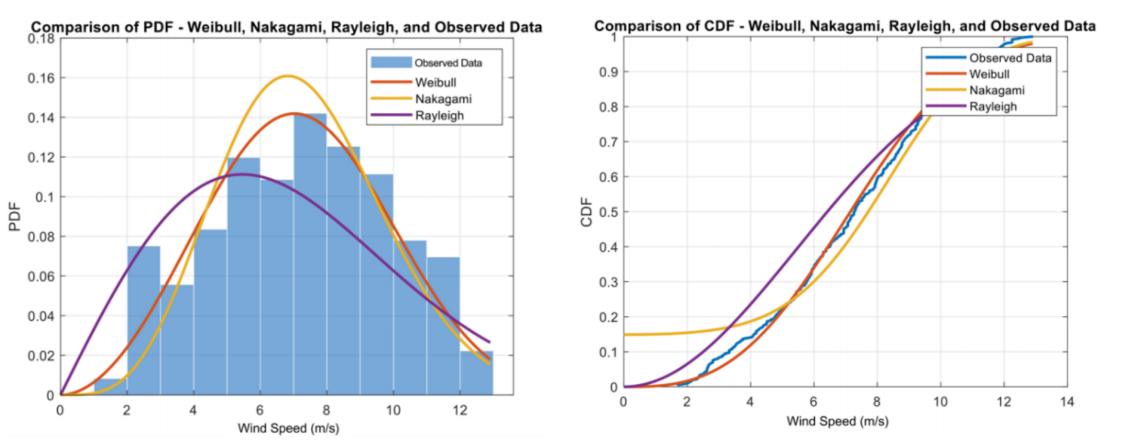
Despite Indonesia’s vast offshore wind potential of 155 GW, current utilization remains low at 0.15 GW. This study evaluates wind speed distributions and cumulative energy production at three strategic locations: Jeneponto, Banda Aceh, and Lombok. Using Weibull, Nakagami, and Rayleigh probability density functions, the research assesses model accuracy through R2 and RMSE metrics. The results show that the parameter values of k and c are 2.9239 and 8.1043, respectively; m and Ω are 2.3117 and 59.4929, respectively, and σ is 5.454 at Jeneponto. In comparison, Banda Aceh has the parameter values of k and c are 2.5520 and 5.3175, respectively; m and Ω are 1.6970 and 26.2341, respectively, and σ is 3.622. Meanwhile, Lombok provides the parameter values of k and c are 2.9755 and 6.7810, respectively; m and Ω are 2.2311 and 41.5548, respectively, and σ is 4.558. Results indicate that the Weibull distribution provides the most accurate fit for Jeneponto (R2 = 0.997, RMSE = 0.0177) and Lombok (R2 = 0.996), while the Rayleigh distribution performs best in Banda Aceh (R2 = 0.993). Comparative analysis of cumulative energy production confirms the Weibull distribution as the superior model for Indonesian offshore wind assessment, yielding the lowest error deviations (0.028–0.087). These findings provide a robust statistical framework for optimizing future offshore wind farm developments in the region. In addition, it helps provide the empirical foundation necessary to integrate systematic offshore wind observations into Indonesia’s long-term energy transition roadmap.
References
1. Langer J, Simanjuntak S, Pfenninger S, et al. How offshore wind could become economically attractive in low-resource regions like Indonesia. iScience. 2022; 25(9): 104945. doi: 10.1016/j.isci.2022.104945
2. Huo J, Ji Y, Ma S, et al. Day-ahead offshore wind speed forecasts: A comparison between WRF-CNN-GRU and statistical methods. Energy Reports. 2026; 15: 109041. doi: 10.1016/j.egyr.2026.109041
3. Al-Ghussain L, Abubaker AM, Ahmad AD. Superposition of Renewable-Energy Supply from Multiple Sites Maximizes Demand-Matching: Towards 100% Renewable Grids in 2050. Applied Energy. 2021; 284: 116402. doi: 10.1016/j.apenergy.2020.116402
4. Syafaruddin, Yusri SA, Putri AK, et al. Estimation Parameters of Wind Speed and Direction for Wind Turbine Applications Using Sarima Method. ICIC Express Letters, Part B: Applications. 2026; 17: 449–458. doi: 10.24507/icicelb.17.05.449
5. Aljeddani SMA, Mohammed MA. A novel approach to Weibull distribution for the assessment of wind energy speed. Alexandria Engineering Journal. 2023; 78: 56–64. doi: 10.1016/j.aej.2023.07.027
6. Kang S, Khanjari A, You S, et al. Comparison of different statistical methods used to estimate Weibull parameters for wind speed contribution in nearby an offshore site, Republic of Korea. Energy Reports. 2021; 7: 7358–7373. doi: 10.1016/j.egyr.2021.10.078
7. Fauzy A, Yue CD, Tu CC, et al. Understanding the Potential of Wind Farm Exploitation in Tropical Island Countries: A Case for Indonesia. Energies. 2021; 14(9): 2652. doi: 10.3390/en14092652
8. Kusuma YF, Fuadi AP, Hakim BA, et al. Navigating challenges on the path to net zero emissions: A comprehensive review of wind turbine technology for implementation in Indonesia. Results in Engineering. 2024; 22: 102008. doi: 10.1016/j.rineng.2024.102008
9. Cakmakyapan S, Ozel G. Generalized Lindley Family with application on Wind Speed Data. Pakistan Journal of Statistics and Operation Research. 2021; 387–397. doi: 10.18187/pjsor.v17i2.2518
10. Rather AA, Özel G. The Weighted Power Lindley Distribution with Applications on the Life Time Data. Pakistan Journal of Statistics and Operation Research. 2020; 225–237. doi: 10.18187/pjsor.v16i2.2931
11. Aygün H, Köse B. A novel mixed Rayleigh distribution model using PID based search algorithm for wind energy applications. Engineering Science and Technology, an International Journal. 2025; 72: 102239. doi: 10.1016/j.jestch.2025.102239
12. Roncallo L, Sofi A, Muscolino G, et al. Imprecise model of thunderstorm wind speed and uncertainty propagation on the maximum dynamic response. Reliability Engineering & System Safety. 2026; 267: 111856. doi: 10.1016/j.ress.2025.111856
13. Liu J, Xiong G, Suganthan PN. Differential evolution-based mixture distribution models for wind energy potential assessment: A comparative study for coastal regions of China. Energy. 2025; 321: 135151. doi: 10.1016/j.energy.2025.135151
14. Hellalbi MA, Bouabdallah A. Elaboration of a Generalized Mixed Model for the wind speed distribution and an assessment of wind energy in Algerian Coastal regions and at the Capes. Energy Conversion and Management. 2024; 305: 118265. doi: 10.1016/j.enconman.2024.118265
15. Ounis H, Aries N. On the wind resource in Algeria: Probability distributions evaluation. Proceedings of the Institution of Mechanical Engineers, Part A: Journal of Power and Energy. 2021; 235(5): 1187–1204. doi: 10.1177/0957650920975883
16. Jahan S, Masseran N, Wan Zin WZ. Spatio-temporal modelling of wind speed using machine learning with a custom Weibull deviance loss for XGBoost. Energy Reports. 2026; 15: 109207. doi: 10.1016/j.egyr.2026.109207
17. Shi Z, Li J, Jiang Z, et al. WGformer: A Weibull-Gaussian Informer based model for wind speed prediction. Engineering Applications of Artificial Intelligence. 2024; 131: 107891. doi: 10.1016/j.engappai.2024.107891
18. Liu J, Xiong G, Fu X, et al. Estimating the best-fit parameters of Weibull distribution with numerical methods for wind energy assessment: A case study in China. Energy Strategy Reviews. 2026; 63: 102017. doi: 10.1016/j.esr.2025.102017
19. Nymphas EF, Teliat RO. Evaluation of the performance of five distribution functions for estimating Weibull parameters for wind energy potential in Nigeria. Scientific African. 2024; 23: e02037. doi: 10.1016/j.sciaf.2023.e02037
20. Cruz-Estudillo JJ, Nicolás-Balderas E, Arenas-López JP, et al. Comparative analysis of Weibull parameter estimation methods for wind resource assessment: A case study in Mexico. Energy Reports. 2026; 15: 109036. doi: 10.1016/j.egyr.2026.109036
21. Bertrand KSE, Abraham K, Lucien M. Sustainable Energy Through Wind Speed and Power Density Analysis in Ambam, South Region of Cameroon. Frontiers in Energy Research. 2020; 8: 176. doi: 10.3389/fenrg.2020.00176
22. Yadav AK, Malik H, Yadav V, et al. Comparative analysis of Weibull parameters estimation for wind power potential assessments. Results in Engineering. 2024; 23: 102300. doi: 10.1016/j.rineng.2024.102300
23. Zou Q, Wen J. Stress-strength reliability estimation based on probability weighted moments in small sample scenario with three-parameter Weibull distribution. Reliability Engineering & System Safety. 2025; 264: 111340. doi: 10.1016/j.ress.2025.111340
24. Mahto AK, Tripathi YM, Dey S, et al. Efficient estimation of the density and distribution functions of Weibull-Burr XII distribution. Alexandria Engineering Journal. 2024; 104: 576–586. doi: 10.1016/j.aej.2024.07.118
25. Wang W, Gao Y, Ikegaya N. Approximating wind speed probability distributions around a building by mixture Weibull distribution with the methods of moments and L-moments. Journal of Wind Engineering and Industrial Aerodynamics. 2025; 257: 106001. doi: 10.1016/j.jweia.2024.106001
26. Suriadi S, Nabilah M, Zainal M, et al. Comparative Analysis of Wind Energy Potential with Nakagami and Weibull Distribution Methods for Wind Turbine Planning. Aceh International Journal of Science and Technology. 2023; 12(1): 104–115. doi: 10.13170/aijst.12.1.30736
27. Katuuk HFJ, Syafaruddin, Akil YS. Wind Speed Calculation Utilizing the Hellmann Coefficient Method and Roughness Length for Wind Turbine Application. In: Proceedings of the 2024 7th International Seminar on Research of Information Technology and Intelligent Systems (ISRITI); 11 December 2024; Yogyakarta, Indonesia. pp. 1030–1035. doi: 10.1109/ISRITI64779.2024.10963592
28. Aziz A, Tsuanyo D, Nsouandele J, et al. Influence of Weibull parameters on the estimation of wind energy potential. Sustainable Energy Research. 2023; 10(1): 5. doi: 10.1186/s40807-023-00075-y
Downloads
Published
How to Cite
Issue
Section
License
Copyright (c) 2026 Syafaruddin, Aflah Fikri Mahmud, Yusri Syam Akil, Putri Aisyah Kurnia, Sri Mawar Said, Anuar Mohamad

This work is licensed under a Creative Commons Attribution 4.0 International License.





.jpg)
.jpg)