Silver-coated copper-integrated CuMn2O4 spinel electrodes prepared by mechanochemical–thermal processing for hybrid energy-storage applications
DOI:
https://doi.org/10.18686/cest840Keywords:
CuMn2O4 spinel oxide; mechanochemical synthesis; Ag-coated Cu powder; metal–air batteries; supercapacitorsAbstract
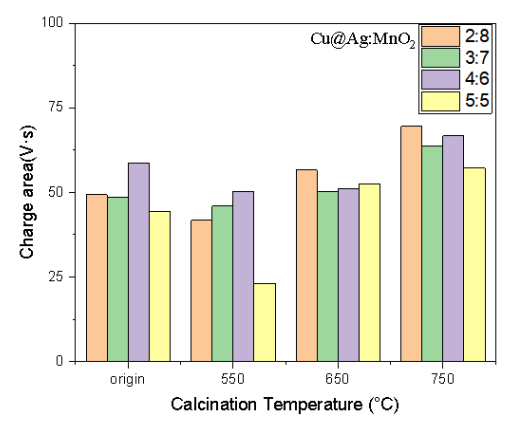
CuMn2O4 spinel oxides are promising electrode materials because of their multiple redox states and structural stability, but their practical performance is limited by low electrical conductivity and inefficient charge transfer. In this study, Ag-coated Cu (Cu@Ag) particles were integrated with MnO2 through mechanochemical ball milling followed by calcination at 550, 650, and 750 °C. The effects of the Cu@Ag:MnO2 mass ratio and calcination temperature on phase evolution, microstructure, and electrochemical behavior were investigated. X-ray diffraction showed progressive conversion of Cu-containing phases to CuO and subsequently to spinel CuMn2O4, accompanied by crystallite growth at higher temperatures. Scanning electron microscopy revealed improved particle connectivity at 650 °C, whereas calcination at 750 °C caused grain coarsening and particle coalescence. The electrodes exhibited combined electric double-layer and Faradaic charge-storage behavior. The highest integrated CV charge area, 69.0 V·s, was obtained for the 2:8 composition calcined at 750 °C, while the highest open-circuit voltage, approximately 1.10 V, occurred for the 3:7 composition calcined at 650 °C. Considering phase development, microstructural stability, CV profile retention, open-circuit voltage, and internal resistance, the 4:6 composition calcined at 650 °C provided the most balanced overall response. Because a CuMn2O4-only control electrode was not included, the contribution of Cu@Ag should be interpreted qualitatively.
References
1. Alemu MA, Ebissa DT, Getie MZ, et al. Recent development of rechargeable solid-state metal-air batteries for electric mobility. Energy Reports. 2024; 12: 517–528. doi: 10.1016/j.egyr.2024.06.007
2. Tang W, Mai J, Liu L, et al. Recent advances of bifunctional catalysts for zinc air batteries with stability considerations: from selecting materials to reconstruction. Nanoscale Advances. 2023; 5(17): 4368–4401. doi: 10.1039/D3NA00074E
3. Dai Y, Yu J, Cheng C, et al. Mini-review of perovskite oxides as oxygen electrocatalysts for rechargeable zinc–air batteries. Chemical Engineering Journal. 2020; 397: 125516. doi: 10.1016/j.cej.2020.125516
4. Zhao Z, Liu Y, Yu J, et al. Critical metrics for practical application-oriented rechargeable zinc-air batteries. Current Opinion in Electrochemistry. 2026; 55: 101784. doi: 10.1016/j.coelec.2025.101784
5. Lin X, Chen G, Zhu Y, et al. Advanced dual-atom catalysts for rechargeable zinc-air batteries. Energy Reviews. 2024; 3(3): 100076. doi: 10.1016/j.enrev.2024.100076
6. Liu Q, Shi H, Han T, et al. Research progress in wide-temperature flexible zinc-air batteries. Energy Storage Materials. 2024; 67: 103255. doi: 10.1016/j.ensm.2024.103255
7. Alshoaibi A, Nwachukwu IM. Design-driven innovation in zinc-air battery architecture: Toward flexible, wearable, and grid-scale applications. Current Opinion in Electrochemistry. 2025; 54: 101775. doi: 10.1016/j.coelec.2025.101775
8. Nsanzimana JMV, Cai L, Jiang Z, et al. Engineering Bifunctional Catalytic Microenvironments for Durable and High-Energy-Density Metal–Air Batteries. Nano-Micro Letters. 2025; 17(1): 294. doi: 10.1007/s40820-025-01799-w
9. Deva P, Ravi S, Manikandan E. Facile synthesis of CuMn2O4 nanoparticles for efficient of high performance electrode materials for supercapacitor application. Ceramics International. 2024; 50(7): 11916–11927. doi: 10.1016/j.ceramint.2024.01.095
10. Xie A, Zhang S, Peng W, et al. Oxygen-vacancy-enriched CuMn2O4@CoAl layered double hydroxide nickel foam serving as a sophisticated electrode material for asymmetric supercapacitors. Journal of Alloys and Compounds. 2024; 1005: 176105. doi: 10.1016/j.jallcom.2024.176105
11. Albandari AW, Alyousef HA, Alotaibi BM, et al. Facile synthesis of CuMn2O4 nanoparticle supported on MoS2 nanorods via hydrothermal route for supercapacitor application. Materials Chemistry and Physics. 2024; 322: 129517. doi: 10.1016/j.matchemphys.2024.129517
12. Abel MJ, Pramothkumar A, Senthilkumar N, et al. Flake-like CuMn2O4 nanoparticles synthesized via co-precipitation method for photocatalytic activity. Physica B: Condensed Matter. 2019; 572: 117–124. doi: 10.1016/j.physb.2019.07.047
13. Ma P, Geng Q, Gao X, et al. Solution combustion of spinel CuMn2O4 ceramic pigments for thickness sensitive spectrally selective (TSSS) paint coatings. Ceramics International. 2016; 42(10): 11966–11973. doi: 10.1016/j.ceramint.2016.04.122
14. Boldyreva E. Mechanochemistry of inorganic and organic systems: what is similar, what is different? Chemical Society Reviews. 2013; 42(18): 7719. doi: 10.1039/c3cs60052a
15. Cobos MÁ, Jiménez JA, Llorente I, et al. Ball milling and annealing effect in structural and magnetic properties of copper ferrite by ceramic synthesis. Journal of Alloys and Compounds. 2024; 1006: 176206. doi: 10.1016/j.jallcom.2024.176206
16. Baláž M, Džunda R, Bureš R, et al. Mechanically induced self-propagating reactions (MSRs) to instantly prepare binary metal chalcogenides: assessing the influence of particle size, bulk modulus, reagents melting temperature difference and thermodynamic constants on the ignition time. RSC Mechanochemistry. 2024; 1(1): 94–105. doi: 10.1039/D3MR00001J
17. Baláž P, Achimovičová M, Baláž M, et al. Hallmarks of mechanochemistry: from nanoparticles to technology. Chemical Society Reviews. 2013; 42(18): 7571. doi: 10.1039/c3cs35468g
18. Lin J, Guo Y, Chen X, et al. CO Oxidation over Nanostructured Ceria Supported Bimetallic Cu–Mn Oxides Catalysts: Effect of Cu/Mn Ratio and Calcination Temperature. Catalysis Letters. 2018; 148(1): 181–193. doi: 10.1007/s10562-017-2227-x
19. Nolly C, Ikpo CO, Ndipingwi MM, et al. Pseudocapacitive Effects of Multi-Walled Carbon Nanotubes-Functionalised Spinel Copper Manganese Oxide. Nanomaterials. 2022; 12(19): 3514. doi: 10.3390/nano12193514
20. Tripathi HS, Chowdhury D. Controlled surface engineering of CuMn2O4 spinel nanorods for high performance solid-state symmetric supercapacitor. Journal of Power Sources. 2026; 665: 239041. doi: 10.1016/j.jpowsour.2025.239041
21. Zhang C, Xie A, Zhang W, et al. CuMn2O4 spinel anchored on graphene nanosheets as a novel electrode material for supercapacitor. Journal of Energy Storage. 2021; 34: 102181. doi: 10.1016/j.est.2020.102181
22. Li L, Jiang G, Ma J. CuMn2O4/graphene nanosheets as excellent anode for lithium-ion battery. Materials Research Bulletin. 2018; 104: 53–59. doi: 10.1016/j.materresbull.2018.03.051
23. Chandran MKN, Babu GNS, Sathish M. CuMn2O4 anchored on graphene sheets as a high-performance electrodes for sodium-ion batteries. Journal of Energy Storage. 2023; 65: 107346. doi: 10.1016/j.est.2023.107346
24. Yang CY, Yen YT, Lin LJ, et al. Application of silver-coated copper powder in the catalyst of metal air batteries. Journal of Physics: Conference Series. 2025; 3144(1): 012017. doi: 10.1088/1742-6596/3144/1/012017
25. Ding S, Zhu C, Hojo H, et al. Enhanced catalytic performance of spinel-type Cu-Mn oxides for benzene oxidation under microwave irradiation. Journal of Hazardous Materials. 2022; 424: 127523. doi: 10.1016/j.jhazmat.2021.127523
26. Conway BE. Electrochemical Supercapacitors. Springer; 1999. doi: 10.1007/978-1-4757-3058-6
27. Bi J, Xue F, Cui M, et al. Regulating the Redox Cycle of Highly Dispersed CuMn2O4 on SiO2 for Toluene Catalytic Combustion. Industrial & Engineering Chemistry Research. 2024; 63(25): 10997–11008. doi: 10.1021/acs.iecr.4c01071
28. Wan X, Tang N, Xie Q, et al. A CuMn2O4 spinel oxide as a superior catalyst for the aerobic oxidation of 5-hydroxymethylfurfural toward 2,5-furandicarboxylic acid in aqueous solvent. Catalysis Science & Technology. 2021; 11(4): 1497–1509. doi: 10.1039/D0CY01649G
29. Fleischmann S, Mitchell JB, Wang R, et al. Pseudocapacitance: From Fundamental Understanding to High Power Energy Storage Materials. Chemical Reviews. 2020; 120(14): 6738–6782. doi: 10.1021/acs.chemrev.0c00170
30. Wang G, Zhang L, Zhang J. A review of electrode materials for electrochemical supercapacitors. Chemical Society Reviews. 2012; 41(2): 797–828. doi: 10.1039/C1CS15060J
31. Park MS, Kim J, Kim KJ, et al. Porous nanoarchitectures of spinel-type transition metal oxides for electrochemical energy storage systems. Physical Chemistry Chemical Physics. 2015; 17(46): 30963–30977. doi: 10.1039/C5CP05936D
32. Simon P, Gogotsi Y. Materials for electrochemical capacitors. Nature Materials. 2008; 7(11): 845–854. doi: 10.1038/nmat2297
33. Jiang Y, Liu J. Definitions of Pseudocapacitive Materials: A Brief Review. Energy & Environmental Materials. 2019; 2(1): 30–37. doi: 10.1002/eem2.12028
34. Srikala D, Kaushik SD, Verma M. Overview on Spinel Oxides: Synthesis and Applications in Various Fields. Physics of the Solid State. 2024; 66(9): 327–340. doi: 10.1134/S1063783424601073
35. Dippong T, Levei EA, Cadar O. Recent Advances in Synthesis and Applications of MFe2O4 (M = Co, Cu, Mn, Ni, Zn) Nanoparticles. Nanomaterials. 2021; 11(6): 1560. doi: 10.3390/nano11061560
36. Bard AJ, Faulkner LR, White HS, Electrochemical Methods: Fundamentals And Applications. John Wiley & Sons; 2022.
37. Rieger PH. Electrochemistry. Springer; 1994. doi: 10.1007/978-94-011-0691-7
38. Basri TSJ, Anandan B, Karpagam P, et al. Synergistic CuMn2O4/MnO2/MWCNT nanohybrid for ultra-stable and high-energy asymmetric supercapacitors. Journal of Porous Materials. 2025; 32(6): 2483–2495. doi: 10.1007/s10934-025-01837-3
39. Suntivich J, May KJ, Gasteiger HA, et al. A Perovskite Oxide Optimized for Oxygen Evolution Catalysis from Molecular Orbital Principles. Science. 2011; 334(6061): 1383–1385. doi: 10.1126/science.1212858
40. Wang B, Zhang F. Main Descriptors To Correlate Structures with the Performances of Electrocatalysts. Angewandte Chemie International Edition. 2022; 61(4): e202111026. doi: 10.1002/anie.202111026
41. Montalto M, Freitas WDS, Mastronardo E, et al. Spinel-type high-entropy oxides for enhanced oxygen evolution reaction activity in anion exchange membrane water electrolyzers. Chemical Engineering Journal. 2025; 507: 160641. doi: 10.1016/j.cej.2025.160641
Downloads
Published
How to Cite
Issue
Section
License
Copyright (c) 2026 Chih-Hao Yang, Li-Jing Lin, Ruei-Jhih Su, Li-Chi Yun, Jia-Hao Zeng, Dong-Yan Sie, Shih-Hsien Chang

This work is licensed under a Creative Commons Attribution 4.0 International License.





.jpg)
.jpg)