Two-dimensional experiment on wave-structure interaction of modular floating PV under regular waves: Comparison result between rigid and flexible connector
DOI:
https://doi.org/10.18686/cest844Keywords:
flexible connector; heave; marine FPV; RAO (response amplitude operator); pitchAbstract
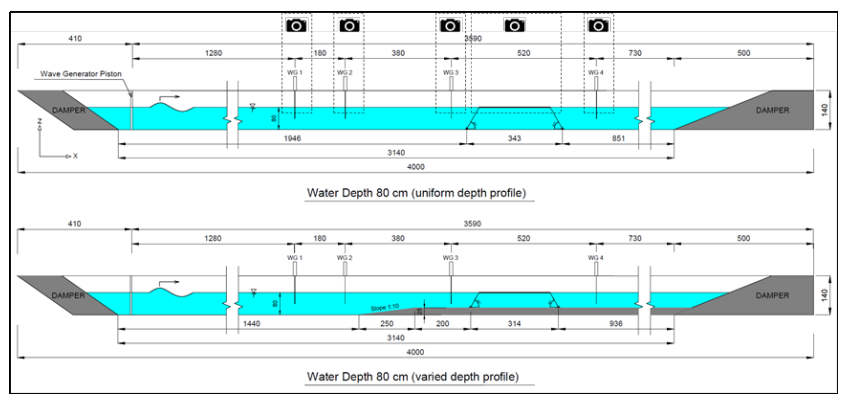
This study experimentally investigates the hydrodynamic response of a modular floating photovoltaic (FPV) system, where individual floaters behave as rigid bodies, and global responses are governed by connector configurations (fixed and flexible connectors) under regular waves. The effects of wave period, water depth, and bottom profile variation are examined. To represent hydroelasticity effects, two different models were developed: a fully rigidly connected array and a hybrid system combining flexible and rigid connectors. The results revealed that flexible connectors reduce global load transfer for incoming waves perpendicular to their rotational axis but introduce higher variability in heave and pitch, whereas rigid connectors produce more coherent motion with higher mean tension. Heave response is primarily governed by resonance and depth-dependent effects. In contrast, pitch response is driven by wave steepness, where larger surface slopes induce stronger differential loading. Bottom profile variation further increases spatial non-uniformity in both responses. Taut mooring systems induce overwash that may affect measurements, highlighting the need to separate mooring and structural models. Although based on a two-dimensional setup, the results provide qualitative insights, supporting further coupled experimental and numerical analyses.
References
1. Zou T, Jiang J, Li H, et al. Structural responses of offshore multi-body floating photovoltaic array under different connection conditions. Applied Ocean Research. 2025; 158: 104544. doi: 10.1016/j.apor.2025.104544
2. Van Der Zanden J, Bunnik T, Cortés A, et al. Wave Basin Tests of a Multi-Body Floating PV System Sheltered by a Floating Breakwater. Energies. 2024; 17(9): 2059. doi: 10.3390/en17092059
3. Kabir E, Kumar P, Kumar S, et al. Solar energy: Potential and future prospects. Renewable and Sustainable Energy Reviews. 2018; 82: 894–900. doi: 10.1016/j.rser.2017.09.094
4. Tay ZY. Three-Dimensional Hydroelasticity of Multi-Connected Modular Offshore Floating Solar Photovoltaic Farm. Journal of Marine Science and Engineering. 2023; 11(10): 1968. doi: 10.3390/jmse11101968
5. Barbón A, Bayón-Cueli C, Bayón L, et al. A methodology for an optimal design of ground-mounted photovoltaic power plants. Applied Energy. 2022; 314: 118881. doi: 10.1016/j.apenergy.2022.118881
6. Luo W, Zhang X, Tian X, et al. Conceptual design and model test of a pontoon-truss type offshore floating photovoltaic system with soft connection. Ocean Engineering. 2024; 309: 118518. doi: 10.1016/j.oceaneng.2024.118518
7. Liu L, Wang Q, Lin H, et al. Power Generation Efficiency and Prospects of Floating Photovoltaic Systems. Energy Procedia. 2017; 105: 1136–1142. doi: 10.1016/j.egypro.2017.03.483
8. Sahu A, Yadav N, Sudhakar K. Floating photovoltaic power plant: A review. Renewable and Sustainable Energy Reviews. 2016; 66: 815–824. doi: 10.1016/j.rser.2016.08.051
9. Hao R, Sun X, Zhao Y, et al. Advancing floating photovoltaic systems: trends, challenges, and future directions in sustainable energy development. International Journal of Green Energy. 2025; 22(4): 688–709. doi: 10.1080/15435075.2024.2423264
10. Trapani K, Santafé MR. A review of floating photovoltaic installations: 2007–2013. Progress in Photovoltaics: Research and Applications. 2015; 23(4): 524–532. doi: 10.1002/pip.2466
11. Emami A, Karimirad M. Further development of offshore floating solar and its design requirements. Marine Structures. 2025; 100: 103730. doi: 10.1016/j.marstruc.2024.103730
12. Jiang Z, Dai J, Saettone S, et al. Design and model test of a soft-connected lattice-structured floating solar photovoltaic concept for harsh offshore conditions. Marine Structures. 2023; 90: 103426. doi: 10.1016/j.marstruc.2023.103426
13. Shi Y, Wei Y, Chen K, et al. Frequency-domain approach of hydroelastic response for flexible offshore floating photovoltaic under combined wind and wave loads. Ocean Engineering. 2025; 323: 120565. doi: 10.1016/j.oceaneng.2025.120565
14. Claus R, López M. Key issues in the design of floating photovoltaic structures for the marine environment. Renewable and Sustainable Energy Reviews. 2022; 164: 112502. doi: 10.1016/j.rser.2022.112502
15. Yang RY, Yu SH. A Study on a Floating Solar Energy System Applied in an Intertidal Zone. Energies. 2021; 14(22): 7789. doi: 10.3390/en14227789
16. Jia G, Zhang Z, Zhao Y, et al. Effects of flexible connectors on hydrodynamic and energy output characteristics of floating photovoltaic (FPV) arrays in harsh marine environments: A physical model analysis. Renewable Energy. 2026; 256: 124266. doi: 10.1016/j.renene.2025.124266
17. Ding R, Zhang H, Liu C, et al. Connector configuration effect on the dynamic characteristics of multi-modular floating structure. Journal of Ocean Engineering and Science. 2024; 9(6): 517–527. doi: 10.1016/j.joes.2022.08.003
18. Jiang D, Tan KH, Wang CM, et al. Research and development in connector systems for Very Large Floating Structures. Ocean Engineering. 2021; 232: 109150. doi: 10.1016/j.oceaneng.2021.109150
19. Ji C, Gao X, Xu S. Study on the influence of connector designs on the hydrodynamic performance of an offshore floating photovoltaic. Ocean Engineering. 2024; 308: 118298. doi: 10.1016/j.oceaneng.2024.118298
20. Ma G, Zhang C, Chen H, et al. Hydrodynamic analysis of floating photovoltaic system constrained with rigid connectors. Scientific Reports. 2024; 14(1): 29920. doi: 10.1038/s41598-024-81245-w
21. Kaymak MK, Şahin AD. Problems encountered with floating photovoltaic systems under real conditions: A new FPV concept and novel solutions. Sustainable Energy Technologies and Assessments. 2021; 47: 101504. doi: 10.1016/j.seta.2021.101504
22. Suzuki H, Riggs HR, Fujikubo M, et al. Very Large Floating Structures. In: Proceedings of the ASME 2007 26th International Conference on Offshore Mechanics and Arctic Engineering; 1 January 2007; San Diego, CA, USA. pp. 597–608. doi: 10.1115/OMAE2007-29758
23. Rajendran S, Soares CG. Numerical investigation of the vertical response of a containership in large amplitude waves. Ocean Engineering. 2016; 123: 440–451. doi: 10.1016/j.oceaneng.2016.06.039
24. Naiborhu MA, Tawekal RL, Firdaus AM, et al. Model Setup Evaluation for Two-Dimensional Physical Model of Wave-Structure Interaction for Modular Floating Photovoltaic. Sustainable Marine Structures. 2025; 132–149. doi: 10.36956/sms.v7i4.2719
25. Delacroix S, Bourdier S, Soulard T, et al. Experimental Modelling of a Floating Solar Power Plant Array under Wave Forcing. Energies. 2023; 16(13): 5198. doi: 10.3390/en16135198
26. Ikhennicheu M, Blanc A, Danglade B, et al. OrcaFlex Modelling of a Multi-Body Floating Solar Island Subjected to Waves. Energies. 2022; 15(23): 9260. doi: 10.3390/en15239260
27. Bai Y, Jin WL. Random Variables and Uncertainty Analysis. In: Marine Structural Design. Elsevier; 2016. pp. 615–625. doi: 10.1016/B978-0-08-099997-5.00033-2
28. Choi YK. A Study on Power Generation Analysis of Floating PV System Considering Environmental Impact. International Journal of Software Engineering and Its Applications. 2014; 8(1): 75–84. doi: 10.14257/ijseia.2014.8.1.07
Downloads
Published
How to Cite
Issue
Section
License
Copyright (c) 2026 Maria Angelin Naiborhu, Ricky Lukman Tawekal, Farid Putra Bakti, Ahmad Muchlis Firdaus, Eko Charnius Ilman, Muhamad Rayhan Khashib, Reynard Alexander Zebua, Adinda Putri Kania Hermanto, Hasya Farhana, Ahmad Safii Maarif

This work is licensed under a Creative Commons Attribution 4.0 International License.





.jpg)
.jpg)