Design of a waste-based heat recovery system for industrial baking ovens at a large-scale food facility
DOI:
https://doi.org/10.18686/cest846Keywords:
waste heat recovery thermal pipe technology; industrial baking processes; food production; energy utilization efficiency; thermal energy recuperationAbstract
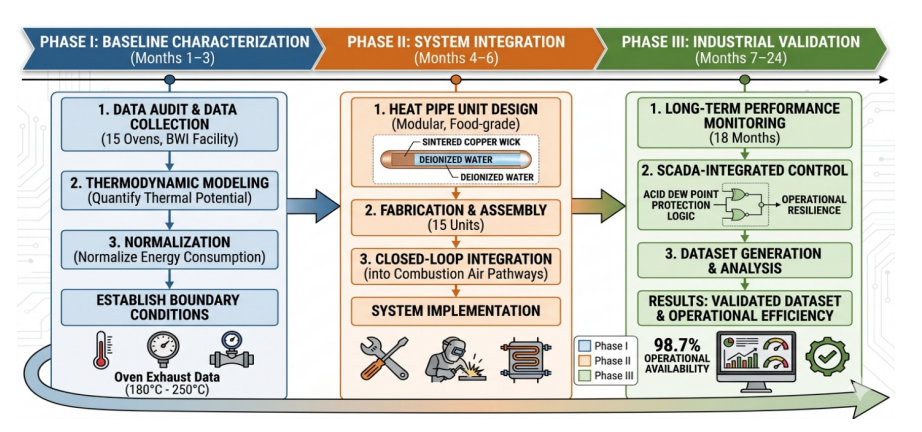
Food manufacturing facilities are a crucial industry for many national economies. However, maintaining a sterile, clean environment they require also demand large amounts of energy and fuel, necessitating in-depth scientific studies to conserve energy in such complex environments. This study designed a unique, large-scale, and industrial-level waste heat recovery (WHR) system with an 18-month implementation within 15 tunnel ovens at a Biscuits and Wafers Industry (BWI) plant in Yemen, a country facing multiple energy challenges. Initial measurements indicated that up to 60% of thermal energy was delivered within the exhaust gases at 150–250 ℃, with a cumulative waste energy of up to 6,000 MWh/year. To overcome this, modular heat pipe systems with deionized water and a sintered copper wick were incorporated to preheat combustion air. Material integrity was verified through Helium leak testing (<1*10−9 mbar*L/s) and monthly ATP bioluminescence swabbing (<10 RLU), providing empirical evidence of zero cross-contamination and HACCP compliance. The proposed system had thermal efficiencies (η) of 36–42%, and exergy efficiencies (ψ) of 22–28%, indicating that an energy saving of more than 3,000 MWh/year and a reduction of about 650 t CO2 emissions could be achieved. Economic analysis resulted in a very competitive simple payback period of 4.1–4.6 years and an Internal Rate of Return (IRR) of 20–22.3%. Besides, the proposed design also offers validated design parameters and SCADA-based control strategies to scale up carbon-neutral thermal recovery in the global food manufacturing industry. It also provides economic standards and operational values for wider industry applications.
References
1. Ríos-Fernández JC. Energy and Exergy Evaluation of the Integrated Waste Energy Recovery System (IWERS) and the Solar‐Powered Integrated Waste Energy Recovery System (SPIWERS) in Various Climates. International Journal of Energy Research. 2025; 2025(1): 4282464. doi: 10.1155/er/4282464
2. Serban C, Mandis A, Pisa I, et al. Optimizing Energy Efficiency by Implementing a Heat Recovery System in an Industrial Process Used in Energy Communities. In: Proceedings of the 2025 IEEE International Conference on Environment and Electrical Engineering and 2025 IEEE Industrial and Commercial Power Systems Europe; 15–18 July 2025; Chania, Greece. pp. 1–6. doi: 10.1109/EEEIC/ICPSEurope64998.2025.11169111
3. Stadnyk I, Piddubnyi V, Chahaida A, et al. Energy Saving Thermal Systems on the Mobile Platform of the Mini-Bakery. Journal of Mechanical Engineering. 2023; 73(1): 169–186. doi: 10.2478/scjme-2023-0014
4. Stadnyk I, Piddubnyi V, Balaban S, et al. Methodology for assessing the heat potential recovery regime at food industry enterprises. Animal Science and Food Technology. 2023; 14(1). doi: 10.31548/animal.1.2023.95
5. Zamri NF, Rahin AN, et al. The Representative Thermal Conductivity of Wickless Heat Pipes in a Thermoelectric Generator Module Design via Computational Numerical Analysis. Journal of Applied Engineering Design and Simulation. 2023; 3(1): 40–50. doi: 10.24191/jaeds.v3i1.61
6. Erdoğan M, Acar MS. Thermodynamic analysis of a tunnel biscuit oven and heat recovery system. WAPRIME. 2024; 1(1): 1–15. doi: 10.5281/ZENODO.14930792
7. Ríos‐Fernández JC. Thermoeconomic analysis of the IWERS system for steam heat recovery from bakery ovens. Energy Science & Engineering. 2024; 12(7): 2852–2863. doi: 10.1002/ese3.1772
8. Alexandratos N, Bruinsma J. World Agriculture Towards 2030/2050: The 2012 Revision. Food and Agriculture Organization of the United Nations; 2012. Available online: https://www.fao.org/4/ap106e/ap106e.pdf
9. Chowdhury JI, Asfand F, Ja’fari M, et al. Waste heat recovery integration options for commercial bakeries in a thermo-economic-environmental perspective. Case Studies in Thermal Engineering. 2023; 52: 103714. doi: 10.1016/j.csite.2023.103714
10. Kosmadakis G. Industrial waste heat potential and heat exploitation solutions. Applied Thermal Engineering. 2024; 246: 122957. doi: 10.1016/j.applthermaleng.2024.122957
11. Li L, Qian J, Teng S, et al. Comparative analysis and optimization of waste-heat recovery systems with large-temperature-gradient heat transfer. Applied Thermal Engineering. 2023; 234: 121179. doi: 10.1016/j.applthermaleng.2023.121179
12. Ding C, Zhang X, Liang G, et al. Optimizing Exergy Efficiency in Integrated Energy System: A Planning Study Based on Industrial Waste Heat Recovery. IEEE Access. 2024; 12: 148074–148089. doi: 10.1109/ACCESS.2024.3468291
13. Panigrahi SS, Mishra G, Kumar V, et al. Next‐Generation Food Drying: Specialized and Smart Approaches to Boost Efficiency and Quality. Comprehensive Reviews in Food Science and Food Safety. 2025; 24(5): e70269. doi: 10.1111/1541-4337.70269
14. Maksimov I, Kindra V, Vegera A, et al. Thermodynamic Analysis and Optimization of Power Cycles for Waste Heat Recovery. Energies. 2024; 17(24): 6375. doi: 10.3390/en17246375
15. Sutar SV, Yadav GD. Advancements in spray drying system for heat recovery, methodology, and economics: A review. Drying Technology. 2023; 41(16): 2537–2565. doi: 10.1080/07373937.2023.2280641
16. Walden JVM, Wellig B, Stathopoulos P. Heat pump integration in non-continuous industrial processes by Dynamic Pinch Analysis Targeting. Applied Energy. 2023; 352: 121933. doi: 10.1016/j.apenergy.2023.121933
17. Zhong X, Min Z, Yu Q, et al. Food Drying for Low‐Carbon and Future Food: A Review on the Sustainability of Drying Technology. Comprehensive Reviews in Food Science and Food Safety. 2025; 24(6): e70310. doi: 10.1111/1541-4337.70310
18. Deymi-Dashtebayaz M, Davoodi V, Khutornaya J, et al. Parametric analysis and multi-objective optimization of a heat pump dryer based on working conditions and using different refrigerants. Energy. 2023; 284: 129231. doi: 10.1016/j.energy.2023.129231
19. Darvishi H, Khodaei J, Behroozi-Khazaei N, et al. Greenhouse gas emission reduction potential, energy and exergy analysis of combined microwave-convective dryer. Energy. 2023; 285: 128772. doi: 10.1016/j.energy.2023.128772
20. Hashed WBA, Pasupuleti J, Paw JKS, et al. Integrated Approach for Energy Conservation and Efficiency Enhancement of Cooling and Air Conditions in Industrial Operations: A Sustainable Design for Yemen. Jordan Journal of Mechanical and Industrial Engineering. 2025; 19(3): 531–546. doi: 10.59038/jjmie/190306
21. Grossmann L, Smetana S, Bakalis S. Strategies to Reduce Fossil Fuel Use in Food Manufacturing. Annual Review of Food Science and Technology. 2024; 15(1): 329–353. doi: 10.1146/annurev-food-072023-034332
22. Giordano L, Benedetti M, Salvio M. Estimating the Potential for Waste Heat Recovery in Italian Dairy Sector Using a Bottom-Up Approach and Data from Energy Audits. Sustainability. 2023; 15(12): 9719. doi: 10.3390/su15129719
23. Castillo-Vergara M, Quispe-Fuentes I, Poblete J. Technological Innovation in the Food Industry: A Bibliometric Analysis. Engineering Economics. 2021; 32(3): 197–209. doi: 10.5755/j01.ee.32.3.26000
24. Vorderwülbecke A, Korflür I, Löckener R. Industry Analysis of the Bread and Bakery Products Industry: Industry Trends and Their Impacts on Employment and Working Conditions. The Hans Böckler Foundation; 2018. Available online: https://www.econstor.eu/bitstream/10419/177294/1/1017846944.pdf (in German)
25. Remeli MF. Simultaneous Industrial Waste Heat Recovery and Power Generation Using Heat Pipe Assisted Thermoelectric Generator [PhD Thesis]. RMIT University; 2015. doi: 10.25439/RMT.27590877
26. Malcho M, Jandačka J, Lenhard R, et al. Applications of Heat Pipes in Thermal Management. Energies. 2025; 18(19): 5282. doi: 10.3390/en18195282
27. Ravindran RV, Cotter D, Wilson C, et al. Experimental investigation of a small-scale reversible high-temperature heat pump−organic Rankine cycle system for industrial waste heat recovery. Applied Thermal Engineering. 2024; 257: 124237. doi: 10.1016/j.applthermaleng.2024.124237
28. Ștefănica EV, Abid C, Burlacu A, et al. Strategic Optimization of Operational Parameters in a Low-Temperature Waste Heat Recovery System: A Numerical Approach. Sustainability. 2024; 16(16): 7013. doi: 10.3390/su16167013
29. Mishra D, Kumar A. Innovative Waste Heat Recovery in Cement ProductionReducing CO₂ Emissions and Energy Consumption. International Journal of Research and Review in Applied Science, Humanities, and Technology. 2024; 1(1): 1–6. doi: 10.71143/ewn0dm86
30. Do Nascimento NN, Paraíso CM, Molina LCA, et al. Innovative Trends in Modified Membranes: A Mini Review of Applications and Challenges in the Food Sector. Membranes. 2024; 14(10): 209. doi: 10.3390/membranes14100209
31. Altay Ö, Selçuk E, Abacı Ö, et al. Recent progress in food processing applications of air impingement technology: A review. Comprehensive Reviews in Food Science and Food Safety. 2023; 22(4): 3084–3104. doi: 10.1111/1541-4337.13175
Downloads
Published
How to Cite
Issue
Section
License
Copyright (c) 2026 Wael Bakil Ali Hashed, Mohd Helmi Mansor, Johnny Koh Siaw Paw, Mokhtar Ali Amrani

This work is licensed under a Creative Commons Attribution 4.0 International License.





.jpg)
.jpg)