A Hybrid DE–NSGA-II Framework for Stochastic Multi-Objective Optimal Power Flow Considering Wind Uncertainty: Pareto-Based Analysis on a Real Transmission System
DOI:
https://doi.org/10.18686/cest891Keywords:
stochastic optimization; optimal power flow; NSGA-II; differential evolution; wind energy; Pareto front; renewable integrationAbstract
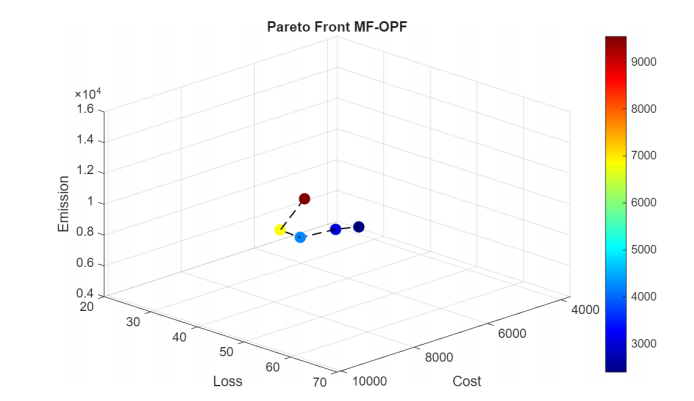
Abstract: This paper proposes a stochastic multi-objective optimal power flow (MO-OPF) framework that incorporates wind power uncertainty using a scenario-based modeling approach. A hybrid Differential Evolution–Non-dominated Sorting Genetic Algorithm II (DE–NSGA-II) is introduced to enhance convergence speed and solution diversity compared to conventional NSGA-II. The proposed model simultaneously minimizes generation cost, transmission losses, and emission levels while satisfying system operational constraints. The methodology is validated on a real transmission network representing the Sulawesi power system. Simulation results show that the proposed approach achieves significant performance improvements, where generation cost is reduced from 10,101 to 3,740.7, transmission losses decrease from 62.955 to 24.65, and emission levels are lowered from 14,571 to 4,101.9 across the obtained Pareto solutions. These results demonstrate the capability of the model to effectively balance conflicting objectives under wind power uncertainty. Furthermore, the generated Pareto front exhibits a well-distributed and non-linear structure, indicating strong diversity and robustness of the hybrid DE–NSGA-II algorithm in exploring the solution space. The obtained solutions reveal clear trade-offs among economic, technical, and environmental objectives, providing flexibility for system operators in decision-making. These findings confirm that the proposed framework is effective and suitable for modern power system operation with high penetration of renewable energy sources.
References
1. Eltohamy MS, Aldawsari MSM, Sadek ARA, et al. Enhancing Electric Grid Flexibility for the Integration of Variable Renewable Energy: Challenges, Innovations, and Future Directions. IEEE Access. 2026; 14: 23080–23109. doi: 10.1109/ACCESS.2026.3660837
2. Ali JS, Qiblawey Y, Alassi A, et al. Power System Stability With High Penetration of Renewable Energy Sources: Challenges, Assessment, and Mitigation Strategies. IEEE Access. 2025; 13: 39912–39934. doi: 10.1109/ACCESS.2025.3546491
3. Li H, Liu L, Wu Q. Physics-guided Chebyshev graph convolution network for optimal power flow. Electric Power Systems Research. 2025; 245: 111651. doi: 10.1016/j.epsr.2025.111651
4. Waheed A, Li J. A hybrid model for efficient reliability assessment of power systems. Sustainable Energy, Grids and Networks. 2026; 45: 102091. doi: 10.1016/j.segan.2025.102091
5. Babiker A, Ahmad SS, Ahmed I, et al. Optimal Power Flow: A Review of State-of-the-Art Techniques and Future Perspectives. IEEE Access. 2025; 13: 60012–60039. doi: 10.1109/ACCESS.2025.3556168
6. Hasan MS, Chowdhury MMUT, Kamalasadan S. Optimal Power Flow in Electric Transmission System: Comparative Study and Analysis of Modeling Methods. IEEE Transactions on Industry Applications. 2025; 61(3): 4328–4341. doi: 10.1109/TIA.2025.3540819
7. Maheshwari A, Sood YR, Jaiswal S. A Comprehensive Review on Stochastic Optimal Power Flow Problems and Solution Methodologies. IETE Technical Review. 2024; 41(2): 147–174. doi: 10.1080/02564602.2023.2224750
8. Nyingu BT, Masike L, Mbukani MWK. Multi-Objective Optimization of Load Flow in Power Systems: An Overview. Energies. 2025; 18(22): 6056. doi: 10.3390/en18226056
9. Katkar AB, Jadhav HT. A hybrid gbestABC–NSGA-II metaheuristic framework with tri-stage constraint handling for stochastic multi-objective optimal power flow in cleaner energy systems. International Journal of Energy and Water Resources. 2026; 10(2): 69. doi: 10.1007/s42108-026-00488-7
10. Chen Z. Optimal Power Flow in Renewable-Integrated Power Systems: A Comprehensive Review. arXiv preprint. 2024. doi: 10.48550/ARXIV.2408.05254
11. Ghasemloo A, Rezaei F, Roshandel R, et al. Comparative analysis of energy supply optimization for a residential stand-alone energy hub under fuel price uncertainty: Deterministic vs. stochastic approaches. Results in Engineering. 2025; 27: 106664. doi: 10.1016/j.rineng.2025.106664
12. Chen Y, Li X, Zhang Z. Risk assessment of rail transit systems with variable renewable energy based on uncertain random theory. International Journal of Electrical Power & Energy Systems. 2025; 164: 110441. doi: 10.1016/j.ijepes.2024.110441
13. Rahimi I, Gandomi AH, Chen F, et al. A Review on Constraint Handling Techniques for Population-based Algorithms: from single-objective to multi-objective optimization. Archives of Computational Methods in Engineering. 2023; 30(3): 2181–2209. doi: 10.1007/s11831-022-09859-9
14. Harkare V, Mangrulkar R, Thorat O, et al. Evolutionary Approaches for Multi-objective Optimization and Pareto-Optimal Solution Selection in Data Analytics. In: Applied Multi-Objective Optimization, Springer Tracts in Nature-Inspired Computing. Springer Nature; 2024. pp. 67–94. doi: 10.1007/978-981-97-0353-1_4
15. Pang LM, Ishibuchi H, Deb K, et al. MaNSGA-II: Many-Objective NSGA-II. IEEE Transactions on Emerging Topics in Computational Intelligence. 2025; 9(6): 3922–3937. doi: 10.1109/TETCI.2025.3576105
16. Saad MR, Emam MM, Houssein EH. An efficient multi-objective parrot optimizer for global and engineering optimization problems. Scientific Reports. 2025; 15(1): 5126. doi: 10.1038/s41598-025-88740-8
17. Saeidi M, Niknam T, Zare M, et al. Enhancing stochastic optimal power flow with modified cheetah optimizer for integrating renewable energy sources. Scientific Reports. 2025; 15(1): 14342. doi: 10.1038/s41598-025-98899-9
18. Katkar AB, Jadhav HT. Dynamic Stochastic Multi-objective Optimal Power Flow incorporating Solar-Wind Energy using Hybrid Gbest-guided Artificial Bee Colony–NSGA-II Algorithm. Preprint. 2025. doi: 10.21203/rs.3.rs-7714779/v1
19. Hafeez A, Ali A, Keerio MU, et al. Optimal site and size of FACTS devices with the integration of uncertain wind generation on a solution of stochastic multi-objective optimal power flow problem. Frontiers in Energy Research. 2023; 11: 1293870. doi: 10.3389/fenrg.2023.1293870
20. Naidu TP, Balasubramanian G, Venkateswararao B. Optimal power flow control optimisation problem incorporating conventional and renewable generation sources: a review. International Journal of Ambient Energy. 2023; 44(1): 1119–1150. doi: 10.1080/01430750.2022.2163287
21. Tentu P, Kundala PKY, Darimireddy NK. Distribution Generators Optimal Power Flow with Renewable Resources Network with Grey Wolf Optimization. Preprint. 2024. doi: 10.20944/preprints202404.1738.v1
22. Rawa M, Al-Turki Y, Sedraoui K, et al. Optimal operation and stochastic scheduling of renewable energy of a microgrid with optimal sizing of battery energy storage considering cost reduction. Journal of Energy Storage. 2023; 59: 106475. doi: 10.1016/j.est.2022.106475
23. Bhavsar S, Pitchumani R, Ortega-Vazquez MA, et al. A hybrid data-driven and model-based approach for computationally efficient stochastic unit commitment and economic dispatch under wind and solar uncertainty. International Journal of Electrical Power & Energy Systems. 2023; 151: 109144. doi: 10.1016/j.ijepes.2023.109144
24. Siregar RH, Away Y, Tarmizi, et al. Minimizing Power Losses for Distributed Generation (DG) Placements by Considering Voltage Profiles on Distribution Lines for Different Loads Using Genetic Algorithm Methods. Energies. 2023; 16(14): 5388. doi: 10.3390/en16145388
25. Yu P, Zhang H, Song Y, et al. Safe reinforcement learning for power system control: A review. Renewable and Sustainable Energy Reviews. 2025; 223: 116022. doi: 10.1016/j.rser.2025.116022
26. Dimovski A, Moncecchi M, Merlo M. Impact of energy communities on the distribution network: An Italian case study. Sustainable Energy, Grids and Networks. 2023; 35: 101148. doi: 10.1016/j.segan.2023.101148
27. Lee SM, Choi SW, Lee EB. Prediction Modeling of Flue Gas Control for Combustion Efficiency Optimization for Steel Mill Power Plant Boilers Based on Partial Least Squares Regression (PLSR). Energies. 2023; 16(19): 6907. doi: 10.3390/en16196907
28. Lu Z, Wang J, Shahidehpour M, et al. Cooperative Operation of Distributed Energy Resources and Thermal Power Plant With a Carbon-Capture-Utilization-and-Storage System. IEEE Transactions on Power Systems. 2024; 39(1): 1850–1866. doi: 10.1109/TPWRS.2023.3253809
29. Bolaños RI, Vega HP, Grisales-Noreña LF, et al. Intelligent Active and Reactive Power Management for Wind-Based Distributed Generation in Microgrids via Advanced Metaheuristic Optimization. Applied System Innovation. 2025; 8(4): 87. doi: 10.3390/asi8040087
30. Liu L, Liu J, Ye Y, et al. Ultra-short-term wind power forecasting based on deep Bayesian model with uncertainty. Renewable Energy. 2023; 205: 598–607. doi: 10.1016/j.renene.2023.01.038
31. Osifeko M, Munda J. Scenario-Based Stochastic Optimization for Renewable Integration Under Forecast Uncertainty: A South African Power System Case Study. Processes. 2025; 13(8): 2560. doi: 10.3390/pr13082560
32. Liu M, Zhu J, Liu M. Optimal AC Power Flow with Energy Storage and Renewable Energy: An Efficient RL Algorithm Capable of Handling Equality Constraints. International Journal of Computational Intelligence Systems. 2025; 18(1): 27. doi: 10.1007/s44196-025-00745-3
33. Houssein EH, Hassan MH, Mahdy MA, et al. Development and application of equilibrium optimizer for optimal power flow calculation of power system. Applied Intelligence. 2023; 53(6): 7232–7253. doi: 10.1007/s10489-022-03796-7
34. Lobos-Cornejo S, Grisales-Noreña LF, Andrade F, et al. Smart Energy Strategy for AC Microgrids to Enhance Economic Performance in Grid-Connected and Standalone Operations: A Gray Wolf Optimizer Approach. Sci. 2025; 7(2): 73. doi: 10.3390/sci7020073
35. Dar MR, Ganguly S. Voltage Regulation and Loss Minimization of Active Distribution Networks With Uncertainties Using Chance-Constrained Model Predictive Control. IEEE Transactions on Power Systems. 2025; 40(3): 2737–2749. doi: 10.1109/TPWRS.2024.3504532
36. Zhang J, Geth F, Heidari R, et al. Beyond simplifications: Evaluating assumptions for low-voltage network modelling in the DER era. Sustainable Energy, Grids and Networks. 2025; 43: 101860. doi: 10.1016/j.segan.2025.101860
Downloads
Published
How to Cite
Issue
Section
License
Copyright (c) 2026 Andi Muhammad Ilyas, Iswan, Agus Siswanto

This work is licensed under a Creative Commons Attribution 4.0 International License.





.jpg)
.jpg)