Development and techno-economic assessment of a trigeneration system based on the gas turbine and solar energy for peak shaving of the power grid
DOI:
https://doi.org/10.18686/cest416Keywords:
trigeneration; techno-economic; CPVT; gas turbine; peak shaving; waste to energyAbstract
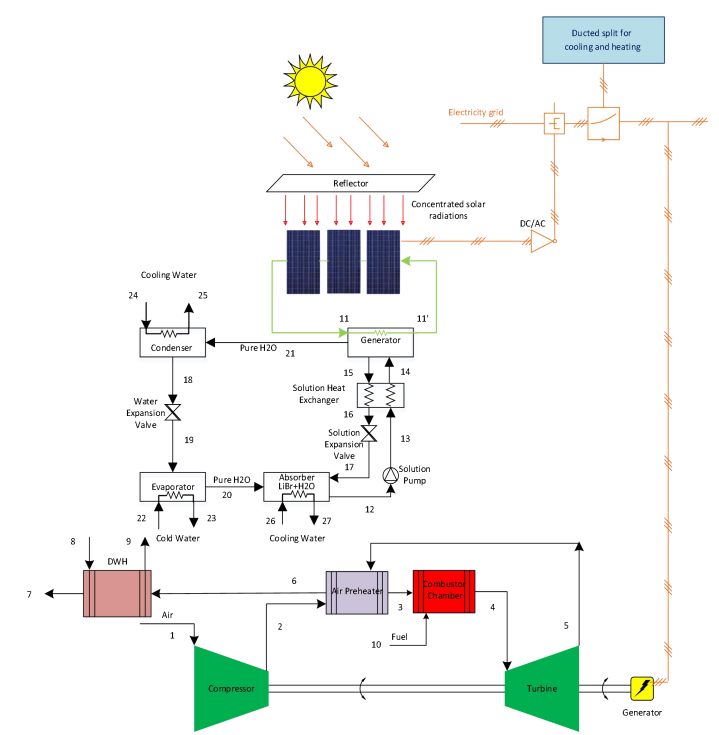
The escalating demands in sectors like steel production and the waning availability of non-renewable energy resources highlight the urgent necessity for sustainable and resilient energy solutions. In this changing landscape, localized energy generation systems, particularly combined cooling, heating, and power (CCHP) systems, emerge as a strong candidate to facilitate independent energy production. Our study involved the development and evaluation of an advanced CCHP system combining a gas turbine and a concentrated solar photovoltaic (CPVT) unit. This system notably enhances the efficiency of both heating and cooling operations through innovative waste-to-energy conversions and a heat transformer incorporated in the CPVT setup. We examined the system’s thermodynamic and energetic principles alongside a detailed techno-economic assessment to establish its economic feasibility. Our results reveal that the proposed system efficiently provides heating, cooling, and electricity, particularly in peak demand intervals, with energy and exergy efficiencies of 51.05% and 29.42%, respectively. The solar photovoltaic component further supported cooling efficiency, demonstrating a performance coefficient of 0.8058. Given the current surge in global electricity costs, our system offers a hopeful alternative, promising sustainable and independent energy solutions at competitive rates, thus indicating a path forward in the enduring energy crisis.
References
1. International Energy Agency. International Energy Agency (IEA) World Energy Outlook 2022; 2022.
2. Ufa RA, Malkova YY, Rudnik VE, et al. A review on distributed generation impacts on electric power system. International Journal of Hydrogen Energy. 2022; 47(47): 20347–20361. doi: 10.1016/j.ijhydene.2022.04.142
3. Electricity domestic consumption. Available online: https://yearbook.enerdata.net/electricity/electricity-domestic-consumption-data.html (accessed on 2 June 2025).
4. United Nations. Energy Statistics Pocketbook 2022. In: Statistics Papers, Serie EN°5. United Nations; 2022.
5. Gharehpetian GB, Mousavi Agah SM. Distributed generation systems: Design, operation, and grid integration; 2017.
6. Kosmadakis G, Manolakos D, Papadakis G. Simulation and economic analysis of a CPV/thermal system coupled with an organic Rankine cycle for increased power generation. Solar Energy. 2011; 85(2): 308–324. doi: 10.1016/j.solener.2010.11.019
7. Bejan, A, Tsatsaronis, G. and Moran, MJ, Thermal design and optimization. John Wiley & Sons; 1995. doi: 10.5860/choice.33-4516
8. Akrami E, Chitsaz A, Nami H, et al. Energetic and exergoeconomic assessment of a multi-generation energy system based on indirect use of geothermal energy. Energy. 2017; 124: 625–639. doi: 10.1016/j.energy.2017.02.006
9. SGT-600 Industrial Gas Turbine. Available online: http://www.heinkel-systeme.de/data/simple/0056/Heinkel_Gas_Turbine_
10. SGT-600_GT_PowerGen_EN.pdf
11. The Solar Atlas of Egypt. Available online: http://www.nrea.gov.eg/Content/files/SOLAR ATLAS 2018 digital1.pdf (accessed on 2 June 2025).
Downloads
Published
How to Cite
Issue
Section
License
Copyright (c) 2026 Kamand Hosseini, Alireza Rostamzadeh Khosroshahi, Ehsan Akrami, Shahram Khalilarya, Hossein Nami

This work is licensed under a Creative Commons Attribution 4.0 International License.





.jpg)
.jpg)