Synergistic co-digestion of agroindustrial biomass waste for optimized digestion for liquid biofertilizer recovery
DOI:
https://doi.org/10.18686/cest484Keywords:
anaerobic co-digestion; biorefinery systems; agricultural residues; nutrient recovery; process optimization; waste valorizationAbstract
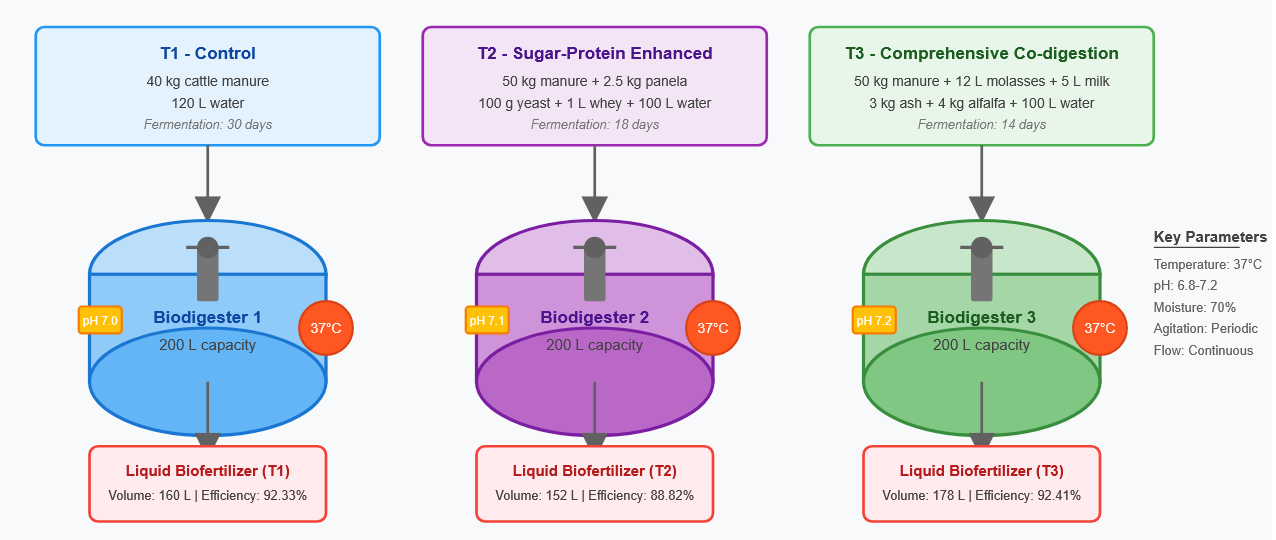
The improvement of biomass energy systems through waste valorization strategies represents a promising approach for rural energy infrastructure development. This study evaluated synergistic anaerobic co-digestion approaches to optimize liquid biofertilizer recovery from diversified agroindustrial biomass waste streams in the Ecuadorian highlands. Three formulations were tested: cattle manure, panela-yeast-whey blend, and molasses-milk-ash-Medicago sativa combination using 200 L tubular biodigesters at 37°C under randomized complete block design. Physicochemical characterization followed NTE INEN standards with ANOVA statistical analysis. The optimized co-digestion formulation achieved substantial improvements in nutrient concentration. Organic matter content elevated to 48.8% while bioconversion efficiency maintained 92.4%. Process optimization reduced fermentation time without compromising volumetric yield, demonstrating enhanced biomass throughput for distributed energy applications. Statistical validation confirmed treatment superiority across all macronutrients (p < 0.001). This multifunctional biorefinery approach transforms heterogeneous agricultural residues into value-added products, advancing biomass valorization technologies and supporting circular bioeconomy development in smallholder energy systems.
References
1. Sen A, Batabyal K, Mondal S, et al. Agriculturally Important Microorganisms: Mechanisms and Applications for Sustainable Agriculture. In: Use of Biofertilizers for Sustainable Agriculture. CRC Press; 2021. pp. 119–136.
2. Yadav AN, Singh J, Singh C, et al. Current Trends in Microbial Biotechnology for Sustainable Agriculture. Springer Singapore; 2021. doi: 10.1007/978-981-15-6949-4
3. Kunatsa T, Xia X. A review on anaerobic digestion with focus on the role of biomass co-digestion, modelling and optimisation on biogas production and enhancement. Bioresource Technology. 2022; 344: 126311. doi: 10.1016/j.biortech.2021.126311
4. Meng X, Yan J, Zuo B, et al. Full-scale of composting process of biogas residues from corn stover anaerobic digestion: Physical-chemical, biology parameters and maturity indexes during whole process. Bioresource Technology. 2020; 302: 122742. doi: 10.1016/j.biortech.2020.122742
5. Manzano Vela DR, Villegas Freire CN, Zabala Vizuete RF, et al. Utilization of Forest Residues for Cellulose Extraction from Timber Species in the High Montane Forest of Chimborazo, Ecuador. Polymers. 2024; 16(19): 2713. doi: 10.3390/polym16192713
6. Ravindran B, Karmegam N, Yuvaraj A, et al. RETRACTED: Cleaner production of agriculturally valuable benignant materials from industry generated bio-wastes: A review. Bioresource Technology. 2021; 320: 124281. doi: 10.1016/j.biortech.2020.124281
7. Tuli DK, Agrawal R, Satlewal A, et al. Kinetic and enzyme recycling studies of immobilized b-glucosidase for lignocellulosic biomass hydrolysis. Environmental Engineering and Management Journal. 2018; 17(6): 1385–1398. doi: 10.30638/eemj.2018.137
8. Abdulkarim AY, Abdulsalam S, El-Nafaty UA, et al. Bio-Fertilizers via Co-Digestion: a Review. Path of Science. 2019; 5(6): 3001–3011. doi: 10.22178/pos.47-3
9. Instituto Ecuatoriano de Normalización. NTE INEN 220: 2013 Fertilizantes o Abonos. Muestreo. INEN, 2013. Available online: https://www.agrocalidad.gob.ec/wp-content/uploads/2020/05/ac6 (accessed on 3June 2025).
10. Instituto Ecuatoriano de Normalización. NTE INEN 211: 98 FERTILIZANTERS O ABONOS. TOLERANCIAS. 2011. Available online: https://www.gob.ec/sites/default/files/regulations/2018-10/Documento_Base%20Legal%20NTE%20INEN%20211%20Fertilizantes%20o%20Abonos%20Tolerancias_1 (accessed on 3June 2025).
11. Mącik M, Gryta A, Frąc M. Biofertilizers in agriculture: An overview on concepts, strategies and effects on soil microorganisms. Advances in Agronomy, 2020, 162: 31-87. doi: 10.1016/bs.agron.2020.02.001
12. Hadidi M, Bahlaouan B, Antri SE, et al. Biotransformation of food waste to bio-products: biogas and biofertilizer. International Journal of Environmental Studies. 2022; 80(3): 672–686. doi: 10.1080/00207233.2022.2096953
13. Estación Agrometeorológica-Espoch|Escuela Superior Politecnica De Chimborazo. Available online: https://www.espoch.edu.ec/wp-content/uploads/2025/01/ANUARIO_CLIMATOLOGICO_2024 (accessed on 16 August 2025).
14. Boletines–INAMHI. Available online: https://servicios.inamhi.gob.ec/clima/ (accessed on 18 August 2025).
15. Duan Y, Wang Z, Ganeshan P, et al. Anaerobic digestion in global bio-energy production for sustainable bioeconomy: Potential and research challenges. Renewable and Sustainable Energy Reviews. 2025; 208: 114985. doi: 10.1016/j.rser.2024.114985
16. Akhiar A, Battimelli A, Torrijos M, et al. Comprehensive characterization of the liquid fraction of digestates from full-scale anaerobic co-digestion. Waste Management. 2017; 59: 118–128. doi: 10.1016/j.wasman.2016.11.005
17. Xiao Q, Hu J, Huang M, et al. Valorizing the waste bottom ash for improving anaerobic digestion performances towards a “Win-Win” strategy between biomass power generation and biomethane production. Journal of Cleaner Production. 2021; 295: 126508. doi: 10.1016/j.jclepro.2021.126508
18. Kearney TE, Larkin MJ, Levett PN. The effect of slurry storage and anaerobic digestion on survival of pathogenic bacteria. Journal of Applied Bacteriology. 1993; 74(1): 86–93. doi: 10.1111/j.1365-2672.1993.tb03000.x
19. Gao H, Chang XL, Li S, et al. Enhancing effect of conductive materials and rumen microorganisms on the anaerobic digestion performance of a real traditional Chinese medicine wastewater. Journal of Water Process Engineering. 2024; 67: 106157. doi: 10.1016/j.jwpe.2024.106157
20. Montoro SB, Lucas J, Santos DFL, et al. Anaerobic co-digestion of sweet potato and dairy cattle manure: A technical and economic evaluation for energy and biofertilizer production. Journal of Cleaner Production. 2019; 226: 1082–1091. doi: 10.1016/j.jclepro.2019.04.148
21. Chong CC, Cheng YW, Ishak S, et al. Anaerobic digestate as a low-cost nutrient source for sustainable microalgae cultivation: A way forward through waste valorization approach. Science of The Total Environment. 2022; 803: 150070. doi: 10.1016/j.scitotenv.2021.150070
22. Abelenda AM, Aiouache F. Wood Ash Based Treatment of Anaerobic Digestate: State-of-the-Art and Possibilities. Processes. 2022; 10(1): 147. doi: 10.3390/PR10010147/S1
23. Veroneze ML, Schwantes D, Gonçalves AC, et al. Production of biogas and biofertilizer using anaerobic reactors with swine manure and glycerin doses. Journal of Cleaner Production. 2019; 213: 176–184. doi: 10.1016/j.jclepro.2018.12.181
24. Egwu U, Uchenna-Egwu B, Ezeokpube GC. Ash-extracts from plant residues can provide sufficient buffering alkalinity and trace elements required to prevent operation instability to guarantee optimum methane yield during anaerobic digestion of agricultural residues. Journal of Cleaner Production. 2021; 318: 128369. doi: 10.1016/j.jclepro.2021.128369
25. Veroneze ML, Schwantes D, Gonçalves Jr AC, et al. Production of Biogas and Biofertilizer by the Co-digestion of Effluent from Cellulose Industry with Addition of Glycerin. Journal of Agricultural Science. 2019; 11(3): 242. doi: 10.5539/jas.v11n3p242
26. Hadidi M, Bahlaouan B, Asbai Z, et al. Optimizing biogas and biofertilizer production from abundant Moroccan industrial organic wastes by the formulation and the use of a fungal inoculum. Advances in Environmental Technology. 2021; 7(4): 275–287. doi: 10.22104/aet.2022.5357.1450
27. Feicán Mejía C. Manual de producción de abonos orgánicos. Available online: https://repositorio.iniap.gob.ec/items/d7546b2d-e2c5-4c7c-b525-1c8441888935.(accessed on 18 August 2025).
28. Marchaim U. Biogas processes for sustainable development. Available online: https://www.fao.org/4/t0541e/T0541E00.htm#Contents (accessed on 20 January 2025).
29. Negri C, Ricci M, Zilio M, et al. Anaerobic digestion of food waste for bio-energy production in China and Southeast Asia: A review. Renewable and Sustainable Energy Reviews. 2020; 133: 110138. doi: 10.1016/j.rser.2020.110138
30. Cano-Hernández M, Bennet-Eaton A, Silva-Guerrero E, et al. The biological characteristics of anaerobic fermentation of cattle and pig excreta (Spanish). Agrociencia. Available online: https://www.scielo.org.mx/pdf/agro/v50n4/1405-3195-agro-50-04-471 (accessed on 7 January 2026).
31. Wang S, Chen D, Zhang X, et al. Humus composition of mineral–microbial residue from microbial utilization of lignin involving different mineral types. Lupwayi N, ed. Canadian Journal of Soil Science. 2019; 99(2): 208–216. doi: 10.1139/cjss-2018-0135
32. Espinoza Merino JP, Apaza Rojas C, Luizaga Herrera I. Characteristics and Analysis of the biological application of Organic waste in the Biogas Production experimental Unit of the Petroleum, Natural Gas and Energy Laboratory at Valle Private University (Spanish). Journal Boliviano de Ciencias. 2020; 16(48): 50–65. doi: 10.52428/20758944.v16i48.347
33. Navarro AF, Cegarra J, Roig A, et al. Relationships between organic matter and carbon contents of organic wastes. Bioresour Technol. 1993; 44(3): 203–207. doi: 10.1016/0960-8524(93)90153-3
34. Gil Ramírez LA, Leiva Cabrera FA, Lezama Escobedo MK, et al. “biol” biological proliferator: Physical, chemical and microbial properties (Spanish). Revista Alfa. 2023; 7(20): 336–345. doi: 10.33996/revistaalfa.v7i20.219
35. Jara-Samaniego LJ, Gallegos-Núñez JM, Cruz-Torres MA. Processing and characteristics of organic residue organisms (Spanish). InterSedes. 2021; 189–203. doi: 10.15517/ISUCR.V22I45.46013
36. Bednář M, Šarapatka B. Relationships between physical–geographical factors and soil degradation on agricultural land. Environmental Research. 2018; 164: 660–668. doi: 10.1016/j.envres.2018.03.042
37. Liu X, Huang X, Wu Y, et al. Activation of nitrite by freezing process for anaerobic digestion enhancement of waste activated sludge: Performance and mechanisms. Chemical Engineering Journal. 2020; 387: 124147. doi: 10.1016/j.cej.2020.124147
38. Cavinato C, Giuliano A, Bolzonella D, et al. Bio-hythane production from food waste by dark fermentation coupled with anaerobic digestion process: A long-term pilot scale experience. International Journal of Hydrogen Energy. 2012; 37(15): 11549–11555. doi: 10.1016/j.ijhydene.2012.03.065
39. Wojnowska-Baryła I, Kulikowska D, Bernat K. Effect of Bio-Based Products on Waste Management. Sustainability. 2020; 12(5): 2088. doi: 10.3390/su12052088
40. Zhang M, Zhang Y, Li Z, et al. Anaerobic co-digestion of food waste/excess sludge: substrates - products transformation and role of NADH as an indicator. Journal of Environmental Management. 2019; 232: 197–206. doi: 10.1016/j.jenvman.2018.11.087
41. Rahman MdA, Møller HB, Saha CK, et al. Optimal ratio for anaerobic co-digestion of poultry droppings and lignocellulosic-rich substrates for enhanced biogas production. Energy for Sustainable Development. 2017; 39: 59–66. doi: 10.1016/j.esd.2017.04.004
42. Mlinar S, Weig AR, Freitag R. Influence of NH3 and NH4+ on anaerobic digestion and microbial population structure at increasing total ammonia nitrogen concentrations. Bioresource Technology. 2022; 361: 127638. doi: 10.1016/j.biortech.2022.127638
43. Lichtfouse E, Navarrete M, Debaeke P, et al. Sustainable Agriculture. Springer Netherlands; 2009. doi: 10.1007/978-90-481-2666-8
44. Li B, Dinkler K, Zhao N, et al. Response of phosphorus speciation to organic loading rates and temperatures during anaerobic co-digestion of animal manures and wheat straw. Science of The Total Environment. 2022; 838: 155921. doi: 10.1016/j.scitotenv.2022.155921
45. Chojnacka K, Moustakas K. Anaerobic digestate management for carbon neutrality and fertilizer use: A review of current practices and future opportunities. Biomass and Bioenergy. 2024; 180: 106991. doi: 10.1016/j.biombioe.2023.106991
46. Abbas Y, Yun S, Wang Z, et al. Recent advances in bio-based carbon materials for anaerobic digestion: A review. Renewable and Sustainable Energy Reviews. 2021; 135: 110378. doi: 10.1016/j.rser.2020.110378
47. Barampouti EM, Mai S, Malamis D, et al. Exploring technological alternatives of nutrient recovery from digestate as a secondary resource. Renewable and Sustainable Energy Reviews. 2020; 134: 110379. doi: 10.1016/j.rser.2020.110379
48. Zhang J, Qu Y, Qi Q, et al. The bio-chemical cycle of iron and the function induced by ZVI addition in anaerobic digestion: A review. Water Research. 2020; 186: 116405. doi: 10.1016/j.watres.2020.116405
49. Díaz Plasencia SL. Organic fertilizers for alfalfa (Medicago sativa v. vicus) production are produced in Cajamarca (Spanish). Universidad Privada Antonio Guillermo Urrelo; 2017.
50. Dinkler K, Li B, Guo J, et al. Adapted Hedley fractionation for the analysis of inorganic phosphate in biogas digestate. Bioresource Technology. 2021; 331: 125038. doi: 10.1016/j.biortech.2021.125038
51. Camilleri-Rumbau MS. Treatment of Manure and Digestate Liquid Fractions Using Membranes: Opportunities and Challenges. International Journal of Environmental Research and Public Health. 2021; 18(6): 3107. doi: 10.3390/IJERPH18063107
52. Ramón AJ, Romero FL, Simanca J. A series of excrement biological digesters designed for obtaining methane gas and fertilizer from pig excrement fermentation (Spanish). Revista ambiental agua, aire y suelo. 2013; 1(1). doi: 10.24054/19009178.V1.N1.2006.110
53. Naderi-Boldaji M, Keller T. Degree of soil compactness is highly correlated with the soil physical quality index S. Soil and Tillage Research. 2016; 159: 41–46. doi: 10.1016/j.still.2016.01.010
54. Zhao G, Zhu X, Zheng G, et al. Development of biofertilizers for sustainable agriculture over four decades (1980–2022). Geography and Sustainability. 2024; 5(1): 19–28. doi: 10.1016/j.geosus.2023.09.006
55. Mata-Alvarez J, Dosta J, Romero-Güiza MS, et al. A critical review on anaerobic co-digestion achievements between 2010 and 2013. Renewable and Sustainable Energy Reviews. 2014; 36: 412–427. doi: 10.1016/j.rser.2014.04.039
56. Shi Y, Xing S, Wang X, et al. Changes of the reactor performance and the properties of granular sludge under tetracycline (TC) stress. Bioresource Technology. 2013; 139: 170–175. doi: 10.1016/j.biortech.2013.03.037
57. Kumar A, Samadder SR. A review on technological options of waste to energy for effective management of municipal solid waste. Waste Management. 2017; 69: 407–422. doi: 10.1016/j.wasman.2017.08.046
58. Harun MY, Dayang Radiah AB, Zainal Abidin Z, et al. Effect of physical pretreatment on dilute acid hydrolysis of water hyacinth (Eichhornia crassipes). Bioresource Technology. 2011; 102(8): 5193–5199. doi: 10.1016/j.biortech.2011.02.001
59. Gökdai Z, Sınağ A, Yumak T. Comparison of the catalytic efficiency of synthesized nano tin oxide particles and various catalysts for the pyrolysis of hazelnut shell. Biomass and Bioenergy. 2010; 34(3): 402–410. doi: 10.1016/j.biombioe.2009.12.003
60. Tian X, Wang Y, Zeng Z, et al. Research progress on the role of common metal catalysts in biomass pyrolysis: a state-of-the-art review. Green Chemistry. 2022; 24(10): 3922–3942. doi: 10.1039/d1gc04537g
61. Tambone F, Genevini P, D’Imporzano G, et al. Assessing amendment properties of digestate by studying the organic matter composition and the degree of biological stability during the anaerobic digestion of the organic fraction of MSW. Bioresource Technology. 2009; 100(12): 3140–3142. doi: 10.1016/j.biortech.2009.02.012
62. Mao C, Feng Y, Wang X, et al. Review on research achievements of biogas from anaerobic digestion. Renewable and Sustainable Energy Reviews. 2015; 45: 540–555. doi: 10.1016/j.rser.2015.02.032
63. Manzano D, Parra V, Zurita S, et al. Physicochemical evaluation of humus and compost as a strategy to strengthen sustainable agriculture. Revista de la Facultad de Agronomía, Universidad del Zulia. 2025; 42(3): e254236. doi: 10.47280/revfacagron(luz).v42.n3.vii
64. Streimikiene D, Kasperowicz R. Review of economic growth and energy consumption: A panel cointegration analysis for EU countries. Renewable and Sustainable Energy Reviews. 2016; 59: 1545–1549. doi: 10.1016/j.rser.2016.01.041
65. Angelidaki I, Treu L, Tsapekos P, et al. Biogas upgrading and utilization: Current status and perspectives. Biotechnology Advances. 2018; 36(2): 452–466. doi: 10.1016/j.biotechadv.2018.01.011
66. Lindorfer H, Braun R, Kirchmayr R. Self-heating of anaerobic digesters using energy crops. Water Science and Technology. 2006; 53(8): 159–166. doi: 10.2166/wst.2006.246
67. Möller K, Müller T. Effects of anaerobic digestion on digestate nutrient availability and crop growth: A review. Engineering in Life Sciences. 2012; 12(3): 242–257. doi: 10.1002/elsc.201100085
68. Holm-Nielsen JB, Al Seadi T, Oleskowicz-Popiel P. The future of anaerobic digestion and biogas utilization. Bioresource Technology. 2009; 100(22): 5478–5484. doi: 10.1016/j.biortech.2008.12.046
Downloads
Published
How to Cite
Issue
Section
License
Copyright (c) 2026 Dennis Renato Manzano Vela, John Oswaldo Ortega Castro, Ana Carola Flores Mancheno, Catherine Frey

This work is licensed under a Creative Commons Attribution 4.0 International License.





.jpg)
.jpg)