Decarbonizing road infrastructure: A framework for adopting energy-efficient pavement technologies in Thailand
DOI:
https://doi.org/10.18686/cest571Keywords:
green road technologies; decarbonization; road infrastructure; energy efficiency; policy-implementation gapAbstract
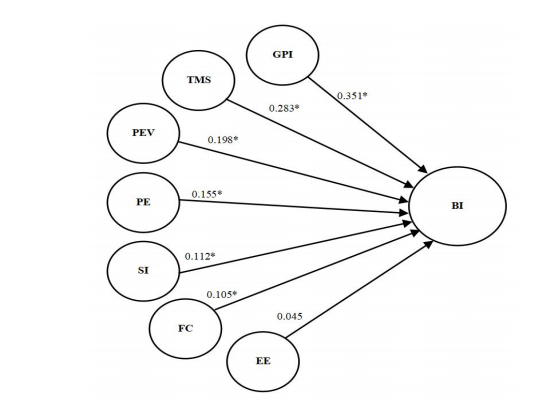
This study develops and empirically validates a comprehensive framework to explain the factors influencing the adoption of Green Road Technologies (GRTs) in Thailand’s road construction industry, a critical component of the nation’s 2050 carbon-neutrality goal. Despite supportive government policies, a significant implementation gap hinders widespread adoption of GRT. To diagnose this issue, we employ an explanatory sequential mixed-methods design (QUAL → QUAN), where insights from 15 in-depth interviews with senior industry stakeholders directly informed the development of a quantitative model. Phase 2 involves a survey of 350 construction professionals, with the data analyzed using Partial Least Squares Structural Equation Modeling (PLS-SEM). The scientific novelty of this research lies in its extension of the Unified Theory of Acceptance and Use of Technology (UTAUT), which differs from prior studies by integrating macro-level (Governmental Policy & Incentives) and meso-level (Top Management Support) structural drivers to adapt the model for a capital-intensive, non-IT industry in a developing economy. The model demonstrates high explanatory power (R2 = 68.7%), indicating that Governmental Policy & Incentives (β = 0.351) and Top Management Support (β = 0.283) are the strongest drivers of behavioral intention. Perceived Economic Viability and Performance Expectancy were also significant, whereas Effort Expectancy was not, reflecting the unique professional culture of the engineering sector. The primary theoretical contribution is an empirically validated, multi-level framework that integrates policy, organizational, and individual factors, offering a nuanced understanding of technology adoption beyond traditional models. Practically, the findings provide a clear roadmap for stakeholders to bridge the policy-implementation gap and accelerate infrastructure decarbonization.
References
1. Kang S, Yang R, Ozer H, et al. Life-cycle greenhouse gases and energy consumption for material and construction phases of pavement with traffic delay. Transportation Research Record: Journal of the Transportation Research Board. 2014; 2428(1): 27–34. doi: 10.3141/2428-04
2. Wang T, Lee IS, Kendall A, et al. Life cycle energy consumption and GHG emission from pavement rehabilitation with different rolling resistance. Journal of Cleaner Production. 2012; 33: 86–96. doi: 10.1016/j.jclepro.2012.05.001
3. Abey ST, Kolathayar S. Embodied energy and carbon emissions of pavements: A review. In: Lecture Notes in Civil Engineering. Springer; 2019. pp. 167–174.
4. Lah, O. Factors of Change: The influence of policy environment factors on climate change mitigation strategies in the transport sector. Transportation Research Procedia, 2017; 25, 3495-3510. doi: 10.1016/j.trpro.2017.05.265
5. Miliutenko S. Life cycle impacts of road infrastructure: Case study for Sweden. Transportation Research Record: Journal of the Transportation Research Board. 2012. 2287(1): 112–119. doi: 10.3141/2287-13
6. Xia Q, Hua D, Shi Y, et al. Unveiling the dislocation mechanism induced by irradiation defects in austenitic FeCrNi alloy. International Journal of Plasticity. 2025; 193: 104451. doi: 10.1016/j.ijplas.2025.104451
7. Ye W, Xie M, Zhou Q, et al. Superior wear performance of CoCrNi matrix composite reinforced with quasi-continuously networked graphene nanosheets and in-situ carbide. Friction. 2025; 13(8): 9441001. doi: 10.26599/frict.2025.9441001
8. Hua D, Xia Q, Li J, et al. Atomistic simulation of the interactions of radiation damage and grain boundaries in austenitic FeCrNi alloy. Journal of Nuclear Materials. 2026; 618: 156234. doi: 10.1016/j.jnucmat.2025.156234
9. Rudman CE, Jenkins KJ. Sustainable road construction practice in a developing country: A South African perspective. Sustainable Construction Materials 2012. 2012. pp. 1–17. doi: 10.1061/9780784412671.0001
10. Kumar R, Rao GA, Ryntathiang TL. Green road approach in Indian road construction for the sustainable development. In: Sustainable Infrastructure Development. Springer; 2018. pp. 107–121.
11. Wu P, Xia B, Zhao X, et al. Defining green road infrastructure projects: A critical review. In Sustainable Construction and Design. Springer. 2015; pp. 125–132.
12. Chan S, Bennett B, Kazmierowski T. Implementation of ontario's pavement sustainability rating system - greenpave. airfield and highway pavement 2013. 2013. pp. 22–29. doi: 10.1061/9780784413005.003
13. Condurat M, Condurat M, Ionita G. The environmental performances of reclaimed asphalt and bituminous sand pavements for transition toward low carbon mobility. Journal of Sustainable Architecture and Civil Engineering. 2018; 21(4): 50–62. doi: 10.5755/j01.sace.21.4.18486
14. Yaro NSA, Sutanto MH, Baloo L, et al. A comprehensive overview of the utilization of recycled waste materials and technologies in asphalt pavements: Towards environmental and sustainable low-carbon roads. Processes. 2023; 11(7): 2095. doi: 10.3390/pr110720951.
15. Baek J, Hu H, et al. Estimating carbon reductions of green highway technologies. International Journal of Environmental Science and Development. 2015; 6(10): 775–780. doi: 10.7763/ijesd.2015.v6.697
16. Pantelidou H, Nicholson D, Hughes L, et al. Application of carbon calculators to estimate carbon dioxide emissions reduction in road construction projects. Transportation Research Record: Journal of the Transportation Research Board. 2012; 2287(1): 93–101. doi: 10.3141/2287-11
17. Limmeechokchai B, Lorm R. Scenario-based assessment of decarbonized transport sector in Thailand towards carbon neutrality 2050. International Journal of Building, Urban, Interior and Landscape Technology (BUILT). 2024; 22(2): 256385. doi: 10.56261/built.v22.256385
18. Limmeechokchai B, Bahadur Pradhan B, Chunark P, et al. Energy system transformation for attainability of net zero emissions in Thailand. International Journal of Sustainable Energy Planning and Management. 2022; 35: 27–44. doi: 10.54337/ijsepm.7116
19. Chotichanathawewong Q. On the dynamics of low carbon green growth in Thailand. In Low-Carbon Green Growth in Asia. Springer; 2016. pp. 131–184.
20. Limmeechokchai B, Winyuchakrit P, Pita P, et al. Decarbonizing Transport Sector in Thailand Towards 2050. 2022 International Conference and Utility Exhibition on Energy, Environment and Climate Change (ICUE). IEEE. 2022; 1–7. doi: 10.1109/icue55325.2022.10113536
21. Hoy M, Horpibulsuk S, Rachan R, et al. Recycled asphalt pavement–fly ash geopolymers as a sustainable pavement base material: Strength and toxic leaching investigations. Science of The Total Environment. 2016; 573: 19–26. doi: 10.1016/j.scitotenv.2016.08.078
22. Kokkaew N, Rudjanakanoknad J. Green assessment of Thailand's highway infrastructure: A Green Growth Index approach. KSCE Journal of Civil Engineering. 2017; 21(7): 2526–2537. doi: 10.1007/s12205-017-0923-0
23. Babon-Ayeng P, Kissi E, Tannor RA, et al. Critical success factors (CSFs) for the adoption of green construction concepts in road construction in Ghana. International Journal of Construction Management. 2022; 24(13): 1465–1474. doi: 10.1080/15623599.2022.2131122
24. Huang Y, Parry T. Pavement life cycle assessment. In: Sustainable Construction Materials. Springer; 2014. pp. 1–40.
25. Chen J, Yu Z, Chen G, et al. Evaluation of policy instruments for promoting green transportation in developing countries. Sustainability. 2021; 13(3): 1122. doi: 10.3390/su13031122
26. Kongklaew C, Phoungthong K, Prabpayak C, et al. Barriers to Electric Vehicle Adoption in Thailand. Sustainability. 2021; 13(22): 12839. doi: 10.3390/su132212839
27. Vithayaporn S, Nitivattananon V, Sasaki N, et al. Assessment of the factors influencing the performance of the adoption of green logistics in urban tourism in Thailand's eastern economic corridor. Social Sciences. 2023; 12(5): 300. doi: 10.3390/socsci12050300
28. Santos J, Bressi S, Cerezo V, et al. SUP&R DSS: A sustainability-based decision support system for road pavements. Journal of Cleaner Production. 2019; 206: 524–540. doi: 10.1016/j.jclepro.2018.08.308
29. Huang Y, Qiao Z, Zhang H. Evaluation of an economy-technology-green development system for asphalt pavement construction in China based on synergetics. Journal of Cleaner Production. 2021; 289: 125132. doi: 10.1016/j.jclepro.2020.125132
30. Mosier RD, Gransberg DD. Carbon Footprint Cost Index: A Pavement Case Study. Procedia Engineering. 2015; 118: 781–786. doi: 10.1016/j.proeng.2015.08.514
31. Braun V, Clarke V. Using thematic analysis in psychology. Qualitative Research in Psychology. 2006; 3(2): 77–101. doi: 10.1191/1478088706qp063oa
32. Hair JF. A primer on partial least squares structural equation modeling (PLS-SEM). Sage; 2014.
Downloads
Published
How to Cite
Issue
Section
License
Copyright (c) 2026 Disayapat Pakdeearporn, Danupon Sangnak

This work is licensed under a Creative Commons Attribution 4.0 International License.





.jpg)
.jpg)