Article Heat recovery and heating system for liquid-cooled data center: Energy, economic, and environmental analysis
DOI:
https://doi.org/10.18686/cest630Keywords:
liquid-cooling data center; heat recovery; real-time load fluctuation; partial power usage effectiveness; economic and environmental analysisAbstract
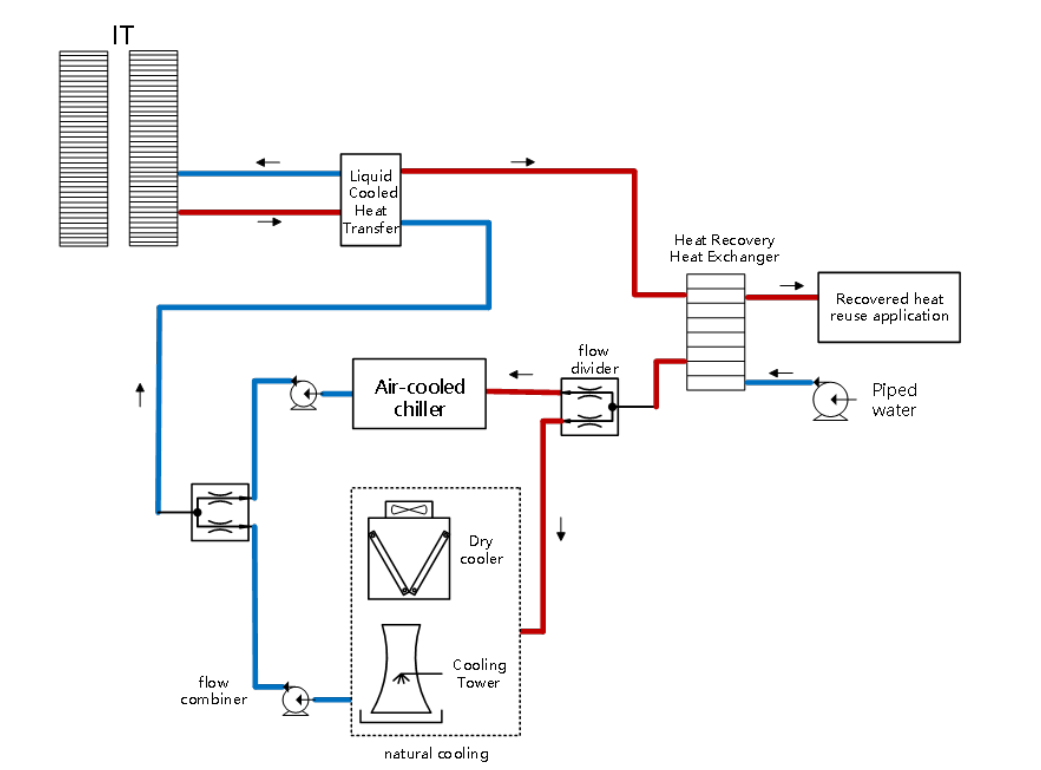
With the rapid growth of data centers driven by information technology development, a significant amount of waste heat generated by cooling systems is currently not effectively utilized and is often discarded. Recovering this waste heat is therefore of great importance for improving overall energy efficiency and promoting low-carbon operation. In this study, we simulate a cold plate liquid cooling system integrated with a waste heat recovery unit that utilizes different natural cooling sources, taking into account real-time fluctuations in thermal load demand. The results show that, compared with conventional liquid-cooling systems without heat recovery, the proposed configurations reduce cooling system power consumption by approximately 20–30% across all operating conditions. The minimum partial Power Usage Effectiveness (pPUE) reaches 1.13, indicating a highly efficient cooling subsystem. Moreover, up to 23% of the energy consumed in the data center can be effectively reused when temperature constraints of the heat user are considered. From an economic perspective, selling the recovered heat for domestic hot water production can reduce the annual operating cost of the liquid-cooling system by approximately ¥200,000, resulting in a short payback period. From an environmental perspective, the waste heat recovery system significantly supports low-carbon heating, reducing carbon emissions by about 110 tCO2 per year compared with conventional gas boilers and air-source heat pumps. Overall, this study demonstrates that liquid-cooled data centers can serve as reliable and economically attractive heat sources under realistic dynamic operating conditions, providing practical guidance for large-scale waste heat recovery deployment.
References
1. Li Z, Luo H, Jiang Y, et al. Comprehensive review and future prospects on chip-scale thermal management: Core of data center's thermal management. Applied Thermal Engineering. 2024; 251: 123612. doi: 10.1016/j.applthermaleng.2024.123612
2. Zhang Y, Fan C, Li G. Discussions of Cold Plate Liquid Cooling Technology and Its Applications in Data Center Thermal Management. Frontiers in Energy Research. 2022; 10: 954718. doi: 10.3389/fenrg.2022.954718
3. Kong R, Zhang H, Tang M, et al. Enhancing data center cooling efficiency and ability: A comprehensive review of direct liquid cooling technologies. Energy. 2024; 308: 132846. doi: 10.1016/j.energy.2024.132846
4. Hao Y, Zhou H, Tian T, et al. Data centers waste heat recovery technologies: Review and evaluation. Applied Energy. 2025; 384: 125489. doi: 10.1016/j.apenergy.2025.125489
5. Ding J, Zhang H, Leng D, et al. Experimental investigation and application analysis on an integrated system of free cooling and heat recovery for data centers. International Journal of Refrigeration. 2022; 136: 142–151. doi: 10.1016/j.ijrefrig.2022.01.003
6. Ebrahimi K, Jones GF, Fleischer AS. A review of data center cooling technology, operating conditions and the corresponding low-grade waste heat recovery opportunities. Renewable and Sustainable Energy Reviews. 2014; 31: 622–638. doi: 10.1016/j.rser.2013.12.007
7. Nadjahi C, Louahlia H, Lemasson S. A review of thermal management and innovative cooling strategies for data center. Sustainable Computing: Informatics and Systems. 2018; 19: 14–28. doi: 10.1016/j.suscom.2018.05.002
8. Davies GF, Maidment GG, Tozer RM. Using data centres for combined heating and cooling: An investigation for London. Applied Thermal Engineering. 2016; 94: 296–304. doi: 10.1016/j.applthermaleng.2015.09.111
9. Deymi-Dashtebayaz M, Valipour-Namanlo S. Thermoeconomic and environmental feasibility of waste heat recovery of a data center using air source heat pump. Journal of Cleaner Production. 2019; 219: 117–126. doi: 10.1016/j.jclepro.2019.02.061
10. Oró E, Allepuz R, Martorell I, et al. Design and economic analysis of liquid cooled data centres for waste heat recovery: A case study for an indoor swimming pool. Sustainable Cities and Society. 2018; 36: 185–203. doi: 10.1016/j.scs.2017.10.012
11. Zimmermann S, Meijer I, Tiwari MK, et al. Aquasar: A hot water cooled data center with direct energy reuse. Energy. 2012; 43(1): 237–245. doi: 10.1016/j.energy.2012.04.037
12. Marcinichen JB, Olivier JA, Thome JR. On-chip two-phase cooling of datacenters: Cooling system and energy recovery evaluation. Applied Thermal Engineering. 2012; 41: 36–51. doi: 10.1016/j.applthermaleng.2011.12.008
13. Carbó A, Oró E, Salom J, et al. Experimental and numerical analysis for potential heat reuse in liquid cooled data centres. Energy Conversion and Management. 2016; 112: 135–145. doi: 10.1016/j.enconman.2016.01.003
14. Beaty DL. Internal IT load profile variability. ASHRAE Journal. 2013; 55(2): 72–74.
15. Zhu Y, Zhang Q, Zeng L, et al. An advanced control strategy of hybrid cooling system with cold water storage system in data center. Energy. 2024; 291: 130304. doi: 10.1016/j.energy.2024.130304
16. Iyengar M, David M, Parida P, et al. Server liquid cooling with chiller-less data center design to enable significant energy savings. In: Proceedings of the 28th Annual IEEE Semiconductor Thermal Measurement and Management Symposium (SEMI-THERM); 18–22 March 2012; San Jose, CA, USA. pp. 212–223. doi: 10.1109/STHERM.2012.6188851
17. Gao YB, Liu CJ, Zhao BZ. Design and Exploration on Liquid Cooling System of Blade Server. Electro-Mechanical Engineering. 2020; 36(6): 20–23. (in Chinese)
18. Wu XF. Application of Energy Saving Technology for Liquid Air Dual Channel Refrigeration System in a Data Center. Building Energy Environment. 2019; 38(6): 33–35. (in Chinese)
19. Chen JQ. Study on energy saving of refrigeration technology in high-performance cloud computing center. Refrigeration and Air-Conditioning. 2019; 19: 7–9. (in Chinese)
20. Shoukourian H, Wilde T, Huber H, et al. Analysis of the efficiency characteristics of the first High-Temperature Direct Liquid Cooled Petascale supercomputer and its cooling infrastructure. Journal of Parallel and Distributed Computing. 2017; 107: 87–100. doi: 10.1016/j.jpdc.2017.04.005
21. Xie CH, Zhao YY. Application of Liquid Cooling Technology in Communication Industry and Related Suggestions. Telecom Power Technology. 2019; 36(S1). (in Chinese)
22. Cho J, Park B, Jang S. Development of an independent modular air containment system for high-density data centers: Experimental investigation of row-based cooling performance and PUE. Energy. 2022; 258: 124787. doi: 10.1016/j.energy.2022.124787
23. Xi C, Cao S-J. Challenges and Future Development Paths of Low Carbon Building Design: A Review. Buildings. 2022; 12(2): 163. doi: 10.3390/buildings12020163
24. Ministry of Housing and Urban–Rural Development of the People's Republic of China. Data Center Design Specifications (GB 50174-2017). Ministry of Housing and Urban–Rural Development of the People's Republic of China; 2017. (in Chinese)
25. Zhou F, Tian X, Song Y, et al. Dynamic performance of an integrated heat pump system coupled free cooling and waste heat recovery in data centers. Energy. 2025; 323: 135838. doi: 10.1016/j.energy.2025.135838
26. Yang R, Shue NS. Simulation Study for the Effect of the Storage Design on the Performance of a Large Solar Hot Water System. In: Proceedings of the 2013 IEEE Green Technologies Conference (GreenTech); 4–5 April 2013; Denver, CO, USA. pp. 467–472. doi: 10.1109/GreenTech.2013.77
Downloads
Published
How to Cite
Issue
Section
License
Copyright (c) 2026 Wuming Cai, Hao Li, Chong Zhai, Dong Li

This work is licensed under a Creative Commons Attribution 4.0 International License.





.jpg)
.jpg)