Hybrid Artificial Intelligence-based Computational Fluid Dynamics model for optimizing Offshore Wind Farm aerodynamics under variable marine climate conditions
DOI:
https://doi.org/10.18686/cest634Keywords:
Offshore Wind Farm optimization , Artificial Intelligence , Computational Fluid Dynamics , wake interaction modelling , surrogate modelling , marine climate variability , multi-objective evolutionary optimizationAbstract
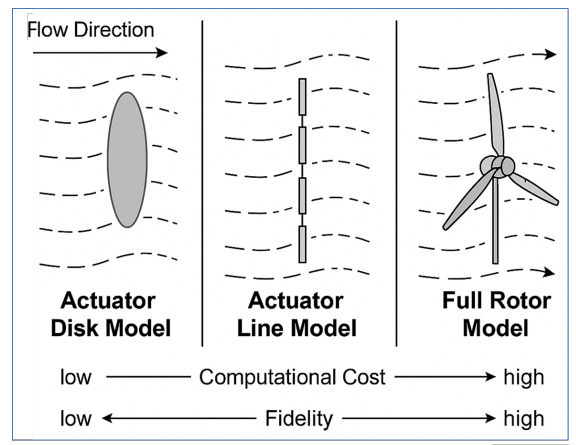
Aerodynamic optimization of Offshore Wind Farms (OWF) is challenged by nonlinear wake interactions, turbulence transport, and stochastic Marine Climate Conditions (MCC). High-fidelity Computational Fluid Dynamics (CFD) models capture these dynamics accurately but impose prohibitive computational costs for large-scale optimization. Analytical wake models offer computational efficiency but oversimplify complex turbulence interactions. This study presents a hybrid Artificial Intelligence (AI)-CFD that integrates Deep Neural Network (DNN) surrogates with selective CFD validation to enable efficient, robust optimization under MCC. The model employs unsteady Reynolds-averaged Navier-Stokes simulations with actuator-line turbine representation to generate training data, which are used to train an ensemble surrogate model incorporating dimensionally reduced climate states. Uncertainty-driven adaptive sampling triggers CFD validation for high-uncertainty configurations, maintaining physical fidelity while accelerating optimization. A multi-objective evolutionary algorithm (NSGA-II) optimizes turbine layout, yaw angles, and pitch controls to balance power generation, wake losses, and structural loading. Validation on an 80-turbine, 320 MW wind farm in Dhanushkodi, Tamil Nadu, sea proves 7.8% power improvement, 23.5% wake-loss reduction, and 11.2% network load decrease compared to the baseline, with 7.2× computational speedup vs. CFD-only optimization. Sensitivity analyses confirm robustness across wind speeds (6–12 m·s−1), turbulence intensities (5–15%), and inflow directions (0–30°). The model establishes a scalable methodology for optimizing OWF under realistic MCC.
References
1. Chatzidaki L. Offshore Wind Power: Climate Change Mitigation and Geopolitics [Master's Thesis]. University of Piraeus; 2024. (in Greek)
2. Fischereit J, Larsén XG, Hahmann AN. Climatic impacts of wind-wave-wake interactions in offshore wind farms. Frontiers in Energy Research. 2022; 10: 881459.
3. Tiwari UD, Ghaisas NS, Mitra K. Wind Farm Performance Assessment Using CFD: Key Factors, SOWFA, and Yaw Misalignment Case Study. In: Optimization, Uncertainty and Machine Learning in Wind Energy Conversion Systems. Springer Nature Singapore; 2025. pp. 79–104.
4. Bowman J, Mims K, Bhushan S, et al. Development, Verification, and Validation of a Machine-Learned Actuator Line Propeller Model. In: Proceedings of the ASME 2025 Fluids Engineering Division Summer Meeting; 27–30 July 2025; Philadelphia, PA, USA.
5. Liu S, Li Q, Lu B, et al. Prediction of offshore wind turbine wake and output power using large eddy simulation and a convolutional neural network. Energy Conversion and Management. 2025; 324: 119326.
6. Pawar S, Sharma A, Vijayakumar G, et al. Towards multi-fidelity deep learning of wind turbine wakes. Renewable Energy. 2022; 200: 867–879.
7. Weihing P, Cormier M, Lutz T, et al. The near-wake development of a wind turbine operating in stalled conditions–Part 1: Assessment of numerical models. Wind Energy Science. 2024; 9(4): 933–962.
8. Rosencrans D, Lundquist JK, Optis M, et al. Seasonal variability of wake impacts on US mid-Atlantic offshore wind plant power production. Wind Energy Science. 2024; 9(3): 555–583.
9. Haghi R, Crawford C. Data-driven surrogate model for wind turbine damage equivalent load. Wind Energy Science Discussions. 2023; 9: 2039–2062.
10. Hu W, Yang Q, Yuan Z, et al. Wind farm layout optimization in complex terrain based on CFD and IGA-PSO. Energy. 2024; 288: 129745.
11. Zhao X, Xing X, Kang CW, et al. Predictive modeling of wake flow for a floating offshore wind turbine using dynamic mode decomposition. Ocean Engineering. 2025; 334: 121590.
12. Liew J, Riva R, Friis-Møller M, et al. Wind farm control optimisation under load constraints via surrogate modelling. Journal of Physics: Conference Series. 2024; 2767: 092039.
13. Lu Q, Cao Y, Xie P, et al. A Scalable Data-Driven Surrogate Model for 3D Dynamic Wind Farm Wake Prediction Using Physics-Inspired Neural Networks and Wind Box Decomposition. Energies. 2025; 18(13): 3356.
14. Ouro P, Ghobrial M, Ali K, et al. Numerical modelling of offshore wind-farm cluster wakes. Renewable and Sustainable Energy Reviews. 2025; 215: 115526.
15. Nguyen TH, Toubeau JF, Jaeger ED, et al. Topology-aware surrogate for future offshore wind farms using machine learning. Renewable Energy. 2025; 256: 123657.
16. Yang K, Zhang M, Yang S, et al. Pareto frontier for multi-objective wind farm layout optimization, balancing power production and turbine fatigue life. Renewable Energy. 2025; 252: 123429.
17. Ye M, Li M, Liu M, et al. Overview of Data-Driven Models for Wind Turbine Wake Flows. Journal of Marine Science and Application. 2025; 24: 1–20.
18. Settles B. Active Learning Literature Survey. University of Wisconsin-Madison Department of Computer Sciences; 2009.
19. Deb K, Pratap A, Agarwal S, et al. A fast and elitist multiobjective genetic algorithm: NSGA-II. IEEE Transactions on Evolutionary Computation. 2002; 6(2): 182–197.
20. Sezavar HR, Karimi H, Hasanzadeh S, et al. Enhancing Overcurrent Relay Performance in Power Systems with Distributed Generation: An AI-Based Approach. In: Proceedings of the 2025 12th Iranian Conference on Renewable Energies and Distributed Generation (ICREDG); 26 February 2025; Qom, Iran.
21. Mohammed MN, Aljibori HSS, Al-Tamimi A, et al. Toward Sustainable Smart Cities in Bahrain: A Groundbreaking Approach to Marine Renewable Energy Harnessing Sea Tides and Waves for a Greener Energy Future. In: Proceedings of the IEEE 8th International Conference on Engineering Technologies and Applied Sciences; 25–27 October 2023; Manama, Bahrain.
22. Hamad AH, Dawod AY, Abdulqader MF, et al. A secure sharing control framework supporting elastic mobile cloud computing. International Journal of Electrical and Computer Engineering. 2023; 13(2): 2270–2277. doi: 10.11591/ijece.v13i2.pp2270-2277
23. Bhattarai S. Comparative Study of Different Perovskite Active Layers for Attaining Higher Efficiency Solar Cells: Numerical Simulation Approach. Sustainability (Switzerland). 2023; 15(17): 12805. doi: 10.3390/su151712805
24. Kareem BA, Zubaidi SL, Al-Ansari N, et al. Review of Recent Trends in the Hybridisation of Preprocessing-Based and Parameter Optimisation-Based Hybrid Models to Forecast Univariate Streamflow. Computer Modeling in Engineering and Sciences. 2024; 138: 1–41. doi: 10.32604/cmes.2023.027954
25. Chen Y, Zhao Z, Zhuo H, et al. Surface dependent effects of Mn-doping on the catalytic activity of α-Fe2O3 for ortho-para hydrogen conversion. Clean Energy Science and Technology. 2025; 3(4): 574. doi: 10.18686/cest574
Downloads
Published
How to Cite
Issue
Section
License
Copyright (c) 2026 Hayder M. Ali, Rachel Nallathamby, Saravanan Ramaiah, Radhika Rani Chintala, Aseel Smerat, Temur Eshchanov, Bekzod Madaminov, Sudhakar Sengan

This work is licensed under a Creative Commons Attribution 4.0 International License.





.jpg)
.jpg)