Machine learning-driven predictive maintenance models for hydrogen fuel cell systems in smart transportation networks
DOI:
https://doi.org/10.18686/cest636Keywords:
predictive maintenance; hydrogen fuel cell systems; smart transportation networks; proton exchange membrane fuel cell; remaining useful life; machine learning; hybrid deep learningAbstract
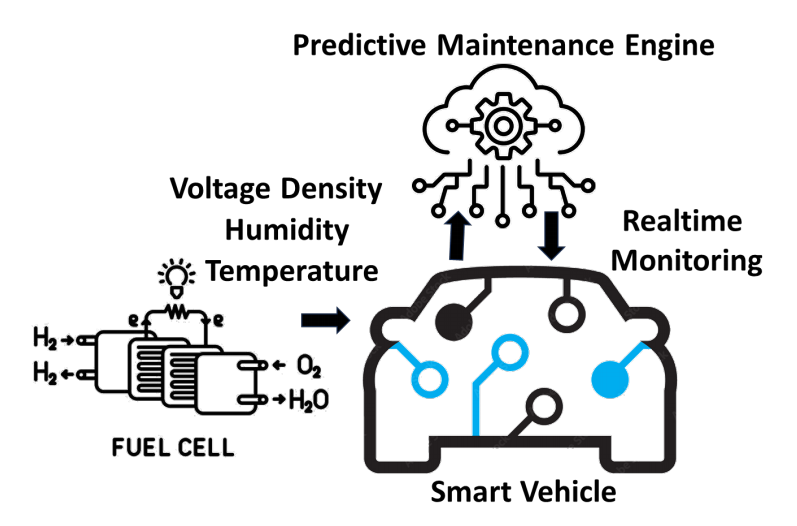
Hydrogen Fuel Cells (HFCs) are a central technology for advancing decarbonized mobility in Smart Transportation Networks (STN), yet their durability is limited by advanced electrochemical and thermal degradation. Anticipating such errors requires Predictive Maintenance Models (PMM) capable of extracting health indicators and predicting model behavior under dynamic operating conditions. This study develops Machine Learning (ML)-driven models for Fault Detection (FD), Remaining Useful Life (RUL) prediction, and prognostic reliability test in the Proton Exchange Membrane Fuel Cell (PEMFC) model. A 24-cell PEMFC stack dataset comprising 1500 h of operation under automotive load cycling was employed to analyze Supervised Learning (SL), Deep Temporal Networks (DTN), and a physics-guided hybrid residual model. Model training used cross-entropy and Mean Squared Error (MSE) objectives with causality-preserving temporal partitioning. Results proved that Deep Learning (DL) methods outperformed traditional classifiers, with the hybrid residual LSTM achieving 97.3% classification accuracy, 65.1 h RUL prediction RMSE, and early prognostic stabilization 85 h before error. Robustness analyses verified resilience against sensor noise, and computational profiling confirmed real-time feasibility with implication latency below 50 ms. These results establish that integrating physics-guided constraints into data-driven models yields accurate, deployable predictive maintenance for HFC, thereby enhancing safety, efficiency, and availability in STN.
References
1. Kiani M, Zhao Y, Zhang R. Proton exchange membrane fuel cells: recent developments and future perspectives. Chemical Communications. 2025; 61(52): 9392–9411. doi: 10.1039/D5CC01478F
2. Osman AI, Chen Z, Elgarahy AM, et al. Membrane Technology for Energy Saving: Principles, Techniques, Applications, Challenges, and Prospects. Advanced Energy and Sustainability Research. 2024; 5(5): 2400011. doi: 10.1002/aesr.202400011
3. Arun M, Giddey S, Joseph P, et al. Challenges and mitigation strategies for general failure and degradation in polymer electrolyte membrane-based fuel cells and electrolysers. Journal of Materials Chemistry A. 2025; 13(16): 11236–11263. doi: 10.1039/D4TA08823A
4. Kumar P, Ganguly S. Prognostic Modeling for PEM Fuel Cells: A Comparative Analysis Among Different Types of Approaches. IEEE Access. 2025; 13: 156768–156784. doi: 10.1109/ACCESS.2025.3606630
5. Xu Y, Li X, Cao Y, et al. Review: application of machine learning methods to performance evaluation, lifetime prediction and integrated management of hydrogen fuel cells. Environment, Development and Sustainability. 2025. doi: 10.1007/s10668-025-06386-y
6. Algburi RNA, Aljibori HSS, Al-Huda Z, et al. Advanced fault diagnosis in industrial robots through hierarchical hyper-laplacian priors and singular spectrum analysis. Complex & Intelligent Systems. 2025; 11(6): 282. doi: 10.1007/s40747-025-01915-8
7. Almngoshi HZ, C M, Kanaka Ratnam AS, et al. Data Visualisation Models for Analytics Use Artificial Intelligence to Predict Diabetes in Women. Journal of Machine and Computing. 2025; 5(1): 551–560. doi: 10.53759/7669/jmc202505043
8. Abdul Raheem AK, Zuhair M. Enhancing credit risk management in the banking sector through machine learning-based predictive models. Journal of Theoretical and Applied Information Technology. 2023; 101(16): 6522–6530. Available online: https://www.researchgate.net/publication/373923311_enhancing_credit_risk_management_in_the_banking_sector_through_machine_learning-based_predictive_models
9. Algburi RNA, Aljibori HSS, Al-Huda Z, et al. SSA-Sparse MHD: Singular Spectrum Analysis Paired with Sparse Maximum Harmonics Deconvolution for Detecting Feeble Defect Signals in Industrial Robots. In: Proceedings of the 2024 8th International Artificial Intelligence and Data Processing Symposium (IDAP); 21 September 2024; Malatya, Türkiye. pp. 1–9. doi: 10.1109/IDAP64064.2024.10710846
10. Algburi RNA, Sultan Aljibori HS, Al-Huda Z, et al. HHLP-SSA: Enhanced Fault Diagnosis in Industrial Robots Using Hierarchical Hyper-Laplacian Prior and Singular Spectrum Analysis. In: Proceedings of the 2024 8th International Artificial Intelligence and Data Processing Symposium (IDAP); 21 September 2024; Malatya, Türkiye. pp. 1–8. doi: 10.1109/IDAP64064.2024.10711014
11. Wu H, Zhang R, Zhu W, et al. A health index-based approach for fuel cell lifetime estimation. iScience. 2024; 27(11): 110979. doi: 10.1016/j.isci.2024.110979
12. Chen L, Yang J, Deng P, et al. Remaining useful life prediction of fuel cells using a dual data-driven model with relative power loss rate-based health indicator under real-world traffic conditions. International Journal of Hydrogen Energy. 2025; 157: 150366. doi: 10.1016/j.ijhydene.2025.150366
13. Gürsoy Mİ. Short and long-term prognostics of the remaining useful life of a proton exchange membrane fuel cell using deep learning and transformer model. International Journal of Hydrogen Energy. 2025; 143: 1120–1132. doi: 10.1016/j.ijhydene.2024.12.512
14. Huang B, Wang J. Applications of Physics-Informed Neural Networks in Power Systems —A Review. IEEE Transactions on Power Systems. 2023; 38(1): 572–588. doi: 10.1109/TPWRS.2022.3162473
15. Wang F, Zhai Z, Zhao Z, et al. Physics-informed neural network for lithium-ion battery degradation stable modeling and prognosis. Nature Communications. 2024; 15(1): 4332. doi: 10.1038/s41467-024-48779-z
16. Zerrougui I, Li Z, Hissel D. Physics-Informed Neural Network for modeling and predicting temperature fluctuations in proton exchange membrane electrolysis. Energy and AI. 2025; 20: 100474. doi: 10.1016/j.egyai.2025.100474
17. Ko T, Kim D, Park J, et al. Physics-informed neural network for long-term prognostics of proton exchange membrane fuel cells. Applied Energy. 2025; 382: 125318. doi: 10.1016/j.apenergy.2025.125318
18. Pettorossi C, Morvillier R, Heiries V, et al. Physics-guided fault diagnosis method for proton exchange membrane fuel cells based on LSTM neural network. Journal of Power Sources. 2025; 626: 235696. doi: 10.1016/j.jpowsour.2024.235696
19. Zhou N, Zeng H, Zheng Z, et al. PEMFC RUL Prediction for Non-Stationary Time Series Based on Crossformer Model. Applied Sciences. 2025; 15(5): 2515. doi: 10.3390/app15052515
20. Bhattarai S, Mohammed MKA, Madan J, et al. Comparative Study of Different Perovskite Active Layers for Attaining Higher Efficiency Solar Cells: Numerical Simulation Approach. Sustainability (Switzerland). 2023; 15(17): 12805. doi: 10.3390/su151712805
21. Ahn J, Lee Y, Kim N, et al. Federated Learning for Predictive Maintenance and Anomaly Detection Using Time Series Data Distribution Shifts in Manufacturing Processes. Sensors. 2023; 23(17): 7331. doi: 10.3390/s23177331
22. Hosni H. Secure Predictive Maintenance for Industrial Systems Using Federated Learning. Journal of Innovations in Business and Industry. 2025; 4(1): 69–78. doi: 10.61552/JIBI.2026.01.007
23. Mohammed MN, Aljibori HSS, Al-Tamimi A, et al. Toward Sustainable Smart Cities in Bahrain: A Groundbreaking Approach to Marine Renewable Energy Harnessing Sea Tides and Waves for a Greener Energy Future. In: Proceedings of the IEEE 8th International Conference on Engineering Technologies and Applied Sciences; 25–27 October 2023; Manama, Bahrain. doi: 10.1109/ICETAS59148.2023.10346346
24. Saadh, MJ, Ali ABM, Hanoon Z, et al. The ability of ZnO and MgO nanocages for adsorption and sensing performance of anticancer drug detection. Journal of Molecular Graphics and Modelling. 2025; 137: 109003. doi: 10.1016/j.jmgm.2025.109003
25. Danielis R, Scorrano M, Masutti M, et al. Fuel Cell Electric Buses: A Systematic Literature Review. Energies. 2024; 17(20): 5096. doi: 10.3390/en17205096
26. Siegel JB, Stefanopoulou AG, McKahn D. 24 Cell Proton Exchange Membrane Fuel Cell Stack, 300 Square cm Area Voltage Parameterization. University of Michigan; 2020. doi: 10.7302/DY3H-SF31
27. Niu Y, Merza AM, Kadhem SI, et al. Evaluation of wind-solar hybrid power generation system based on Monte Carlo method. International Journal of Electrical and Computer Engineering. 2023; 13(4): 4401–4411. doi: 10.11591/ijece.v13i4.pp4401-4411
Downloads
Published
How to Cite
Issue
Section
License
Copyright (c) 2026 Hayder M. Ali, Khushboo Tripathi, Bhaskar Marapelli, Aseel Smerat, Firas Tayseer Ayasrah, Gnana Jeslin Jeya Chandir Mohana Dhas, Bekzod Madaminov, Sudhakar Sengan

This work is licensed under a Creative Commons Attribution 4.0 International License.





.jpg)
.jpg)