Rooftop-based solar and rainwater harvesting systems as a sustainable urban solution for the water–energy nexus
DOI:
https://doi.org/10.18686/cest666Keywords:
environmental sustainability; technical; financial; rainwater harvesting potential; eastern Mediterranean; arid desert climate; tropical regions PV systemAbstract
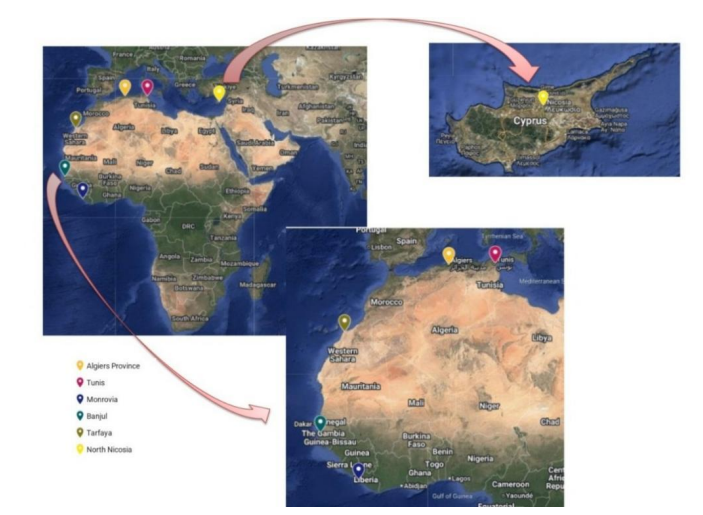
The technical, financial, and environmental sustainability of a 70.20 kW grid-connected photovoltaic system combined with rainwater harvesting is investigated in six geographically varied regions (Algiers, Banjul, Monrovia, North Nicosia, Tarfaya, and Tunis). These locations, which represent various climatic zones across Africa and the Eastern Mediterranean, are especially selected to provide a comprehensive assessment concerning how environmental factors affect combined water-energy performance. Rainfall analysis reveals significant regional variation: Monrovia has the highest rainwater harvesting potential (RHP), ranging from 392 to 571 m3, followed by Banjul (138–232 m3), while arid Tarfaya has the lowest RHP, ranging from 10 to 42 m3. Moreover, the results reveal that latitude has a major influence on optimal energy generation. In all the Mediterranean regions analyzed herein (Algiers, Tunis, and North Nicosia), the yearly output varies between 105 and 115 MWh when the angle of inclination is between 30° and 40°. A tilt of 10° to 20° yields the best results for tropical regions, while in the arid desert climate of Tarfaya, the best performance of the PV system is obtained for a tilt ranging from 20° to 30°. Furthermore, the results of the economic assessment demonstrate that LCOE varies by region, ranging from a minimum of 2.37 cents/kWh for Algiers to a maximum of 6.04 cents/kWh for Tunis. North Nicosia and Tarfaya had the shortest payback periods, at 2.34 and 2.02 years, respectively. Additionally, the Mediterranean zone’s lifetime GHG savings ranged from 1136–1344 kg CO2-eq to the semi-arid Tarfaya region’s 2339 kg CO2-eq. Consequently, the combined assessment highlights the necessity of climate-adaptive design to maximize the sustainability of integrated PV-rainwater systems.
References
1. Khondoker M, Mandal S, Gurav R, et al. Freshwater Shortage, Salinity Increase, and Global Food Production: A Need for Sustainable Irrigation Water Desalination—A Scoping Review. Earth. 2023; 4(2): 223–240. doi: 10.3390/earth4020012
2. Soomro S e hyder, Boota MW, Guo J, et al. Drought management for long-term water sustainability and resilience. Marine and Freshwater Research. 2025; 76(5). doi: 10.1071/mf24210
3. Chen S, Liu P, Li Z. Low-carbon transition pathway of the power sector with high penetration of renewable energy. Renewable and Sustainable Energy Reviews. 2020; 130: 109985. doi: 10.1016/j.rser.2020.109985
4. Das A, Mishra S. Smart and sustainable water management: policy, technology, and innovation pathways for resource resilience. Green Technology, Resilience, and Sustainability. 2025; 5(1): 1–26. doi: 10.1007/s44173-025-00022-8
5. Xu WD, Burns MJ, Cherqui F, et al. Real-time controlled rainwater harvesting systems can improve the performance of stormwater networks. Journal of Hydrology. 2022; 614: 128503. doi: 10.1016/j.jhydrol.2022.128503
6. Ghimire SR, Johnston JM, Ingwersen WW, et al. Life cycle assessment of a commercial rainwater harvesting system compared with a municipal water supply system. Journal of Cleaner Production. 2017; 151: 74–86. doi: 10.1016/j.jclepro.2017.02.025
7. Noori AR, Singh SK. Rainfall assessment and water harvesting potential in an urban area for artificial groundwater recharge with land use and land cover approach. Water Resources Management. 2023; 37(13): 5215–5234. doi: 10.1007/s11269-023-03602-0
8. Adham A, Wesseling JG, Abed R, et al. Assessing the impact of climate change on rainwater harvesting in the Oum Zessar watershed in Southeastern Tunisia. Agricultural Water Management. 2019; 221: 131–140. doi: 10.1016/j.agwat.2019.05.006
9. Wartalska K, Grzegorzek M, Bełcik M, et al. The potential of rainwater harvesting systems in Europe–Current state of Art and future perspectives. Water Resources Management. 2024; 38(12): 4657–4683. doi: 10.1007/s11269-024-03882-0
10. Joshi S, Mittal S, Holloway P, et al. High resolution global spatiotemporal assessment of rooftop solar photovoltaics potential for renewable electricity generation. Nature Communications. 2021; 12(1): 5738. doi: 10.1038/s41467-021-25720-2
11. Asif M, Sharieff R, Olawale M, et al. Unlocking the potential of unregulated rooftops for solar PV on residential buildings: Identifying and addressing key challenges. Energy Nexus. 2025; 18: 100447. doi: 10.1016/j.nexus.2025.100447
12. Ranjgar B, Niccolai A. Large-Scale rooftop solar photovoltaic power production potential assessment: A case study for tehran metropolitan area, Iran. Energies. 2023; 16(20): 7111. doi: 10.3390/en16207111
13. Bernasconi D, Guariso G. Rooftop PV: Potential and impacts in a complex territory. Energies. 2021; 14(12): 3687. doi: 10.3390/en14123687
14. Chong WT, Naghavi MS, Poh SC, et al. Techno-economic analysis of a wind–solar hybrid renewable energy system with rainwater collection feature for urban high-rise application. Applied Energy. 2011; 88(11): 4067–4077. doi: 10.1016/j.apenergy.2011.04.042
15. Chong WT, Fazlizan A, Poh SC, et al. Early development of an innovative building integrated wind, solar and rain water harvester for urban high rise application. Energy and Buildings. 2012; 47: 201–207. doi: 10.1016/j.enbuild.2011.11.041
16. Chong WT, Wang XH, Wong KH, et al. Performance assessment of a hybrid solar-wind-rain eco-roof system for buildings. Energy and Buildings. 2016; 127: 1028–1042. doi: 10.1016/j.enbuild.2016.06.065
17. Wang X, Chong W, Wong K, et al. Preliminary Techno–Environment–Economic Evaluation of an innovative hybrid renewable energy harvester system for residential application. Energies. 2019; 12(8): 1496. doi: 10.3390/en12081496
18. Cao H, Zeng X, Wu L, et al. A hybrid wind and rainwater energy harvesting system for applications in sea-crossing bridges. Ocean Engineering. 2021; 234: 109267. doi: 10.1016/j.oceaneng.2021.109267
19. Kassem Y, Gökçekuş H, Kiraz A. et al. Integrating rainwater harvesting and solar energy systems for sustainable water and energy management in low rainfall agricultural region: A case study from Gönyeli, Northern Cyprus. Sustainability. 2025; 17(18): 8508. doi: 10.3390/su17188508
20. Wilczak JM, Akish E, Capotondi A, et al. Evaluation and bias correction of the era5 reanalysis over the united states for wind and solar energy applications. Energies. 2024; 17(7): 1667. doi: 10.3390/en17071667
21. Kumar P, Srivastava SS, Jivani N, et al. Long‐term assessment of ERA5 reanalysis rainfall for lightning events over India observed by Tropical Rainfall Measurement Mission Lightning Imaging Sensor. Quarterly Journal of the Royal Meteorological Society. 2024; 150(761): 2472–2488. doi: 10.1002/qj.4719
22. Bernard B, Riegert D, Abdella K, et al. A simulated weather-driven bio-economic optimization model for agricultural planning. Mathematics. 2025; 13(24): 4010. doi: 10.3390/math13244010
23. Chakri A, Abakarim S, Rodrigues JCA, et al. Spatial bias correction of ERA5_Ag reanalysis precipitation using machine learning models in Semi-Arid region of Morocco. Atmosphere. 2025; 16(11): 1234. doi: 10.3390/atmos16111234
24. Habibie MI, Nurda N, Sencaki DB, et al. Assessing regional precipitation patterns using multiple global satellite-based datasets in the upper citarum watershed, Indonesia. Journal of the Indian Society of Remote Sensing. 2024; 52(10): 2251–2265. doi: 10.1007/s12524-024-01952-9
25. Villar-Navascués R, Pérez-Morales A, Gil-Guirado S. Assessment of rainwater harvesting potential from roof catchments through clustering analysis. Water. 2020; 12(9): 2623. doi: 10.3390/w12092623
26. Kassem Y, Gökçekuş H, Gökçekuş R. Towards sustainable energy solutions: Evaluating the impact of floating PV systems in reducing water evaporation and enhancing energy production in northern cyprus. Energies. 2024; 17(21): 5300. doi: 10.3390/en17215300
27. Waterloo MJ, Arshad R, de la Loma González B, et al. Rainwater harvesting potential from photovoltaic energy systems in the Sahel. Water-Energy Nexus. 2025; 8: 115–131. doi: 10.1016/j.wen.2025.04.002
28. Ye W, Ma E, Liao L, et al. Applicability of photovoltaic panel rainwater harvesting system in improving water-energy-food nexus performance in semi-arid areas. Science of The Total Environment. 2023; 896: 164938. doi: 10.1016/j.scitotenv.2023.164938
29. Tran SH, Dang HTT, Dao DA, et al. On-site rainwater harvesting and treatment for drinking water supply: assessment of cost and technical issues. Environmental Science and Pollution Research. 2020; 28(10): 11928–11941. doi: 10.1007/s11356-020-07977-0
30. Snelder D, Kahimba F, Korodjouma O, et al. Adaptations in water harvesting technologies for enhancing food security and livelihood: A multi-country study in Sub-Saharan Africa. In Rainwater-Smart Agriculture in Arid and Semi-Arid Areas: Fostering the Use of Rainwater for Food Security, Poverty Alleviation, Landscape Restoration and Climate Resilience. Cham: Springer International Publishing; 2017.
31. Mucheru-Muna M, Waswa F, Mairura FS. Socio-economic factors influencing utilization of rain water harvesting and saving technologies in Tharaka South, Eastern Kenya. Agricultural Water Management. 2017; 194: 150–159. doi: 10.1016/j.agwat.2017.09.005
32. Kaushik V, Sharma SK, Kumar M. Role of Solar Energy for Sustainable Environment. In Renewable Energy Development: Technology, Material and Sustainability. Singapore: Springer Nature Singapore; 2025.
33. Oiganji E, Igbadun H, Amaza PS, et al. Innovative technologies for improved water productivity and climate change mitigation, adaptation, and resilience: a review. Journal of Applied Sciences and Environmental Management. 2025; 29(1): 123–136. doi: 10.4314/jasem.v29i1.17
34. Dhar AR. Building Climate-Resilient food systems through the Water–Energy–Food–Environment Nexus. Environments. 2025; 12(5): 167. doi: 10.3390/environments12050167
35. Bamisile O, Acen C, Cai D, et al. The environmental factors affecting solar photovoltaic output. Renewable and Sustainable Energy Reviews. 2025; 208: 115073. doi: 10.1016/j.rser.2024.115073
36. García-Chica A, Rodriguez-Perez AM, Caparros-Mancera JJ, et al. Integrated photovoltaic system for rainwater collection and sustainable irrigation. Irrigation Science. 2025; 43(6): 1385–1395. doi: 10.1007/s00271-025-01028-7
37. Dola IA, Hasan M, Rahman A. Assessment of rooftop area for rainwater harvesting in densely populated city: advancing sustainable water management practices. International Journal of Energy and Water Resources. 2024; 9(2): 293–304. doi: 10.1007/s42108-024-00328-6
38. Yusoff MN, Talib A, Sohaimi NS, et al. Rainwater Harvesting for Sustainable Water Use. Frontiers Water and Environment. 2025; 7(1): 38–45. doi: 10.37934/fwe.7.1.3845
39. Pacheco GCR, Alves C de MA. A Framework to Evaluate the Performance of Urban Rainwater Harvesting Systems Considering Water and Sanitation Utility Perspectives under Deep Uncertainties. Water Resources Management. 2025; 39(13): 6823–6840. doi: 10.1007/s11269-025-04278-4
40. Yadav AK, Chandel SS. Tilt angle optimization to maximize incident solar radiation: A review. Renewable and Sustainable Energy Reviews. 2013; 23: 503–513. doi: 10.1016/j.rser.2013.02.027
41. Ruperto RF, Luis PB, Ángel PV. Determination of optimal tilt and orientation angles for fixed photovoltaic systems using a three-dimensional vector analysis of direct normal irradiance in equatorial regions. In Solar. 2025; 5(4): 55. doi: 10.3390/solar5040055
42. Warburg CT, Pogrebnaya T, Kivevele T. Optimized Tilted Solar Radiation in Equator Region: Case Study of Seven Climatic Zones in Tanzania. Renewable Energy Research and Applications. 2025; 6(1): 75–82.
43. Gürfidan R, Yiğit F, Kabul A. Exergy focused optimum solar panel tilt angle determination with improved hybrid model: The case of Turkey. Engineering Applications of Artificial Intelligence. 2025; 145: 110220. doi: 10.1016/j.engappai.2025.110220
44. Serrano-Guerrero X, Cantos E, Feijoo JJ, et al. Optimal tilt and orientation angles in fixed flat surfaces to maximize the capture of solar insolation: A case study in ecuador. Applied Sciences. 2021; 11(10): 4546. doi: 10.3390/app11104546
45. Duranay ZB, Guldemir H. Power Prediction in Photovoltaic Systems with Neural Networks: A Multi-Parameter Approach. Applied Sciences. 2025; 15(7): 3615. doi: 10.3390/app15073615
46. Sarmah P, Das D, Saikia M, et al. Comprehensive Analysis of Solar Panel Performance and Correlations with Meteorological Parameters. ACS Omega. 2023; 8(50): 47897–47904. doi: 10.1021/acsomega.3c06442
47. Obaideen K, Nooman AlMallahi M, Alami AH, et al. On the contribution of solar energy to sustainable developments goals: Case study on Mohammed bin Rashid Al Maktoum Solar Park. International Journal of Thermofluids. 2021; 12: 100123. doi: 10.1016/j.ijft.2021.100123
Downloads
Published
How to Cite
Issue
Section
License
Copyright (c) 2026 Youssef Kassem; Hüseyin Gökçekuş, Hasan Yeşilyüz, Saeed Hussein Alhmoud

This work is licensed under a Creative Commons Attribution 4.0 International License.





.jpg)
.jpg)