Direct use of geothermal energy as a source of sustainable competitive advantage for MSMEs
DOI:
https://doi.org/10.18686/cest667Keywords:
geothermal energy , MSMEs , sustainable competitive advantage , VRIO , IndonesiaAbstract
Geothermal energy is a renewable resource that can drive green industrial growth and holds significant potential to enhance the competitiveness of Micro, Small, and Medium Enterprises (MSMEs) in Indonesia. This study aims to determine which MSME sectors can potentially utilize geothermal energy directly to strengthen their long-term competitiveness. Using the Value, Rarity, Imitability, and Organization (VRIO) framework within the Resource-Based View (RBV), this research adopts a qualitative case study approach in Garut Regency. Data were obtained through 1) field observations of factories (leather tanning, dodol, vetiver oil, and batik), and 2) semi-structured interviews and expert assessment involving 17 participants representing MSME owners, government agencies, academics, and a geothermal energy company. The findings indicate that MSMEs in the leather tanning, dodol production, and vetiver oil sectors demonstrate relatively higher potential for competitive advantage and innovation capability compared to those in the batik sector. These advantages stem from valuable and unique local resources and more established organizational supports. However, limitations of support from the government and association, and the risk of product imitation by other regions, remain key challenges. Overall, the study provides empirical insights into the perceived link between geothermal utilization and MSME competitiveness, offering strategic implications for policymakers to strengthen organizational capacity and promote sustainable energy adoption.
References
1. Agbonifo PE. Renewable energy development: Opportunities and barriers within the context of global energy politics. International Journal of Energy Economics and Policy. 2021; 11(2): 141–148. doi: 10.32479/ijeep.10773
2. Solangi YA, Cheng L, Shah SAA. Assessing and overcoming the renewable energy barriers for sustainable development in Pakistan: An integrated AHP and fuzzy TOPSIS approach. Renewable Energy. 2021; 173: 209–222. doi: 10.1016/j.renene.2021.03.141
3. Kurniawan TA, Othman MHD, Singh D, et al. Technological solutions for long-term storage of partially used nuclear waste: A critical review. Annals of Nuclear Energy. 2022; 166: 108736. doi: 10.1016/j.anucene.2021.108736
4. Antar M, Lyu D, Nazari M, et al. Biomass for a sustainable bioeconomy: An overview of world biomass production and utilization. Renewable and Sustainable Energy Reviews. 2021; 139: 110691. doi: 10.1016/j.rser.2020.110691
5. Ioannidis R, Koutsoyiannis D. A review of land use, visibility and public perception of renewable energy in the context of landscape impact. Applied Energy. 2020; 276: 115367. doi: 10.1016/j.apenergy.2020.115367
6. Rahman A, Farrok O, Haque MM. Environmental impact of renewable energy source based electrical power plants: Solar, wind, hydroelectric, biomass, geothermal, tidal, ocean, and osmotic. Renewable and Sustainable Energy Reviews. 2022; 161: 112279. doi: 10.1016/j.rser.2022.112279
7. Manzella A. General introduction to geothermal energy. In: Manzella A, Allansdottir A, Pellizzone A (editors). Geothermal Energy and Society. Springer; 2025. pp. 11–17. doi: 10.1007/978-3-031-81920-9_1
8. Liu L, Qi S, Zhang Y, et al. Isotopic and hydrogeochemical characteristics and genesis of warm springs in the Jiangcang Basin, Qinghai, China. Frontiers in Earth Science. 2022; 10: 905852. doi: 10.3389/feart.2022.905852
9. Olabi AG, Mahmoud M, Soudan B, et al. Geothermal based hybrid energy systems, toward eco-friendly energy approaches. Renewable Energy. 2020; 147: 2003–2012. doi: 10.1016/j.renene.2019.09.140
10. Lund JW, Toth AN. Direct utilization of geothermal energy 2020 worldwide review. Geothermics. 2021; 90: 101915. doi: 10.1016/j.geothermics.2020.101915
11. Pola M, Cacace M, Fabbri P, et al. Fault control on a thermal anomaly: Conceptual and numerical modeling of a low-temperature geothermal system in the Southern Alps foreland basin, NE Italy. Journal of Geophysical Research: Solid Earth. 2020; 125(5): e2019JB017394. doi: 10.1029/2019JB017394
12. Oldmeadow E, Marinova D, Birks D, et al. Low temperature geothermal applications as enablers of sustainable development: Practical case studies from Australia and UK. Water Resources Management. 2011; 25(12): 3053–3071. doi: 10.1007/s11269-011-9785-2
13. Romanach L, Carr-Cornish S, Muriuki G. Societal acceptance of an emerging energy technology: How is geothermal energy portrayed in Australian media? Renewable and Sustainable Energy Reviews. 2015; 42: 1143–1150. doi: 10.1016/j.rser.2014.10.088
14. Pan SY, Gao M, Shah KJ, et al. Establishment of enhanced geothermal energy utilization plans: Barriers and strategies. Renewable Energy. 2019; 132: 19–32. doi: 10.1016/j.renene.2018.07.126
15. Rudiyanto B, Birri M, Avian C, et al. A genetic algorithm approach for optimization of geothermal power plant production: Case studies of direct steam cycle in Kamojang. South African Journal of Chemical Engineering. 2023; 45: 1–9. doi: 10.1016/j.sajce.2023.04.002
16. Pambudi NA. Geothermal power generation in Indonesia, a country within the Ring of Fire: Current status, future development and policy. Renewable and Sustainable Energy Reviews. 2017; 81(Part 2): 2893–2901. doi: 10.1016/j.rser.2017.06.096
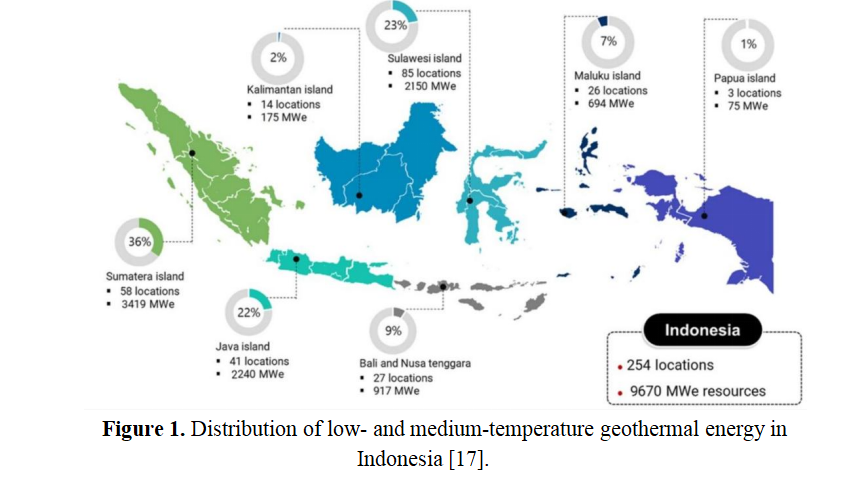
17. Ministry of Energy and Mineral Resources Republic of Indonesia Geological Agency, Center for Mineral Coal and Geothermal Resources. Geothermal area distribution map and its resources in Indonesia. In: Indonesia's Minerals, Goal, and Geothermal Resources and Reserves 2021. Ministry of Energy and Mineral Resources Republic of Indonesia Geological Agency, Center for Mineral Coal and Geothermal Resources; 2021. p. 190. Available online: https://geologi.esdm.go.id/storage/publikasi/gIY50hqnqkYEtdjToQsEpJrOVBVnNDZa8k0rOUXz.pdf
18. Koeswahyono I, Maharani DP, Liemanto A. Legal breakthrough of the Indonesian job creation law for ease, protection, and empowerment of MSMEs during the COVID-19 pandemic. Cogent Social Sciences. 2022; 8(1): 2084895. doi: 10.1080/23311886.2022.2084895
19. Singh D, Khamba JS, Nanda T. Problems and prospects of Indian MSMEs: A literature review. International Journal of Business Excellence. 2018; 15(2): 129–188. doi: 10.1504/IJBEX.2018.091923
20. Rokhim R, Lubis AW, Faradynawati IAA, et al. Examining the role of microfinance: A creating shared value perspective. International Journal of Ethics and Systems. 2022; 39(2): 379–401. doi: 10.1108/ijoes-09-2021-0168
21. Tambunan T. Recent evidence of the development of micro, small and medium enterprises in Indonesia. Journal of Global Entrepreneurship Research. 2019; 9: 18. doi: 10.1186/s40497-018-0140-4
22. Edobor F, Sambo-Magaji A. Small and medium enterprises and sustainable economic development. In: Digital Transformation for Business Sustainability and Growth in Emerging MarketsAvailable to Purchase. Emerald Publishing Limited; 2025. pp. 197–222. doi: 10.1108/978-1-83549-109-620251008
23. Mer A, Virdi AS. Chapter 7: Decoding the challenges and skill gaps in small- and medium-sized enterprises in emerging economies: A review and research agenda. In: Contemporary Challenges in Social Science Management: Skills Gaps and Shortages in the Labour Market. Emerald Group Publishing Limited; 2024. pp. 115–134. doi: 10.1108/S1569-37592024000112B007
24. Barney JB, Arikan AM. The resource-based view. In: The Blackwell Handbook of Strategic Management. Wiley; 2005. pp. 123–182. doi: 10.1111/b.9780631218616.2006.00006.x
25. Amaya N, Bernal-Torres CA, Nicolás-Rojas YW, et al. Role of internal resources on the competitive advantage building in a knowledge-intensive organisation in an emerging market. VINE Journal of Information and Knowledge Management Systems. 2022; 54(5): 1153–1169. doi: 10.1108/vjikms-01-2022-0029
26. Lopes J, Farinha L, Ferreira JJ, et al. Does regional VRIO model help policy-makers to assess the resources of a region? A stakeholder perception approach. Land Use Policy. 2018; 79: 659–670. doi: 10.1016/j.landusepol.2018.07.040
27. Farinha L, Lopes J, Sebastião JR, et al. How do stakeholders evaluate smart specialization policies defined for their regions? Competitiveness Review. 2021; 31(3): 594–624. doi: 10.1108/CR-12-2019-0149
28. Candolfi-Arballo N, Hualde-Alfaro A, Espinosa-Díaz Y, et al. The evaluation of technological competencies among leaders of the renewable energy industry: The case of SMEs in Baja California, Mexico. Energies. 2022; 15(16): 5946. doi: 10.3390/en15165946
29. Ramesh J, Ram MM, Varadarajan YS. Sustainable energy strategies for micro, small, and medium enterprises in India: A review. International Journal of Industrial and Systems Engineering. 2021; 37(3): 283–305. doi: 10.1504/IJISE.2021.113445
30. Rockwell S. A resource-based framework for strategically managing identity. Journal of Organizational Change Management. 2019; 32(1): 80–102. doi: 10.1108/JOCM-01-2018-0012
31. Barney J, Hesterly W. Strategic Management and Competitive Advantage. Pearson Education; 2014.
32. Lopes JM, Farinha L. Assessing regional advantage based on smart specialisation strategies. In: Building an Entrepreneurial and Sustainable Society. IGI Global; 2020. pp. 150–179. doi: 10.4018/978-1-7998-2704-7.ch008
33. Šebestová J, Rylková Ž, Smysl M. How to gain success in SME? A case study of a region in the Czech Republic. South East European Journal of Economics and Business. 2007; 2(1): 41–47. doi: 10.2478/v10033-007-0014-0
34. Ala-Rämi K. Micro-enterprises supporting regional competitiveness in post-mining activities: The case of Callio Pyhäjärvi, Finland. In: Proceedings of the 13th European Conference on Innovation and Entrepreneurship; 20–21 September 2018; Iveru, Portugal.
35. Alamanda DT, Anggadwita G, Rexhepi G, et al. Garut value co-creator: Fostering the growth of SMEs in Garut to attract more customers. European Journal of International Management. 2021; 16(3): 364–383. doi: 10.1504/EJIM.2021.117520
36. Surya DE, Mahmud WAW. Integrating corporate social responsibility with stakeholder role in small and medium enterprise projects: The case of PT Chevron Geothermal Indonesia. Jurnal Komunikasi: Malaysian Journal of Communication. 2025; 41(1): 311–332. doi: 10.17576/JKMJC-2025-4101-18
37. Hennink M, Hutter I, Bailey A. Qualitative Research Methods. SAGE Publications; 2020.
38. Rua O, França A, Fernández Ortiz R. Key drivers of SMEs export performance: The mediating effect of competitive advantage. Journal of Knowledge Management. 2018; 22(2): 257–279. doi: 10.1108/jkm-07-2017-0267
39. Mardatillah A. The enterprise culture heritage of Minangkabau cuisine, West Sumatra of Indonesia as a source of sustainable competitive advantage. Journal of Ethnic Foods. 2020; 7: 34. doi: 10.1186/s42779-020-00059-z
40. Chokera F, Mutambara E. Exploring value-addition initiatives among small-to-medium enterprises in the leather sector in emerging economies. Acta Commercii. 2023; 23(1): a1000. doi: 10.4102/ac.v23i1.1000
41. Aaltonen S, Heinze A, Ielpa G, et al. Enterprise cultural heritage: The source for sustainable competitive advantage and survival for food sector SMEs. The International Journal of Entrepreneurship and Innovation. 2015; 16(2). doi: 10.5367/ijei.2015.0178
42. Zhang J, Jehangir F, Yang L, et al. Competitive advantage and firm performance: The role of organizational culture, organizational innovation, and knowledge sharing. Journal of the Knowledge Economy. 2024; 16: 3081–3107. doi: 10.1007/s13132-024-01910-3
43. Pratt AC. Resilience, locality and the cultural economy. City, Culture and Society. 2015; 6(3): 61–67. doi: 10.1016/j.ccs.2014.11.001
44. Lacaze A, Ferreira FAF, Santos M. Adding value to the VRIO framework using DEMATEL. Management Decision. 2024; 63(4): 1154–1175. doi: 10.1108/MD-10-2023-1935
45. Sołoducho-Pelc L, Sulich A. Between sustainable and temporary competitive advantages in the unstable business environment. Sustainability. 2020; 12(21): 8832. doi: 10.3390/su12218832
46. Anning-Dorson T, Nyamekye MB. Be flexible: Turning innovativeness into competitive advantage in hospitality firms. International Journal of Contemporary Hospitality Management. 2020; 32(2): 605–624. doi: 10.1108/IJCHM-12-2018-1014
47. Widyawati F, Soemaryani I, Muizu WOZ. The effect of social capital and organizational health on competitive advantages of culinary and craft SMEs in Samarinda City. Sustainability. 2023; 15(10): 7945. doi: 10.3390/su15107945
Downloads
Published
How to Cite
Issue
Section
License
Copyright (c) 2026 Djoko Nurprawito, Rahmat Nurcahyo, Dana Santoso Saroso, Fadhlan Kautsar Faturrahman

This work is licensed under a Creative Commons Attribution 4.0 International License.





.jpg)
.jpg)