Experimental tests of an oxy-fuel natural gas burner with CO2 dilution at atmospheric pressure as model conditions for full-scale supercritical combustion
DOI:
https://doi.org/10.18686/cest782Keywords:
CO2-diluted combustion; burner device; experimental test; normal conditions; combustion similarityAbstract
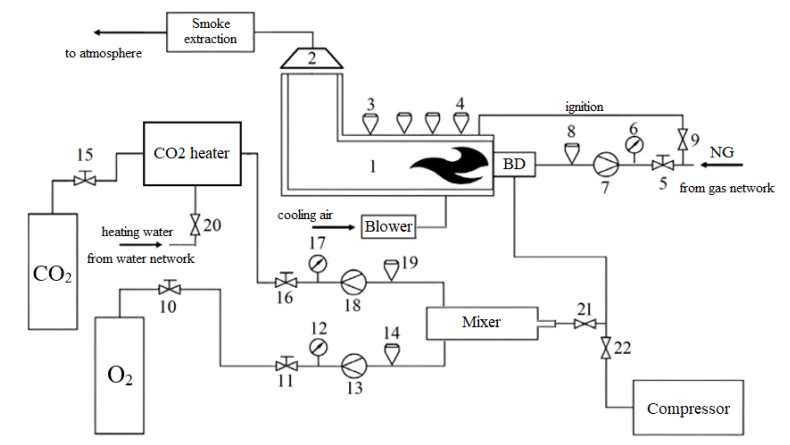
Direct-fired supercritical CO2 cycles are one of the promising approaches to eliminate CO2 emissions in the power energy sector, while maintaining high efficiency and the ability to burn fossil fuels. One of the key elements of such cycles is the combustor, in which natural gas is burned in an O2/CO2 environment at supercritical pressure. Oxy-fuel CO2-diluted combustion differs significantly from traditional air-fuel combustion, which creates the need to adapt existing numerical modeling techniques. Experimental data are required to verify numerical methods, but present experimental studies are fragmented and non-formalized. This paper presents the results of an experimental test of the 15 kW oxy-fuel burner device in a tunnel gas furnace at atmospheric pressure. Experimental tests were carried out with oxygen-fuel ratios (α) of 1, 1.45, and 1.75 in the range of CO2 mass fractions in the oxidizer (γ) from 0 to 0.9. An experimental temperature profile is obtained, the adiabatic combustion temperature is calculated, and the boundaries of stable combustion are determined. Based on the experimental results, the main similarity criteria of combustion were calculated, and it was shown that by changing the composition of the model mixture, it is possible to reduce the discrepancy of the similarity criteria between the model and full-scale oxy-fuel combustors.
References
1. Emissions. Available online: https://www.statista.com/markets/408/topic/949/emissions/ (accessed on 21 February 2026).
2. Allam R, Martin S, Forrest B, et al. Demonstration of the Allam Cycle: An Update on the Development Status of a High Efficiency Supercritical Carbon Dioxide Power Process Employing Full Carbon Capture. Energy Procedia. 2017; 114: 5948–5966. doi: 10.1016/j.egypro.2017.03.1731
3. What's new in GRI-Mech 3.0. Available online: http://combustion.berkeley.edu/gri-mech/version30/text30.html. (accessed on 21 February 2026).
4. Komarov I, Kharlamova D, Makhmutov B, et al. Natural Gas-Oxygen Combustion in a Super-Critical Carbon Dioxide Gas Turbine Combustor. E3S Web of Conferences. 2020; 178: 01027. doi: 10.1051/e3sconf/202017801027
5. Hu X, Yu Q, Liu J, et al. Investigation of laminar flame speeds of CH4/O2/CO2 mixtures at ordinary pressure and kinetic simulation. Energy. 2014; 70: 626–634. doi: 10.1016/j.energy.2014.04.029
6. Nomoto H, Itoh M, Brown W, et al. ICOPE-15-1176 Cycle and Turbine Development for the Supercritical Carbon Dioxide Allam Cycle. In: Proceedings of the International Conference on Power Engineering (ICOPE); 30 November–4 December 2015; Yokohama, Japan. doi: 10.1299/jsmeicope.2015.12._ICOPE-15-_112
7. Iwai Y, Itoh M, Morisawa Y, et al. Development Approach to the Combustor of Gas Turbine for Oxy-Fuel, Supercritical CO2 Cycle. In: Proceedings of the ASME Turbo Expo 2015: Turbine Technical Conference and Exposition; 15 June 2015; Montreal, QC, Canada. doi: 10.1115/GT2015-43160
8. Iwai Y, Itoh M. Gas turbine combustor for supercritical carbon dioxide cycle. Toshiba Reviews. 2015; 70: 16–19. (in Japanese)
9. Suzuki S, Iwai Y, Itoh M, et al. High pressure combustion test of gas turbine combustor for 50MWth supercritical CO2 demonstration power plant on Allam cycle. In: Proceedings of the International Gas Turbine Congress; 17–22 November 2019; Tokyo, Japan.
10. Anderson R, Hustad C, Skutley P, et al. Oxy-fuel Turbo Machinery Development for Energy Intensive Industrial Applications. Energy Procedia. 2014; 63: 511–523. doi: 10.1016/j.egypro.2014.11.056
11. Saanum I, Ditaranto M. Experimental Study of Oxy-fuel Combustion under Gas Turbine Conditions. Energy & Fuels. 2017; 31(4): 4445–4451. doi: 10.1021/acs.energyfuels.6b03114
12. Weber R, Mancini M. On scaling and mathematical modelling of large scale industrial flames. Journal of the Energy Institute. 2020; 93(1): 43–51. doi: 10.1016/j.joei.2019.04.010
13. Prieler R, Mayr B, Demuth M, et al. Application of the steady flamelet model on a lab-scale and an industrial furnace for different oxygen concentrations. Energy. 2015; 91: 451–464. doi: 10.1016/j.energy.2015.08.070
14. Osipov S, Komarov I, Zlyvko O, et al. Investigation of the parameters influence of the oxy-fuel burner and the test bench parameters on the deviation of the model similarity criterions from the full-scale values. Applied Chemical Engineering. 2024; 7(1). doi: 10.24294/ace.v7i1.2802
15. Osipov SK, Bryzgunov PA, Shaikh MM, et al. Influence of the experimental setup parameters on the deviation of the similarity criteria in the experimental study of the model boundary conditions from the similarity criteria of the full-scale combustion chamber. Applied Chemical Engineering. 2025; 8(1). doi: 10.59429/ace.v8i1.5645
16. Skubic L, Gyergyek S, Huš M, et al. A review of multiscale modelling approaches for understanding catalytic ammonia synthesis and decomposition. Journal of Catalysis. 2024; 429: 115217. doi: 10.1016/j.jcat.2023.115217
17. Lotrič A, Sekavčnik M, Pohar A, et al. Conceptual design of an integrated thermally self-sustained methanol steam reformer —High-temperature PEM fuel cell stack manportable power generator. International Journal of Hydrogen Energy. 2017; 42(26): 16700–16713. doi: 10.1016/j.ijhydene.2017.05.057
18. Lašič Jurković D, Liu JL, Pohar A, et al. Methane Dry Reforming over Ni/Al2O3 Catalyst in Spark Plasma Reactor: Linking Computational Fluid Dynamics (CFD) with Reaction Kinetic Modelling. Catalysis Today. 2021; 362: 11–21. doi: 10.1016/j.cattod.2020.05.028
19. Harkou E, Adamou P, Al-Salem SM, et al. Computational fluid dynamics (CFD) modelling as a power multiplier tool for the design improvement of gaseous and liquid fuels: current status, challenges and perspectives. Fuel. 2026; 404: 136401. doi: 10.1016/j.fuel.2025.136401
20. Nesterov PM, Osipov SK, Komarov II, et al. Vortex Burner Device. RU 231576 U1, 31 January 2025.
21. PD100I-DA2.5-111-0.25 Model 1х1 High-Reliability Pressure Sensor for Primary Production. Available online: https://owen-kapo.ru//products/pd100i-da25-111-025 (accessed on 21 February 2026). (in Russian)
22. DTPK254-17.80/200/0.5K.1 TCMS (Thermocouple Cable with Mineral Insulation in a Steel Sheath)-Based Thermocouples with Cable Output. Available online: https://owen-kapo.ru//products/dtpk254-178020005k1 (accessed on 21 February 2026). (in Russian)
23. EE741—Technical description for the flow meter EE 741 for compressed air and gases. Available online: https://epluse.nt-rt.ru/images/manuals/EE741.pdf (accessed on 21 February 2026). (in Russian)
24. Thermoscope 300. Available online: https://www.rospribor.com/files/698/195e21d202/tehnicheskie-harakteristiki-pirometra-termoskop-300-2c.pdf (accessed on 21 February 2026). (in Russian)
25. DTPS thermocouples “platinorhodium-platinum”, modification DTPS021.1E-0.5/0.21. Available online: https://owen-prom.ru/products/dtps-termopary-iz-blagorodnykh-metallov/?mod=684275 (accessed on 21 February 2026). (in Russian)
26. VA 520—Insertion flow meter. Available online: https://air.by/upload/iblock/9a1/v3x126o3u9pi2den3ndn151f1qzxohbg.pdf?ysclid=mmxjojxsz2967028737 (accessed on 21 February 2026). (in Russian)
27. Kutateladze SS, Borishansky VM. Heat Transfer Handbook. Gosenergoizdat; 1958. Available online: https://djvu.online/file/JcS7cS5GCUXkN?ysclid=mnyi0fl0y0178912821 (accessed on 21 February 2026). (in Russian)
28. Amato A, Hudak R, Noble DR, et al. Methane Oxy-Combustion for Low CO2 Cycles: Measurements and Modeling of CO and O2 Emissions. In: Proceedings of the ASME Turbo Expo 2010: Power for Land, Sea, and Air; 10 October 2010; Glasgow, UK. pp. 213–222. doi: 10.1115/GT2010-22300
29. Li B, Shi B, Chu Q, et al. Characteristics of stoichiometric CH4/O2/CO2 flame up to the pure oxygen condition. Energy. 2019; 168: 151–159. doi: 10.1016/j.energy.2018.11.039
30. Glarborg P, Bentzen LLB. Chemical Effects of a High CO2 Concentration in Oxy-Fuel Combustion of Methane. Energy & Fuels. 2008; 22(1): 291–296. doi: 10.1021/ef7005854
31. Hu X, Yu Q, Liu J. Chemical effect of CO2 on the laminar flame speeds of oxy-methane mixtures in the condition of various equivalence ratios and oxygen concentrations. International Journal of Hydrogen Energy. 2016; 41(33): 15068–15077. doi: 10.1016/j.ijhydene.2016.05.276
32. Xia W, Huang C, Yang J, et al. Experimental and modeling study of ignition delay times of natural gas with CO2 dilution. Fuel. 2024; 358: 130148. doi: 10.1016/j.fuel.2023.130148
33. Liu Y, Zou C, Cheng J, et al. Experimental and Numerical Study of the Effect of CO2 on the Ignition Delay Times of Methane under Different Pressures and Temperatures. Energy & Fuels. 2018; 32(10): 10999–11009. doi: 10.1021/acs.energyfuels.8b02443
34. Zhong F, Li Q, Ding X, et al. Experimental and chemical kinetics analysis on the combustion behaviors and flame instabilities of diluted methane/air mixtures. International Journal of Heat and Mass Transfer. 2024; 232: 125957. doi: 10.1016/j.ijheatmasstransfer.2024.125957
35. Shang R, Zhuang Z, Yang Y, et al. Laminar flame speed of H2/CH4/air mixtures with CO2 and N2 dilution. International Journal of Hydrogen Energy. 2022; 47(75): 32315–32329. doi: 10.1016/j.ijhydene.2022.07.099
36. Zhukov VP, Sechenov VA, Starikovskii AYu. Spontaneous Ignition of Methane–Air Mixtures in a Wide Range of Pressures. Combustion, Explosion and Shock Waves. 2003; 39(5): 487–495. doi: 10.1023/A:1026186231905
Downloads
Published
How to Cite
Issue
Section
License
Copyright (c) 2026 Sergey Osipov, Pavel Bryzgunov, Vadim Yakovlev, Ilya Feoktistov, Nikolay Rogalev

This work is licensed under a Creative Commons Attribution 4.0 International License.





.jpg)
.jpg)