Development and CFD study of vortex burner device for oxy-fuel combustion chamber
DOI:
https://doi.org/10.18686/cest794Keywords:
Allam cycle; oxy-fuel combustion; carbon dioxide; numerical simulation; burner deviceAbstract
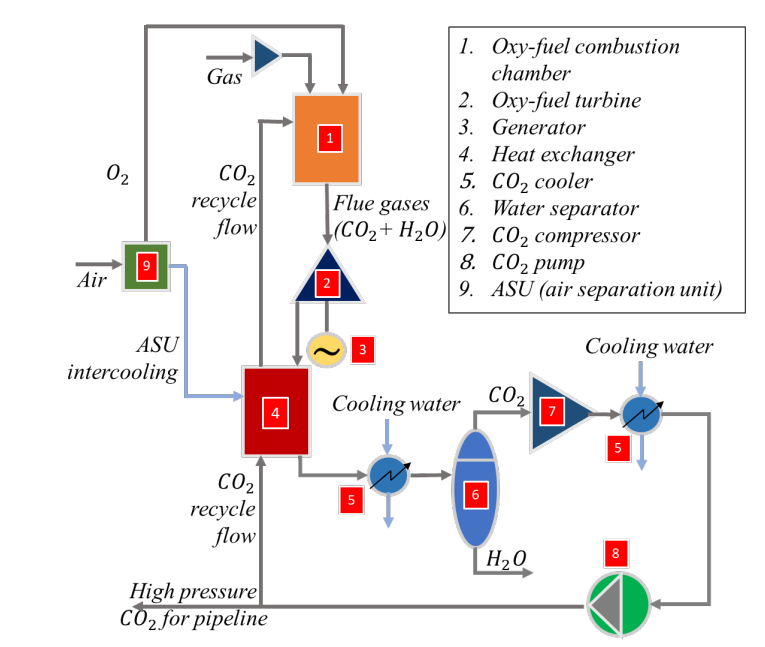
This article presents a comprehensive research and development effort focused on the design of a vortex burner device intended to enable stable oxy fuel combustion of natural gas in a supercritical carbon dioxide (sCO2) environment, as used in the Allam cycle for zero emission power generation. The prototype burner, featuring a conical bluff body, was systematically analyzed using advanced numerical simulations incorporating detailed chemical kinetics. Optimization studies identified the most suitable combustion parameters, namely an oxidizer excess coefficient α = 1.05. This parameter choice is justified by the fact that it yields acceptable emissions of carbon monoxide (CO) and unburned hydrocarbons (UHC) while maintaining a reasonable level of auxiliary power consumption by the air separation unit (ASU). In the numerical investigation employing the prototype configuration, the maximum stable mass fraction of CO2 in the oxidizer diluent mixture (γ) was found to be 0.82, beyond which flame detachment occurred. Through iterative design enhancements—specifically, replacing the conical bluff body with a hemispherical perforated bluff body and incorporating a diffuser-shaped outlet section—the burner configuration was substantially improved. These modifications enhanced flame stability and enabled a significant increase in γ to 0.867. As a result, the peak process temperature was reduced by more than 400 K, while CO emissions decreased by over a factor of 17 compared to the prototype, with unburned hydrocarbon levels remaining low.
References
1. Nagaj R, Gajdzik B, Wolniak R, et al. The Impact of Deep Decarbonization Policy on the Level of Greenhouse Gas Emissions in the European Union. Energies. 2024; 17(5): 1245. doi: 10.3390/en17051245
2. Xie Y, Qiu P, He M, et al. Advances in direct-fired sCO2 cycle and sCO2 oxy-fuel combustion. Fuel. 2026; 409: 137803. doi: 10.1016/j.fuel.2025.137803
3. Kolpakov AY, Zinchenko YV, Galinger AA. Prospects for the implementation of global energy transition scenarios. Problems of Forecasting. 2023; (6): 138–150. doi: 10.47711/0868-6351-201-138-150 (in Russian)
4. Kotowicz J, Michalski S, Brzęczek M. The Characteristics of a Modern Oxy-Fuel Power Plant. Energies. 2019; 12(17): 3374. doi: 10.3390/en12173374
5. Pipitone G, Bolland O. Power generation with CO2 capture: Technology for CO2 purification. International Journal of Greenhouse Gas Control. 2009; 3(5): 528–534. doi: 10.1016/j.ijggc.2009.03.001
6. Yin C, Yan J. Oxy-fuel combustion of pulverized fuels: Combustion fundamentals and modeling. Applied Energy. 2016; 162: 742–762. doi: 10.1016/j.apenergy.2015.10.149
7. Amiri M, Barański J, Stasiak K, et al. Innovative oxy-fuel burner design with direct water injection for enhanced combustion control. Applied Thermal Engineering. 2025; 281: 128700. doi: 10.1016/j.applthermaleng.2025.128700
8. Yun S, Lee J, Cho H, et al. Oxy-fuel combustion-based blue hydrogen production with the integration of water electrolysis. Energy Conversion and Management. 2023; 291: 117275. doi: 10.1016/j.enconman.2023.117275
9. Allam R, Martin S, Forrest B, et al. Demonstration of the Allam Cycle: An Update on the Development Status of a High Efficiency Supercritical Carbon Dioxide Power Process Employing Full Carbon Capture. Energy Procedia. 2017; 114: 5948–5966. doi: 10.1016/j.egypro.2017.03.1731
10. Reale F. The Allam Cycle: A Review of Numerical Modeling Approaches. Energies. 2023; 16(22): 7678. doi: 10.3390/en16227678
11. Sasaki T, Itoh M, Maeda H, et al. Development of Turbine and Combustor for a Semi-Closed Recuperated Brayton Cycle of Supercritical Carbon Dioxide. In: Proceedings of the ASME 2017 Power Conference Joint With ICOPE-17 collocated with the ASME 2017 11th International Conference on Energy Sustainability, the ASME 2017 15th International Conference on Fuel Cell Science, Engineering and Technology, and the ASME 2017 Nuclear Forum; 26 June 2017; Charlotte, NC, USA. p. V001T02A008. doi: 10.1115/POWER-ICOPE2017-3419
12. Barreiro P, Alava I, Blanco JM. Design and scale-up of a hydrogen oxy-fuel burner for high-temperature industrial processes. Fuel. 2026; 405: 136566. doi: 10.1016/j.fuel.2025.136566
13. Zhang G, Huang YP, Zhao YF, et al. High-temperature oxidation and carburization, corrosion protection, materials selection and coolant chemistry for supercritical carbon dioxide power cycles: A review. International Materials Reviews. 2026; 71(1): 30–94. doi: 10.1177/09506608251369099
14. Markushin AN, Baklanov AV, Tsyganov NE. The influence of burner design on the characteristics of the combustion chamber with gaseous fuels. VESTNIK of Samara University. Aerospace and Mechanical Engineering. 2011; 10(3–1): 35–38. Available online: https://journals.ssau.ru/vestnik/article/view/1726 (in Russian)
15. Tu L, Ren Y, Meng H, et al. Additive-manufactured Hencken burner for wide-range oxyfuel combustion of zero-carbon fuels. Review of Scientific Instruments. 2026; 97(3): 035001. doi: 10.1063/5.0315171
16. Islam MNA, Chanda S, Tasnim AF, et al. Design and Demonstration of a Novel Fuel-Flexible Burner for High-Pressure Applications. Next Research. 2025; 2(3): 100437. doi: 10.1016/j.nexres.2025.100437
17. Fordoei EE, Mazaheri K, Mohammadpour A. Numerical study on the heat transfer characteristics, flame structure, and pollutants emission in the MILD methane-air, oxygen-enriched and oxy-methane combustion. Energy. 2021; 218: 119524. doi: 10.1016/j.energy.2020.119524
18. Feng Q, Li Q, Li Y, et al. Assessment of RANS Models for Milli-Channel Turbulent Flow in Drip Irrigation Emitter. Agronomy. 2024; 15(1): 81. doi: 10.3390/agronomy15010081
19. Wang Q, Su X, Yuan X. Assessment of the Turbulence Characteristics of Shaped Film Cooling Hole with Scale Resolving Simulation. Journal of Thermal Science. 2022; 31(1): 47–61. doi: 10.1007/s11630-022-1545-5
20. Harman-Thomas JM, Hughes KJ, Pourkashanian M. The development of a chemical kinetic mechanism for combustion in supercritical carbon dioxide. Energy. 2022; 255: 124490. doi: 10.1016/j.energy.2022.124490
21. Osipov S, Sokolov V, Yakovlev V, et al. Comparative Analysis of the Oxy-Fuel Kinetic Mechanisms by the Ignition Delay Time of Methane. Energies. 2025; 18(9): 2155. doi: 10.3390/en18092155
22. 5 Best Practices for Gas Turbine Combustion Meshing Using Ansys Fluent. Available online: https://www.ansys.com/ko-kr/resource-center/white-paper/5-best-practices-for-gas-turbine-combustion-meshing-using-ansys-fluent (accessed on 11 October 2025).
23. Baker N, Kelly G, O’Sullivan PD. A grid convergence index study of mesh style effect on the accuracy of the numerical results for an indoor airflow profile. International Journal of Ventilation. 2020; 19(4): 300–314. doi: 10.1080/14733315.2019.1667558
24. Ministry of Heavy, Power and Transport Engineering of the USSR. RTM 24.022.11-74: Calculation and Design of Combustion Chambers for Gas Turbine and Combined Cycle Plants. Ministry of Heavy, Power and Transport Engineering of the USSR; 1974. (in Russian)
25. Igorevich KI, Mikhailovna KD, Nikolaevich VA, et al. Investigation of the Effect of CO2 Diluent on Fuel Combustion in Methane–Oxygen Combustion Chambers. Vestnik Ivanovskogo Gosudarstvennogo Energeticheskogo Universiteta. 2021; 2: 14–22. (in Russian)
26. Aleksandrov YB, Mingazov BG. Determination of Combustion Efficiency, Temperature and Emission Characteristics in a Swirled Flow Based on the Theory of Turbulent Combustion. VESTNIK of Samara University. Aerospace and Mechanical Engineering. 2024; 23(1): 123–136. Available online: https://journals.ssau.ru/vestnik/article/view/27333 (in Russian)
Downloads
Published
How to Cite
Issue
Section
License
Copyright (c) 2026 Sergey Osipov, Andrey Vegera, Polina Golosova, Olga Zlyvko, Aleksey Malenkov

This work is licensed under a Creative Commons Attribution 4.0 International License.





.jpg)
.jpg)